
Navigating the Indo-Pacific: India's Strategic Recalibration and What It Means for Korea
Navigating the Indo-Pacific: India's Strategic Recalibration and What It Means for Korea The July 6 Submarine-Launched Missile Test and Regional Signaling China's test launch of a long-range ballistic missile from a nuclear-powered submarine on July 6 marked the second such demonstration into international waters in recent years. The action followed a similar event in September
The July 6 Submarine-Launched Missile Test and Regional Signaling
China's test launch of a long-range ballistic missile from a nuclear-powered submarine on July 6 marked the second such demonstration into international waters in recent years. The action followed a similar event in September 2024 and included advance notifications to selected capitals. This step underscored Beijing's expanding nuclear deterrence capabilities and its readiness to project power across wider maritime domains.
For regional actors, the timing carried particular weight. The test occurred amid visible signs of reduced U.S. enthusiasm for multilateral frameworks such as the Quad and continued ambiguity over the Indo-Pacific terminology in Washington strategy documents. Beijing's move therefore appeared calibrated to highlight both technical reach and political resolve at a moment when several capitals were reassessing reliance on American security guarantees.
India's Turn Toward Multi-Alignment
India has responded to these shifts by pursuing a more autonomous posture that combines bilateral, minilateral, and multilateral channels without exclusive dependence on any single partner. New Delhi's approach reflects the pressures of Chinese territorial pressure along the northern border and the added complication of deepening Sino-Pakistan coordination. Officials have emphasized the need for diversified partnerships that preserve strategic flexibility.
This recalibration does not diminish the importance of the India-U.S. relationship, which remains central to Indian planning. Rather, it supplements that foundation with additional options across the Indo-Pacific. The strategy aims to reduce vulnerability to sudden changes in U.S. policy while still benefiting from American defense commitments where they align with Indian interests.
India-Japan Summit Outcomes and an Updated FOIP Posture
Three days before the Chinese missile test, Japanese Prime Minister Takaichi Sanae concluded the 16th India-Japan Annual Summit in New Delhi. The meeting produced sixteen documented outcomes covering semiconductors, critical minerals, information and communication technology including artificial intelligence, clean energy, and pharmaceuticals. Both sides also reaffirmed their intention to advance an updated Free and Open Indo-Pacific framework.
These agreements illustrate how India and Japan are ring-fencing bilateral cooperation from broader multilateral uncertainties. The emphasis on supply-chain resilience and technology cooperation addresses concrete vulnerabilities exposed by recent regional tensions. For Seoul, the pattern offers a reference point: targeted functional cooperation can proceed even when larger alliance structures face headwinds.
Modi's Three-Nation Tour as a Search for Options
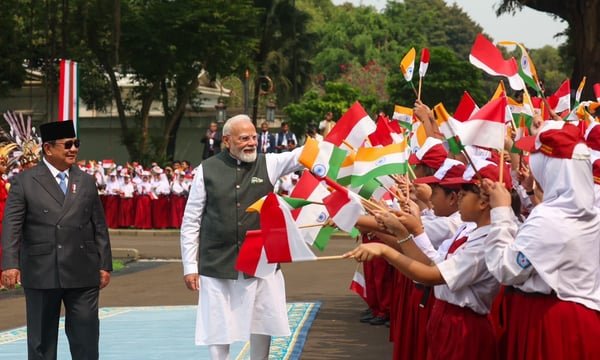
Prime Minister Narendra Modi's arrival in Jakarta on the same day as the missile test initiated a three-nation itinerary that also included Australia and New Zealand. Canberra and Wellington both issued statements of concern regarding the Chinese launch. The tour provided opportunities to test interest in renewed FOIP coordination beyond the Quad format.
Indian commentary has sometimes framed the journey in expansive terms, yet a more measured reading sees it as an effort to expand the number of reliable interlocutors. New Delhi seeks additional capitals it can engage without reducing existing relationships. This distinction matters for middle powers that must balance economic interdependence with security requirements.
South Korea's Own Strategic Recalibration
Seoul confronts comparable pressures. The U.S.-ROK alliance supplies the core of South Korea's defense posture, yet major chaebols maintain deep manufacturing and market exposure to China. Any widening of Indo-Pacific tensions risks direct effects on semiconductor, battery, and automotive supply chains that underpin Korean economic performance.
Unlike India, South Korea must also manage the additional variable of North Korea's nuclear and missile programs. Inter-Korean dynamics remain sensitive to shifts in U.S. attention and Chinese influence. Seoul therefore weighs the benefits of deeper minilateral engagement against the costs of provoking Beijing on economic matters. Recent Korean policy documents have begun to reference Indo-Pacific concepts more explicitly, yet implementation remains measured and phased.
Comparative Hedging: Constraints and Opportunities
India's geographic position and historical non-alignment tradition afford greater latitude for multi-alignment than South Korea currently possesses. New Delhi can cultivate ties with Japan, Australia, and ASEAN states while sustaining a working relationship with Russia. Seoul's peninsular location and alliance treaty impose tighter parameters, limiting the speed and scope of diversification.
Nevertheless, both capitals share an interest in preserving U.S. engagement without becoming wholly dependent on it. India's recent summits demonstrate how functional agreements in technology and resources can create resilient networks. Korea could explore analogous arrangements in critical minerals and defense industrial cooperation with partners such as Australia and Japan, provided these steps remain consistent with alliance obligations.
Middle Powers and the Evolving Indo-Pacific Order
The current period favors middle powers that can combine credible defense ties with diversified economic links. India's approach illustrates one model: active diplomacy that multiplies options while retaining core alignments. South Korea's task is to adapt elements of that model to its distinct constraints, particularly the need to avoid economic coercion while upholding alliance commitments.
Historical precedent suggests that sustained middle-power coordination can shape regional norms even when great-power strategies fluctuate. If Seoul and New Delhi continue to expand practical cooperation in areas such as supply-chain security and maritime domain awareness, they may contribute to a more stable Indo-Pacific architecture less vulnerable to single-power disruption. The coming years will test whether such incremental steps can accumulate into durable strategic depth.
By Prof. David Park, Staff WriterThis article was produced with AI-assisted research and editorial support. Reporting is based on sources cited in the article.
What's Your Reaction?
 Like
0
Like
0
 Dislike
0
Dislike
0
 Love
0
Love
0
 Funny
0
Funny
0
 Wow
0
Wow
0
 Sad
0
Sad
0
 Angry
0
Angry
0

East Asia/Technology Correspondent at Global1.News. Seoul-based voice covering Korean politics, technology, business, and culture. Analyzes how technology and geopolitics intersect across East Asia.














Comments (0)