
Putin's Approval Rating Falls to 66.9% Amid Fuel Crisis
President Vladimir Putin's approval rating has suffered its sharpest single-week decline since the 2022 invasion of Ukraine, according to polling data released this week by state-run VTsIOM. The drop coincides with a deepening fuel crisis across Russia triggered by Ukrainian drone strikes on oil refineries, raising questions about the durability of public support for the Kremli
President Vladimir Putin's approval rating has suffered its sharpest single-week decline since the 2022 invasion of Ukraine, according to polling data released this week by state-run VTsIOM. The drop coincides with a deepening fuel crisis across Russia triggered by Ukrainian drone strikes on oil refineries, raising questions about the durability of public support for the Kremlin as domestic hardships mount.
Putin's Sinking Popularity: Approval Plummets as Fuel Crisis Bites
Moscow, Russia – July 2026 — The following analysis examines the polling data, the fuel crisis, and what these developments mean for Kremlin power dynamics.
VTsIOM Data Deep Dive
The VTsIOM poll conducted from June 22 to 28 surveyed 1,600 Russians and recorded President Vladimir Putin's job approval rating at 66.9 percent. This figure represents a decline from the previous week's 70.4 percent. The drop marks the fastest weekly decrease recorded since the start of the Ukraine invasion. Official results also showed disapproval rising to 21.3 percent from 19.7 percent in the prior period. These shifts arrive at a moment when domestic economic strains are becoming harder to overlook in everyday Russian life.
Trust metrics followed a similar downward trajectory. The trust rating fell from 76.7 percent to 73.3 percent over the same week. These numbers come directly from the state-affiliated polling organization and reflect responses collected amid ongoing economic pressures. The survey methodology remained consistent with prior weeks, allowing direct comparison of the shifts. Such consistency makes the recent erosion stand out against the steadier readings that characterized earlier months of the conflict.
Context from earlier in the year places the current reading near the April low of 65.6 percent. That earlier dip coincided with internet blackouts and restrictions on Telegram channels. The June decline therefore continues a pattern of erosion tied to visible domestic hardships rather than isolated events. Observers tracking these figures note that repeated dips linked to tangible shortages tend to linger longer in public memory than temporary disruptions from information controls.
VTsIOM subsequently halted publication of its open-ended trust survey after the metric reached its lowest point since 2022. This decision limits public access to unprompted responses on leadership confidence. The move aligns with broader patterns in state polling practices during periods of heightened sensitivity. By restricting the release of certain data points, the organization effectively narrows the window through which Russians can gauge collective sentiment on the country's direction.
Analysts examining the full sequence of weekly results see the June numbers as part of a gradual but accelerating slide. The combination of falling approval and rising disapproval suggests that even modest economic discomfort can register quickly in state-conducted surveys. This latest movement, occurring against the backdrop of fuel shortages, raises questions about how long the current trajectory can be contained without further adjustments in how such data is gathered and presented.
Levada Center Comparison
The independent Levada Center reported a June approval rating of 74 percent for President Putin. This stands in contrast to the 79 percent recorded in May. Levada's figures, gathered outside direct state oversight, provide a parallel data point to VTsIOM results. The two organizations employ differing methodologies yet both document a recent downward movement. The five-point drop over a single month signals that the softening of support is not confined to any single polling approach.
Levada Center maintains its status as an independent entity despite regulatory pressures faced by non-state pollsters in Russia. Its samples draw from broader geographic areas and include respondents less connected to official institutions. The May-to-June decline of five percentage points mirrors the direction seen in state polling but starts from a higher base. This wider sampling frame allows Levada to capture views from segments of the population that may interact less frequently with state-affiliated researchers.
Comparisons between the two sets of data highlight differences in how questions are framed. VTsIOM often uses structured prompts while Levada incorporates more open formats in certain waves. Both nevertheless converge on the observation that support has softened in recent weeks. The narrowing gap between the June readings from each organization suggests that the underlying trend is robust enough to appear across contrasting survey designs.
Analysts note that independent polling can capture sentiments that state surveys sometimes understate. Levada's consistent tracking since the invasion offers a longitudinal view less subject to institutional adjustments. The gap between the two June readings remains narrower than in previous high-tension periods. This convergence lends additional weight to the conclusion that recent economic difficulties are registering across different respondent pools.
Observers tracking both organizations over time emphasize that the parallel declines, though measured differently, point to the same underlying pressure. The fact that Levada's higher starting point still produced a comparable drop indicates that the erosion is not an artifact of any single methodology. Such consistency across sources strengthens the case that domestic hardships are beginning to influence public assessments of leadership performance.
Fuel Crisis Details
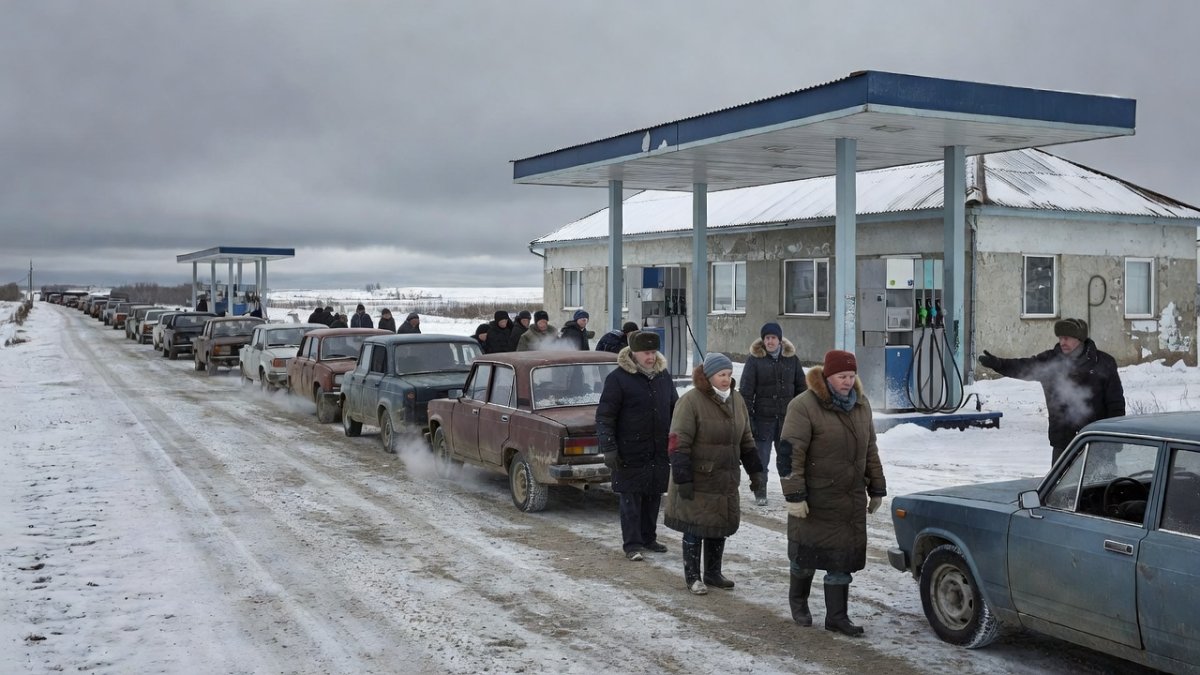
A fuel crisis has spread across Russia with reports of rationing at filling stations and extended lines at pumps. Prices have risen sharply while many stations report empty tanks. Ukrainian drone strikes on oil refineries have disrupted domestic supply chains and reduced output at key facilities. These disruptions have quickly translated into visible shortages that affect both private motorists and commercial operators on a daily basis.
The strikes targeted refining capacity in multiple regions, creating localized shortages that quickly spread. Motorists in affected areas have faced daily limits on purchases and requirements to present documentation for larger volumes. These measures emerged rapidly following intensified attacks on energy infrastructure. The sudden imposition of purchase caps has forced many drivers to alter travel plans and prioritize essential trips over routine movement.
Energy ministry officials have acknowledged the strain on distribution networks. The combination of reduced refinery throughput and seasonal demand has amplified the shortages. Empty pumps have become common sights in both urban centers and rural districts. This widespread visibility of the problem has made the crisis difficult to dismiss as a localized or temporary inconvenience.
The crisis intersects with broader energy politics managed through Kremlin-linked structures. Refinery operators tied to state corporations have sought to reroute supplies while maintaining export commitments. The resulting domestic pinch has placed immediate pressure on ordinary consumers and commercial transport operators alike. Balancing export obligations against internal needs has exposed the limits of existing distribution arrangements under current conditions.
Regional variations in the severity of shortages have further complicated efforts to restore normal supply. Areas closer to damaged facilities have experienced more acute disruptions, while other districts face secondary effects from redirected shipments. The uneven impact across the country underscores how infrastructure vulnerabilities can cascade quickly when key refining nodes are affected.
Gasoline Imports from India
Russia has begun importing gasoline from India to address the shortfall. Kremlin representatives confirmed that talks with Indian suppliers are underway and additional volumes are already arriving. This step marks a reversal from Russia's traditional position as a net exporter of refined products. The shift to imports highlights the urgency with which officials are treating the current supply gap.
Negotiations reportedly involve multiple countries beyond India as officials seek to stabilize supply. The Ministry of Energy has coordinated these discussions alongside major state energy firms. Import arrangements aim to replenish stocks depleted by refinery disruptions. Expanding the range of supplier nations reflects an attempt to reduce reliance on any single external source during this period of heightened need.
Logistical challenges accompany the shift to foreign sourcing. Shipping routes and port handling require coordination with federal agencies responsible for customs and transport. The move underscores the immediate priority placed on restoring fuel availability ahead of peak summer demand. These operational adjustments have required rapid reallocation of resources that were previously oriented toward export logistics.
Energy analysts connected to government circles describe the imports as a temporary bridge. Long-term solutions remain focused on repairing damaged refining capacity. The decision nevertheless signals recognition that domestic production alone cannot meet current needs. By turning to foreign suppliers, authorities have acknowledged the scale of the shortfall while buying time for infrastructure repairs to take effect.
The arrival of imported volumes has begun to ease some of the most visible lines at pumps, yet distribution bottlenecks persist in several regions. Officials continue to monitor how quickly these new supplies can be integrated into existing networks. The experience has illustrated the complexities of reversing long-standing export patterns on short notice.
Expert Analysis on Poll Accuracy
Some experts have pointed to reluctance among Russians to speak candidly with pollsters. Fear of potential retribution influences responses in an environment where criticism of leadership can carry risks. This dynamic may compress the visible extent of dissatisfaction in both state and independent surveys. The possibility that respondents are moderating their answers adds a layer of uncertainty to interpreting the recorded declines.
VTsIOM's decision to limit certain trust questions reflects awareness of these pressures. Respondents may default to safer answers when surveys touch on sensitive political topics. The resulting data therefore captures a filtered version of public sentiment. Such filtering can make it harder to distinguish between genuine stability and cautious self-censorship in the responses.
Independent observers emphasize that polling during wartime carries inherent limitations. Sampling frames can miss segments of the population wary of any interaction with official or semi-official entities. Levada Center's slightly higher readings may partly stem from differences in perceived anonymity. These methodological nuances suggest that the true level of discontent could be understated across the board.
Despite these caveats, the consistent direction of decline across multiple sources lends weight to the trend. The weekly pace of erosion remains notable even if absolute levels stay elevated. Methodological caution does not erase the recorded movement. The fact that both state-linked and independent organizations detect the same downward pattern strengthens the case that the shift is real rather than an artifact of any single survey design.
Longer-term comparisons with earlier wartime periods show that similar polling constraints existed before, yet the current combination of economic pressure and visible shortages appears to be producing measurable movement. This suggests that material hardships may be overcoming some of the usual reticence in respondent answers, even if the full extent of dissatisfaction remains difficult to quantify precisely.
Kremlin Power Dynamics
The approval decline occurs against the backdrop of centralized authority structures centered in the Kremlin. Energy policy decisions flow through a narrow circle of presidential advisors and state corporation heads. Visible fuel shortages test the system's capacity to deliver tangible stability to the population. The speed with which shortages have appeared has placed unusual strain on these tightly controlled decision-making channels.
Regional governors and federal ministries have been tasked with managing local distribution crises. Their performance in mitigating lines and price spikes will be measured against expectations set from Moscow. Any prolonged disruption risks exposing fractures in the vertical of power. Local officials now face direct public scrutiny over issues that originate in national-level infrastructure vulnerabilities.
Putin's personal authority has historically rested on perceptions of competence in both security and economic management. The current convergence of polling erosion and energy shortfalls presents a direct challenge to that narrative. Kremlin communications have so far emphasized external factors over domestic policy adjustments. This framing seeks to insulate leadership from responsibility for the immediate hardships facing ordinary citizens.
Opposition voices and independent commentators argue that sustained economic pain could gradually shift elite calculations. State media continues to frame the situation as temporary and externally driven. The interplay between these narratives will shape how the recorded popularity drop translates into political pressure. How effectively the official narrative can contain public frustration will determine whether the current polling trend accelerates or stabilizes in the coming weeks.
The handling of the fuel crisis through import arrangements and distribution controls also reveals the limits of rapid adaptation within the existing power structure. Decisions made at the center must still be implemented through regional layers that vary in capacity and responsiveness. This vertical chain is now being tested in real time by the visible consequences of refinery disruptions.
By Irina Volkov, Staff WriterThis article was produced with AI-assisted research and editorial support. Reporting is based on sources cited in the article.
What's Your Reaction?
 Like
0
Like
0
 Dislike
0
Dislike
0
 Love
0
Love
0
 Funny
0
Funny
0
 Wow
0
Wow
0
 Sad
0
Sad
0
 Angry
0
Angry
0

Russia/Eastern Europe Correspondent at Global1.News. Covering Russian politics, energy, security, and the shifting dynamics of the post-Soviet space. Provides clear-eyed analysis on one of the world's most opaque regions.













Comments (0)