
NASA to Send World Cup Ball to Moon if US Wins 2026
New Delhi, India – July 1, 2026 In a bold fusion of athletic competition and lunar exploration, NASA Administrator Jared Isaacman declared on June 30, 2026, that the agency will deliver the official FIFA World Cup 2026 soccer ball to the Moon if the United States men's team claims its first-ever title in the ongoing tournament co-hosted by the United States, Mexico, and Canada.

New Delhi, India – July 1, 2026
In a bold fusion of athletic competition and lunar exploration, NASA Administrator Jared Isaacman declared on June 30, 2026, that the agency will deliver the official FIFA World Cup 2026 soccer ball to the Moon if the United States men's team claims its first-ever title in the ongoing tournament co-hosted by the United States, Mexico, and Canada. The announcement arrives as the official match ball has already completed zero-gravity testing aboard the International Space Station, setting the stage for an unprecedented payload on future lunar missions. This development carries particular resonance for India's space program, where ISRO continues to advance its own south-polar ambitions through proven lander technology and upcoming crewed flights.
NASA's Lunar Soccer Ball Initiative and Mission Timeline
NASA's commitment centers on the $20 billion Moon Base program near the lunar south pole, first detailed between March and May 2026. Carlos García-Galán, manager of the program, has outlined initial construction phases beginning in 2026 through uncrewed Blue Origin missions, positioning the soccer ball delivery as both a symbolic and logistical challenge. Administrator Isaacman explicitly stated, "We're going to get the soccer ball there... That's the challenge, Team USA, get the job done," linking the payload directly to the outcome of the 2026 World Cup. The United States men's team has never won a World Cup, in contrast to the women's team which holds four titles, adding competitive stakes to the proposed lunar transport.
Blue Origin serves as NASA's designated plan A for equipment delivery to the Moon Base site. This approach aligns with the Artemis II crewed mission, scheduled for no later than April 2026, which will test systems critical for sustained lunar operations. The integration of a World Cup artifact into these timelines illustrates how NASA seeks to maintain public engagement while executing a multi-year infrastructure buildout valued at $20 billion.
Zero-Gravity Validation and Payload Logistics
The official 2026 World Cup ball has already reached the International Space Station, where astronauts conducted tests in zero gravity to assess its performance characteristics. These evaluations confirmed the ball's suitability for potential microgravity and low-gravity environments, providing data that could inform packaging for lunar transit. NASA plans to incorporate this validated equipment into south-polar delivery sequences once the United States advances in the tournament.
Logistical considerations include integration with Blue Origin landers scheduled for 2026 uncrewed flights. The $20 billion Moon Base budget allocates resources for such specialized payloads alongside core habitat modules, demonstrating how symbolic items can coexist with scientific instrumentation during early construction phases.
India's Chandrayaan Legacy at the Lunar South Pole
ISRO's Chandrayaan-3 mission achieved a successful soft landing near the Moon's south pole in August 2023, establishing India as only the fourth nation to accomplish a lunar landing and the first to target the polar region specifically. This achievement positions Indian assets in close geographic proximity to NASA's planned Moon Base site, creating natural opportunities for data sharing on regolith properties and thermal conditions. Chandrayaan-4, targeted for 2027, will build directly on these findings with enhanced rover and sample-return capabilities.
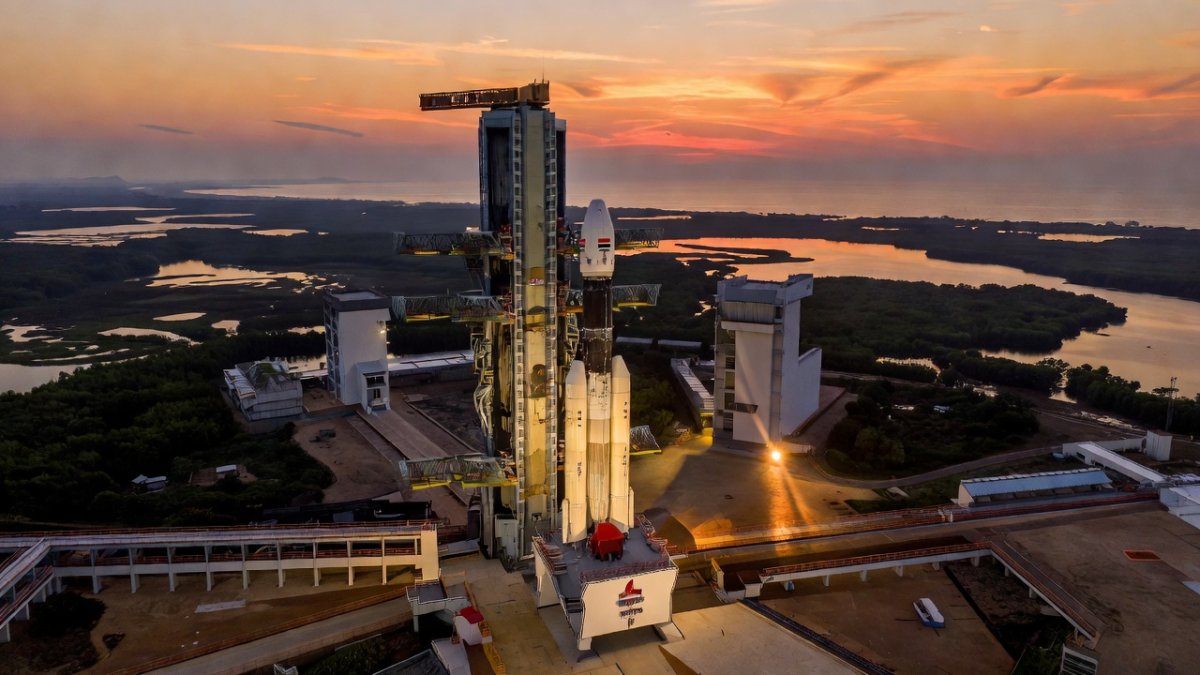
The south-polar focus shared by both programs highlights strategic convergence. While NASA advances a $20 billion infrastructure project with Blue Origin support, ISRO's incremental approach has already delivered operational results at lower cost points, offering comparative lessons in mission efficiency for future joint or parallel activities.
Gaganyaan and India's Human Spaceflight Roadmap
ISRO's Gaganyaan program remains on schedule, with the G1 uncrewed flight targeted for March 2026 and the first crewed mission expected in 2027. These milestones occur against the backdrop of NASA's Artemis II flight no later than April 2026, creating overlapping timelines that could foster technical exchanges on life-support systems and crew safety protocols. India's Aditya-L1 solar mission continues to provide operational data on space weather, supporting both Gaganyaan and potential lunar surface operations.
The progression from Chandrayaan-3's 2023 south-polar landing to Gaganyaan's 2027 crewed objective demonstrates ISRO's methodical scaling of capabilities. This trajectory positions India to contribute meaningfully to lunar south-polar science even as NASA executes its larger-scale Moon Base construction beginning in 2026.
Strategic Implications for India's Space Ambitions
NASA's soccer ball announcement underscores the value of public-facing milestones in sustaining funding and interest for long-duration programs such as the $20 billion Moon Base. For India, similar visibility through Chandrayaan successes and the upcoming Gaganyaan flights can accelerate domestic support for expanded lunar infrastructure. The 2027 Chandrayaan-4 mission offers a concrete platform for demonstrating independent south-polar operations that complement or intersect with international efforts.
Analysis of budget and timeline data reveals India's emphasis on cost-effective sequencing: Chandrayaan-3 delivered results in 2023 at a fraction of NASA's projected outlays, while Gaganyaan targets crewed capability by 2027. This approach may enable India to propose collaborative experiments at the lunar south pole, leveraging existing landing site knowledge to reduce redundancy in site characterization activities.
Future Collaboration and Competitive Dynamics
The ongoing World Cup 2026 and its lunar tie-in coincide with Artemis II preparations, creating a moment when space agencies worldwide assess partnership models. ISRO's proven south-polar landing record from August 2023 and operational Aditya-L1 data provide tangible assets for potential data-sharing agreements. Blue Origin's role as NASA's primary delivery partner for 2026 uncrewed missions further illustrates how commercial entities are integrated into state programs, a model India has begun exploring through its own private sector engagements.
Ultimately, the NASA announcement serves as a reminder that lunar exploration now incorporates cultural and symbolic elements alongside technical objectives. India's space program, anchored by Chandrayaan-3's 2023 success and advancing toward Gaganyaan crewed flight in 2027, stands ready to translate its polar expertise into sustained contributions that advance both national goals and broader scientific understanding of the lunar south pole.
— By Dr. Raj Patel, Staff WriterThis article was produced with AI-assisted research and editorial support. Reporting is based on sources cited in the article.
What's Your Reaction?
 Like
0
Like
0
 Dislike
0
Dislike
0
 Love
0
Love
0
 Funny
0
Funny
0
 Wow
0
Wow
0
 Sad
0
Sad
0
 Angry
0
Angry
0

India/South Asia Correspondent at Global1.News. Analytical voice with a background in science and health journalism. Based in New Delhi, covering Indian politics, education, healthcare, technology, and policy. Breaks down complex data into clear, actionable reporting.















Comments (0)