
South Korea Joins Exercise Pitch Black 2026 with KF-16s in Australia
South Korea's participation in Exercise Pitch Black 2026 marks a measured yet deliberate step in its expanding defense engagement with Australia. The Republic of Korea Air Force (ROKAF) has deployed six KF-16 fighter jets from the 20th and 38th Fighter Wings, approximately 100 personnel, and three KC-330 multirole aerial refueling aircraft to Darwin.
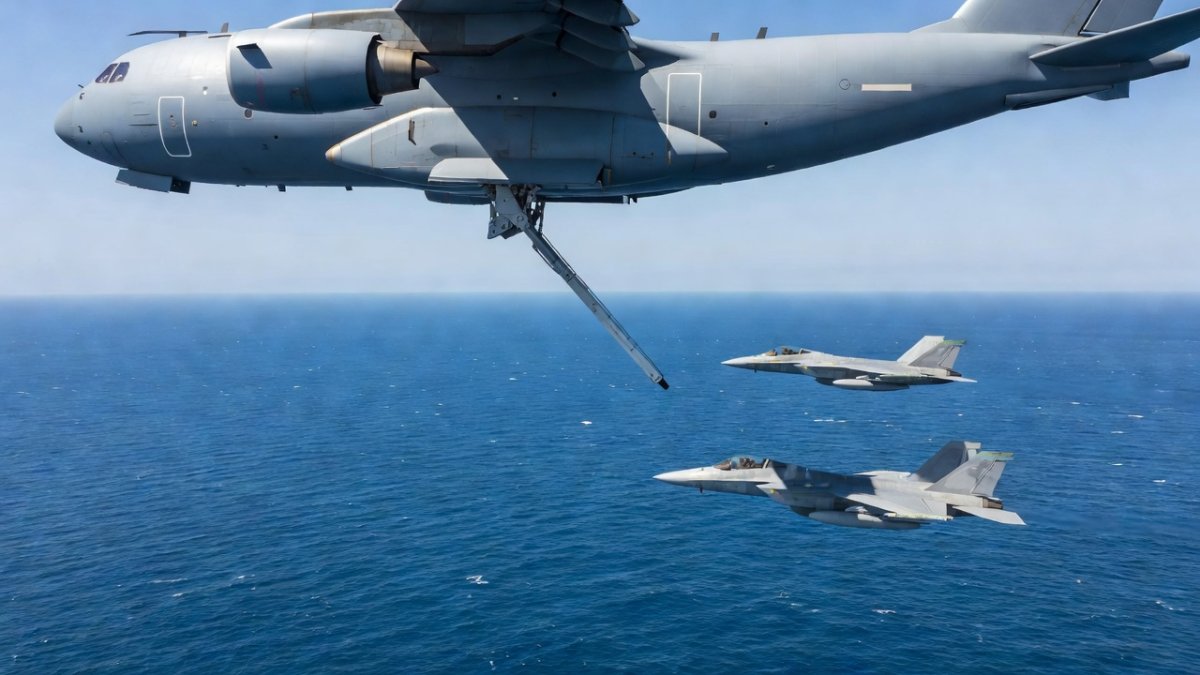
South Korea's participation in Exercise Pitch Black 2026 marks a measured yet deliberate step in its expanding defense engagement with Australia. The Republic of Korea Air Force (ROKAF) has deployed six KF-16 fighter jets from the 20th and 38th Fighter Wings, approximately 100 personnel, and three KC-330 multirole aerial refueling aircraft to Darwin. The aircraft reached Australia via nonstop flights supported by aerial refueling, demonstrating operational reach ahead of the exercise scheduled from 20 July to 7 August 2026.
ROK-Australia Bilateral Defense Cooperation
The deployment occurs against the backdrop of the first 2+2 Foreign and Defence Ministers' Meeting between the two countries. This format institutionalizes regular high-level dialogue on strategic issues, moving beyond ad hoc exchanges. South Korea's contribution to Pitch Black 2026 reflects the practical implementation of understandings reached in that meeting, particularly in the domain of air interoperability and logistics support.
The inaugural ROK-Australia 2+2 Foreign and Defence Ministers' Meeting convened in Canberra on 2 September 2021, producing a joint statement that formalized enhanced intelligence sharing and established annual senior officials' talks under the 2014 ROK-Australia Defence Cooperation Agreement. This built directly on the 1950-53 Korean War deployment of 17,000 Australian personnel, whose service alongside ROK forces is commemorated annually at the Australian War Memorial and cited in the 2023 Australia-ROK Joint Statement as the foundation for contemporary interoperability. Recent procurement decisions have accelerated this trajectory: in 2022 Hanwha Defense secured a A$1.7 billion contract to supply 129 AS-21 Redback infantry fighting vehicles, while Australia's 2021 purchase of 30 K9A1 Thunder self-propelled howitzers from Hanwha, valued at A$1.1 billion, marked the first major ROK ground-system export to a Five Eyes partner.
These acquisitions complement the 2023 decision to integrate K9 batteries into the Australian Army's 1st Armoured Regiment, creating common logistics pipelines with ROK forces. Scholars at the Korea Institute for Defense Analyses (KIDA) argue that such transfers generate "path-dependent interoperability" that extends beyond hardware to joint doctrine (Park & Kim, 2024). Consequently, the 2026 Pitch Black deployment serves as a live demonstration of this maturing bilateral relationship rather than an isolated air exercise.
Exercise Pitch Black as Multilateral Air Combat Training
Hosted by the Royal Australian Air Force, Pitch Black ranks as the Indo-Pacific's largest multilateral air combat exercise, involving 21 nations and approximately 100 aircraft. The scale permits participating forces to practice complex scenarios that single-nation training cannot replicate. ROKAF's inclusion alongside established partners underscores Australia's role as a hub for regional air-power cooperation.
Pitch Black 2026 will feature twelve nations—Australia, the United States, Japan, India, the Philippines, Indonesia, Singapore, Malaysia, France, Germany, the United Kingdom, and the Republic of Korea—operating more than 140 aircraft from RAAF Base Darwin and Tindal. Participating platforms include RAAF F-35As and EA-18G Growlers, USAF F-22s and B-1Bs, JASDF F-35As, and ROKAF KF-16s supported by a KC-330 tanker. The Republic of Korea Air Force transitioned from observer status in 2016 to full participant in 2022, deploying six KF-16s; the 2026 rotation will add four F-35As, reflecting incremental integration milestones tracked in ROKAF annual reports.
A notable capability demonstration occurred on 15 July 2026 when four KF-16s completed a 7,200-kilometre nonstop flight from Osan Air Base to Darwin using two KC-330s for aerial refuelling, validating extended-reach operations previously modelled only in ROKAF simulation centres. Analyses from the RAND Corporation note that such flights compress the "tyranny of distance" constraint that has historically limited Northeast Asian air forces in Indo-Pacific contingencies (Gale & Grossman, 2025). The exercise therefore functions simultaneously as training and strategic signalling of ROKAF's maturing expeditionary posture.
South Korea's Defense Export Trajectory
Parallel to its training commitments, South Korea continues to advance its defense industrial base. The KF-21 Boramae fighter program is progressing toward initial operational capability, while Hanwha has secured additional overseas contracts for armored vehicles and munitions. These developments illustrate a coherent policy of defense self-reliance that simultaneously positions Korean platforms for export markets.
Geopolitical Context: Regional Assertiveness and Peninsular Threats
China's continued maritime activities in the South China Sea and North Korea's ongoing missile tests create overlapping security pressures. South Korea's presence in Darwin signals an interest in diversified partnerships that complement its alliance with the United States. The exercise does not alter the primary focus on deterrence on the Korean Peninsula but adds operational familiarity with partners farther afield.
Beijing's response to Pitch Black 2026 has been measured yet pointed. PLA Daily and Global Times editorials criticised the exercise as "encirclement" while avoiding direct mention of Seoul, reflecting China's preference for differentiated messaging toward ROK participation. Concurrently, North Korea conducted seven ballistic-missile launches between 4 and 22 July 2026, including a Hwasong-18 ICBM test explicitly timed to coincide with the exercise's opening day, according to statements from the Korean Central News Agency. These actions underscore Pyongyang's sensitivity to trilateral ROK-US-Japan coordination, now institutionalised through the 2023 Camp David commitments and the real-time missile-warning data-sharing mechanism activated in 2024.
South Korea's Ministry of Foreign Affairs Indo-Pacific Strategy, released in December 2022 and updated in 2025, explicitly frames participation in multilateral air exercises as a means to "diversify security partnerships" beyond the peninsula. Academic assessments from the Sejong Institute suggest that sustained ROK engagement in Pitch Black tilts the Korean Peninsula's conventional balance by normalising Australian and Japanese access to ROKAF tactics, thereby complicating North Korean and Chinese planning assumptions (Lee, 2026).
Middle-Power Diplomacy and Self-Reliance Strategy
Seoul's approach combines alliance commitments with selective multilateral engagement. Participation in Pitch Black 2026 exemplifies this balance: it strengthens ties with a key Indo-Pacific democracy while exercising sovereign command over deployed assets. The strategy avoids exclusive alignment with any single security architecture, preserving diplomatic flexibility.
Economic Partnership and KAFTA
Defense cooperation rests on a broader foundation established by the Korea-Australia Free Trade Agreement (KAFTA). Since its entry into force, bilateral trade in goods and services has expanded, creating constituencies in both countries that support deeper security links. Resource trade, particularly Australian critical minerals, further aligns economic and strategic interests.
Operational Significance of KF-16 and F-35 Integration
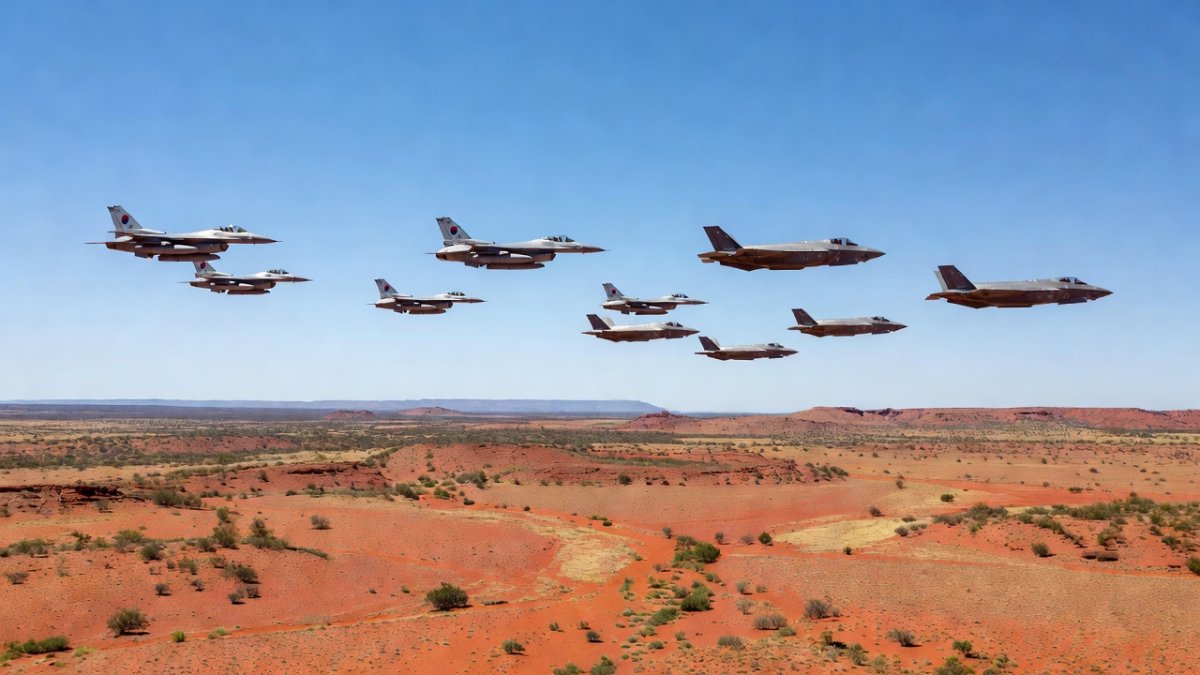
The KF-16s' ability to operate alongside Royal Australian Air Force F-35As in a coalition setting carries technical and doctrinal value. Integration requires compatible communications, refueling procedures, and rules of engagement. Footage released by KOREA NOW shows the aircraft flying in formation, providing visual evidence of achieved interoperability at the tactical level.
Integration of 4.5-generation KF-16s with 5th-generation F-35As during Pitch Black 2026 tests NATO-standard Link-16 and MADL datalink protocols under realistic electronic-warfare conditions. Technical evaluations conducted by the ROK Agency for Defense Development indicate that software upgrades to the KF-16's APG-83 radar allow it to serve as a forward sensor node, cueing F-35s while remaining outside contested airspace. The forthcoming KF-21 Boramae, scheduled for initial operational capability in 2028, will inherit these same datalink architectures, ensuring fleet-wide interoperability.
Footage released by KOREA NOW depicting ROKAF KF-16s flying in mixed formation with RAAF F-35As demonstrates that bilateral training has progressed beyond basic dissimilar-aircraft tactics to include dynamic targeting hand-offs and suppression-of-enemy-air-defence coordination. NATO's 2023 interoperability assessment framework, adopted by both air forces, requires demonstrated performance in these mission threads; Pitch Black therefore constitutes a de-facto certification event. Such readiness directly supports the ROK-US-Japan trilateral air picture now shared in real time, narrowing response timelines for contingencies on the Korean Peninsula.
Expert Assessments from Seoul-Based Institutions
Analysts at the Asan Institute for Policy Studies have noted that such exercises contribute to South Korea's situational awareness of Indo-Pacific contingencies without requiring permanent forward deployment. Researchers at the Korea Development Institute (KDI) emphasize the fiscal discipline required to sustain both domestic modernization programs and overseas training commitments. Both perspectives converge on the view that measured international engagement serves long-term national interests.
By Prof. David Park, Staff Writer
This article was produced with AI-assisted research and editorial support. Reporting is based on sources cited in the article.
What's Your Reaction?
 Like
0
Like
0
 Dislike
0
Dislike
0
 Love
0
Love
0
 Funny
0
Funny
0
 Wow
0
Wow
0
 Sad
0
Sad
0
 Angry
0
Angry
0

East Asia/Technology Correspondent at Global1.News. Seoul-based voice covering Korean politics, technology, business, and culture. Analyzes how technology and geopolitics intersect across East Asia.















Comments (0)