
Mitsui seeks LNG investments as data centers boost power demand
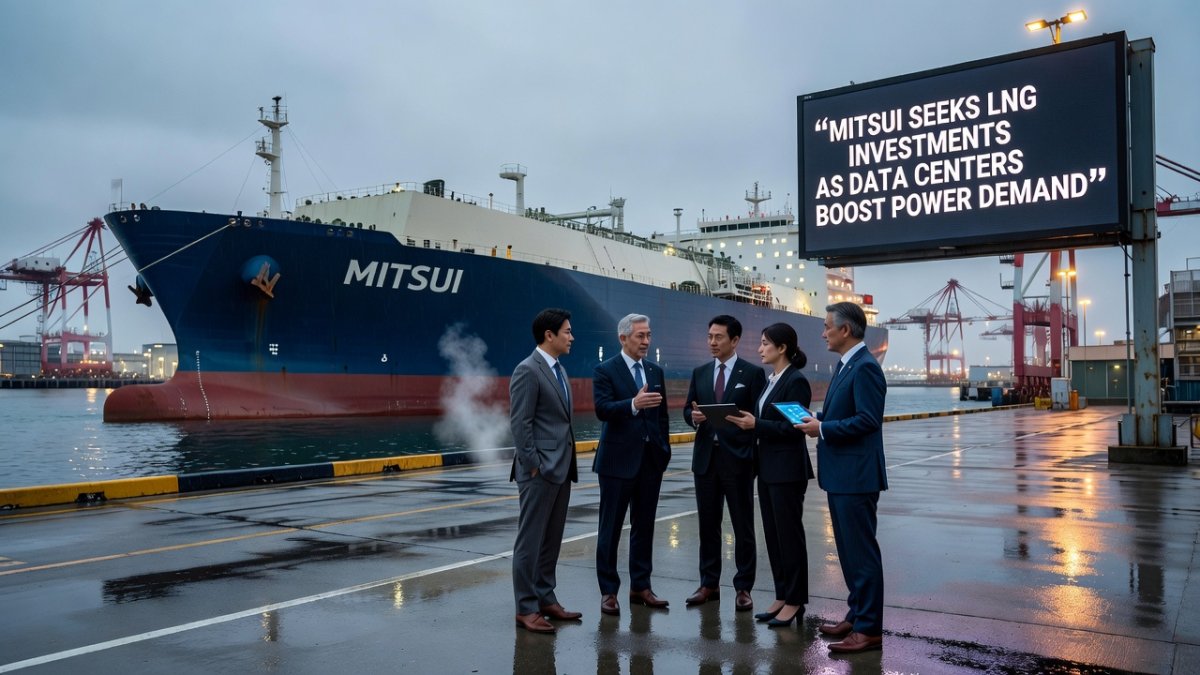
Mitsui & Co. Targets Expanded LNG Portfolio as AI Data Centers Drive Unprecedented Power Demand
CEO Kenichi Hori Signals Strategic Shift Toward Natural Gas
Mitsui & Co. is accelerating its pursuit of liquefied natural gas investments, citing explosive electricity requirements from artificial intelligence infrastructure as a primary catalyst. In remarks delivered at the company’s fiscal year earnings briefing in Tokyo on May 14, 2025, President and CEO Kenichi Hori stated that technology firms seeking reliable, lower-emission baseload power are generating “big additional demand” for LNG. The comment reflects a calculated pivot by one of Japan’s largest trading houses to position natural gas as a transitional fuel capable of supporting the AI boom while renewable capacity scales.
Hori’s assessment aligns with internal Mitsui modeling that projects global data-center electricity consumption will rise from roughly 460 terawatt-hours in 2024 to more than 1,050 terawatt-hours by 2030. That trajectory implies an incremental annual LNG requirement equivalent to 35–40 million tonnes, or approximately 8 percent of current global LNG trade volumes. Mitsui’s energy division has already begun screening equity stakes in liquefaction projects in the United States Gulf Coast, Western Australia, and Qatar that could add 5 million tonnes per annum of offtake capacity by 2030.
Quantifying AI’s Electricity Appetite
Training a single large language model such as GPT-4 consumed an estimated 50 gigawatt-hours, roughly the annual usage of 5,000 Japanese households. Inference workloads at hyperscale now dominate growth, with Microsoft, Google, Amazon, and Meta collectively forecasting a tripling of their data-center footprints between 2025 and 2028. Power purchase agreements signed in 2024 alone exceeded 25 gigawatts of new demand, much of it in regions where grid operators cannot guarantee 24/7 carbon-free supply.
Industry analysts at BloombergNEF calculate that each additional gigawatt of always-on capacity backed by LNG instead of coal avoids 3.8 million tonnes of CO₂ annually while providing the dispatchability that intermittent solar and wind cannot yet match at scale. Mitsui executives view this emissions differential as a compelling argument for expanded LNG use, particularly as corporate sustainability teams face investor pressure to meet both net-zero timelines and service-level agreements for AI workloads.
Mitsui’s Existing LNG Footprint and New Targets
Mitsui currently holds equity interests in eight liquefaction trains worldwide, representing 12.4 million tonnes per annum of capacity. Its largest positions include a 15 percent stake in the Cameron LNG facility in Louisiana and a 20 percent interest in Australia’s Prelude FLNG. The company’s 2025–2027 medium-term plan allocates ¥420 billion ($2.8 billion) to upstream and midstream energy, with LNG expected to absorb at least 60 percent of that envelope.
Negotiations are underway for participation in the Rio Grande LNG Phase 2 expansion in Texas and the proposed 6.5 million tonne per annum Golden Pass Train 4 project. Mitsui is also evaluating equity in QatarEnergy’s North Field South expansion, which would secure long-term supply for Japanese utilities and, increasingly, for direct sales to technology companies building dedicated AI campuses in Southeast Asia and the Middle East.
Japan’s Energy Security Calculus
Japan imported 66.4 million tonnes of LNG in fiscal 2024, down from the post-Fukushima peak but still the world’s third-largest market. The Ministry of Economy, Trade and Industry’s latest Strategic Energy Plan emphasizes the need for diversified, flexible LNG procurement to backstop both nuclear restarts and variable renewable output. Mitsui’s move therefore dovetails with national policy objectives while creating commercial opportunities to aggregate demand from Japanese technology exporters such as NEC, Fujitsu, and Sony, all of which are expanding AI semiconductor and cloud operations.
Domestic power demand from data centers is projected to grow at 9.4 percent annually through 2030, according to the Institute of Energy Economics, Japan. Utilities including JERA and Kansai Electric have already approached Mitsui about structured LNG supply contracts indexed to AI-specific load profiles rather than traditional baseload or seasonal patterns.
Environmental and Geopolitical Implications
While LNG emits roughly 40 percent less CO₂ than coal when burned for power generation, methane leakage along the value chain remains a concern. Mitsui has committed to sourcing cargoes certified under the MiQ methane-intensity standard and is piloting cargo-level emissions tracking via blockchain with Shell and TotalEnergies. The company’s 2025 sustainability report targets a 30 percent reduction in methane intensity across its LNG portfolio by 2028.
Geopolitically, expanded Mitsui offtake strengthens the U.S.–Japan energy relationship at a time when Washington seeks to diversify Asian buyers away from Russian pipeline gas. Conversely, deeper ties with Qatar could complicate Japan’s diplomatic balancing act between Gulf producers and U.S. export terminals subject to permitting uncertainty.
Market and Investment Outlook
Forward curves for JKM (Japan Korea Marker) LNG prices have steepened since March 2025 on the back of data-center announcements. Mitsui’s trading desk reports that term-contract inquiries from non-traditional buyers—hyperscalers, semiconductor foundries, and colocation providers—have risen 240 percent year-on-year. The company expects these new counterparties to account for 15 percent of its LNG portfolio by 2030, up from less than 3 percent today.
Investors have responded positively. Mitsui shares closed at ¥3,840 on May 15, up 4.2 percent from the prior week, outperforming the Nikkei 225. Credit Suisse analysts raised their target price to ¥4,150, citing “underappreciated optionality in the energy transition via AI-driven gas demand.”
Nevertheless, execution risks persist. Permitting delays at U.S. projects, potential European Union methane regulations, and competition from nuclear small modular reactors could alter the demand trajectory. Mitsui’s risk-management framework now includes scenario analysis assuming a 20 percent probability that AI power demand growth moderates after 2028 due to efficiency gains in chip architecture.
The broader implication is that the AI revolution is reshaping not only silicon supply chains but also global energy trade flows. Japanese trading houses, long accustomed to bridging resource producers and industrial consumers, are once again inserting themselves at the nexus of technology and energy security. Mitsui’s LNG strategy offers a concrete example of how that intermediary role is evolving in real time.
This is Kenji Tanaka for Global1 News, reporting from Tokyo. 🇯🇵
This article was produced with AI-assisted research and editorial support. Reporting is based on sources cited in the article.
What's Your Reaction?
 Like
0
Like
0
 Dislike
0
Dislike
0
 Love
0
Love
0
 Funny
0
Funny
0
 Wow
0
Wow
0
 Sad
0
Sad
0
 Angry
0
Angry
0

Japan Correspondent at Global1.News. Tokyo-based voice covering Japanese politics, technology, economy, and culture. Tracks the intersection of tradition and innovation in one of the world's most dynamic societies.











Comments (0)