
We’ve stabilized telecoms sector -Tinubu
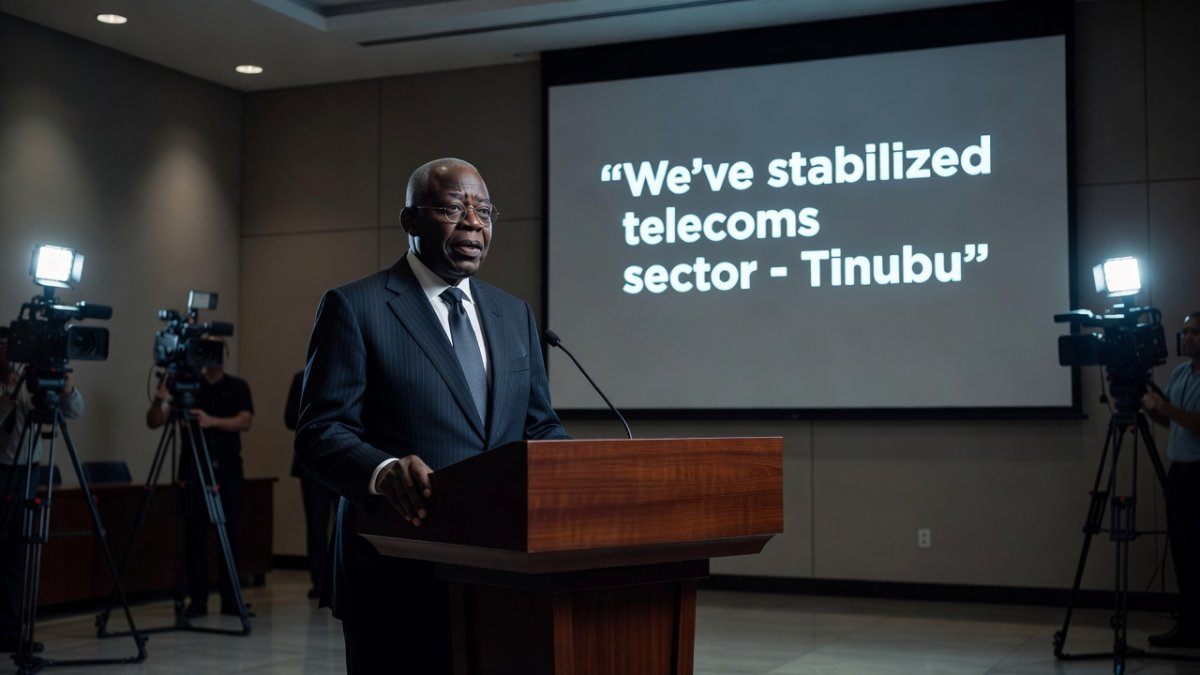
Tinubu Declares Telecoms Sector Stabilized After Years of Crisis, Pledges Fresh Investment Push
President Bola Tinubu on Friday asserted that his administration has successfully stabilized Nigeria’s telecommunications sector, marking a turning point after prolonged operational strains and dwindling investor confidence. Speaking during a virtual address to commemorate the third anniversary of his May 2023 inauguration, the President highlighted policy interventions that he said have begun restoring predictability and attracting renewed capital into an industry critical to the country’s digital economy ambitions.
From Turbulence to Stability: The President’s Assessment
“After years of severe operational pressures and declining investment, we have stabilized the telecommunications sector,” Tinubu stated. He pointed to coordinated efforts between the Federal Government, the Nigerian Communications Commission (NCC), and private operators as the foundation for renewed growth. The remarks come amid broader economic reforms, including the unification of exchange rates and the removal of fuel subsidies, which initially triggered sharp cost increases for telecom firms reliant on imported equipment and diesel-powered infrastructure.
Tinubu emphasized that stabilization does not imply complacency. He announced that the government would soon unveil a N500 billion infrastructure support facility, to be administered through the Bank of Industry, aimed at accelerating 5G deployment and expanding fiber-optic backbone across underserved regions. “Our goal is not merely recovery but leadership in Africa’s digital transformation,” he added.
Background: The Pre-2023 Crisis in Context
Nigeria’s telecom landscape had faced mounting headwinds before Tinubu’s inauguration. Between 2020 and 2023, operators reported cumulative losses exceeding $2.8 billion, driven by naira volatility, multiple taxation, and unreliable electricity supply that forced heavy expenditure on generators. The NCC recorded a 14 percent drop in foreign direct investment inflows into the sector in 2022 compared with the previous year. Major players including MTN Nigeria, Airtel Africa, and Globacom scaled back expansion plans, while smaller licensees struggled with debt servicing.
Subscriber growth, once a reliable metric of sector health, slowed to 3.2 percent annually. Active voice and data lines hovered around 195 million by early 2023, yet average revenue per user declined due to price sensitivity among consumers battered by inflation. Industry analysts at KPMG Nigeria noted that regulatory uncertainty around spectrum pricing and local content requirements further deterred long-term commitments.
Policy Interventions Credited with Reversal
The administration credits several targeted measures for the turnaround. The Presidential Steering Committee on Telecommunications, established in late 2023, streamlined approvals for right-of-way permits, reducing average deployment timelines from 18 months to under nine. The NCC’s decision to auction additional 5G spectrum in the 3.5 GHz band in Q2 2024 generated $820 million in proceeds, earmarked for rural broadband projects.
Additionally, the harmonization of multiple levies into a single 2.5 percent of gross revenue contribution has eased cash-flow pressures. Operators report that forex access through the newly liberalized market has improved equipment importation, with MTN Nigeria confirming a $1.1 billion capital expenditure program for 2025-2027 focused on network modernization.
Expert Perspectives and Industry Reactions
Dr. Aminu Maida, NCC Executive Vice Chairman, described the stabilization as “fragile but real.” In an exclusive interview, he noted: “We have seen a 27 percent year-on-year increase in capital expenditure by licensed operators in the first half of 2025. What matters now is sustaining this momentum through consistent policy signals.”
Chief Executive of Airtel Nigeria, Surendran Chemmarathil, welcomed the President’s remarks but urged further action on power sector reforms. “Telecoms cannot thrive in isolation from reliable electricity,” he said. “Every base station still spends 40 percent of operating costs on diesel. True stabilization requires solving the energy equation.”
Economist and former Central Bank deputy governor, Dr. Kingsley Moghalu, offered cautious optimism. “The sector’s contribution to GDP has risen from 8.7 percent in 2022 to an estimated 10.4 percent in 2025,” he observed. “Yet this growth must translate into broader productivity gains across agriculture, education, and SMEs if it is to justify the social license operators enjoy.”
Economic Implications for Nigeria’s Digital Future
Stabilization carries significant multiplier effects. The World Bank estimates that every 10 percent increase in broadband penetration correlates with 1.4 percent GDP growth in emerging markets. Nigeria’s current penetration rate stands at approximately 45 percent, leaving substantial headroom. Renewed investment could accelerate fintech adoption, already valued at $4.2 billion in transaction volume in 2024, and support the government’s target of creating 2 million digital jobs by 2027.
However, risks remain. Currency depreciation continues to inflate the cost of imported handsets, potentially widening the digital divide. Rural connectivity lags, with only 22 percent of local government areas boasting fiber presence. Consumer protection concerns, including data privacy enforcement and quality-of-service complaints, also require sustained regulatory attention.
Challenges Ahead and Forward-Looking Analysis
While the President’s anniversary speech painted an encouraging picture, independent assessments suggest stabilization is uneven. Smaller operators and internet service providers continue to cite difficulties accessing long-term financing. Spectrum allocation disputes persist in certain regions, and cybersecurity threats have escalated, with reported incidents rising 31 percent in the past year.
Looking ahead, Tinubu’s administration has signaled interest in public-private partnerships for submarine cable landings and data center development. The forthcoming National Broadband Plan 2.0, expected in September, is anticipated to set aggressive targets for 70 percent penetration by 2030. Success will hinge on execution, fiscal discipline, and the ability to insulate the sector from political cycles.
As Nigeria positions itself as a continental digital hub, the telecoms sector’s stabilization represents both an achievement and a test case for broader reform credibility. Investors will watch closely for evidence that recent gains are locked in through predictable regulation and infrastructure support.
This is Sarah Okafor for Global1 News, reporting from Lagos. 🇳🇬
This article was produced with AI-assisted research and editorial support. Reporting is based on sources cited in the article.
What's Your Reaction?
 Like
0
Like
0
 Dislike
0
Dislike
0
 Love
0
Love
0
 Funny
0
Funny
0
 Wow
0
Wow
0
 Sad
0
Sad
0
 Angry
0
Angry
0

Africa Correspondent at Global1.News. Based in Lagos, covering politics, business, technology, and culture across the continent. Focused on telling African stories beyond the headlines — the innovation, entrepreneurs, and communities shaping the region's future.














Comments (0)