
Mind the Gap: Thailand's EV Crossroads — Plug-in Hybrids and the Road Ahead
Thailand stands at a pivotal automotive crossroads where the global shift toward electrification meets the kingdom's deep-rooted reliance on internal combustion engines. With the Bangkok Post podcast "Mind the Gap: The Road Ahead" highlighting insights from Mercedes-Benz Thailand leaders and local engineers, the nation must navigate oil price volatility, infrastructure gaps, an
Thailand stands at a pivotal automotive crossroads where the global shift toward electrification meets the kingdom's deep-rooted reliance on internal combustion engines. With the Bangkok Post podcast "Mind the Gap: The Road Ahead" highlighting insights from Mercedes-Benz Thailand leaders and local engineers, the nation must navigate oil price volatility, infrastructure gaps, and shifting buyer preferences among younger generations. This analysis explores how plug-in hybrids serve as a practical bridge while full EVs gain ground under the EV 30@30 policy.
The Oil Crisis Igniting EV Interest Across Southeast Asia
The 2022 global oil price surge, triggered by geopolitical tensions in Eastern Europe, pushed Brent crude above 120 United States dollars per barrel and directly affected Thai drivers who rely on imported fuel for daily commutes in Bangkok's heavy traffic. Christian Schell, President and CEO of Mercedes-Benz Thailand Ltd., noted during the podcast that this crisis accelerated interest in electric vehicles throughout Southeast Asia, particularly in urban centers like Bangkok and industrial zones near Laem Chabang port. Thai consumers in Samut Prakan province began exploring alternatives as gasoline prices at PTT stations climbed above 40 baht per liter.
Thailand's position as ASEAN's largest automobile producer, with over 1.8 million vehicles manufactured in 2023 according to the Federation of Thai Industries, placed the country at the center of regional discussions on energy transition. The Board of Investment offered tax exemptions for EV manufacturers setting up in Rayong's Eastern Economic Corridor, drawing attention from Japanese and Chinese firms. This policy response connected directly to the kingdom's goal of reducing dependence on Middle Eastern oil imports that have historically strained the national budget.
In Chiang Mai, tourism operators reported higher operating costs for gasoline-powered tour vans during the post-pandemic recovery, prompting early experiments with hybrid models on routes to Doi Suthep temple. The podcast guest Thitipong Phawadee, a Network Operations Center Engineer at 2C2P and Rangsit University graduate, emphasized how younger engineers in Isaan provinces viewed these price shocks as a catalyst for adopting new technologies. Local communities in Khon Kaen began discussing collective purchases of charging equipment to support shared EV taxis.
Buddhist principles of mindfulness toward resource consumption resonated with Thai environmental groups in Phuket, where hotel chains considered electric shuttles for airport transfers from Phuket International Airport. The oil crisis highlighted the need for balanced choices that honor both economic realities and the cultural value placed on harmony with nature. Southeast Asian neighbors such as Vietnam saw similar spikes in VinFast EV inquiries, yet Thailand's established manufacturing base gave it a distinct advantage in scaling production.
Mercedes-Benz Thailand responded by accelerating plug-in hybrid introductions at its assembly operations, ensuring models could handle long-distance travel between Bangkok and the northeastern Isaan region without range anxiety. Data from the Energy Policy and Planning Office showed hybrid registrations rising 35 percent in the first half of 2023. These developments underscored Thailand's transitional strategy amid fluctuating global energy markets.
Plug-in Hybrids as Thailand's Practical Bridge to Electrification
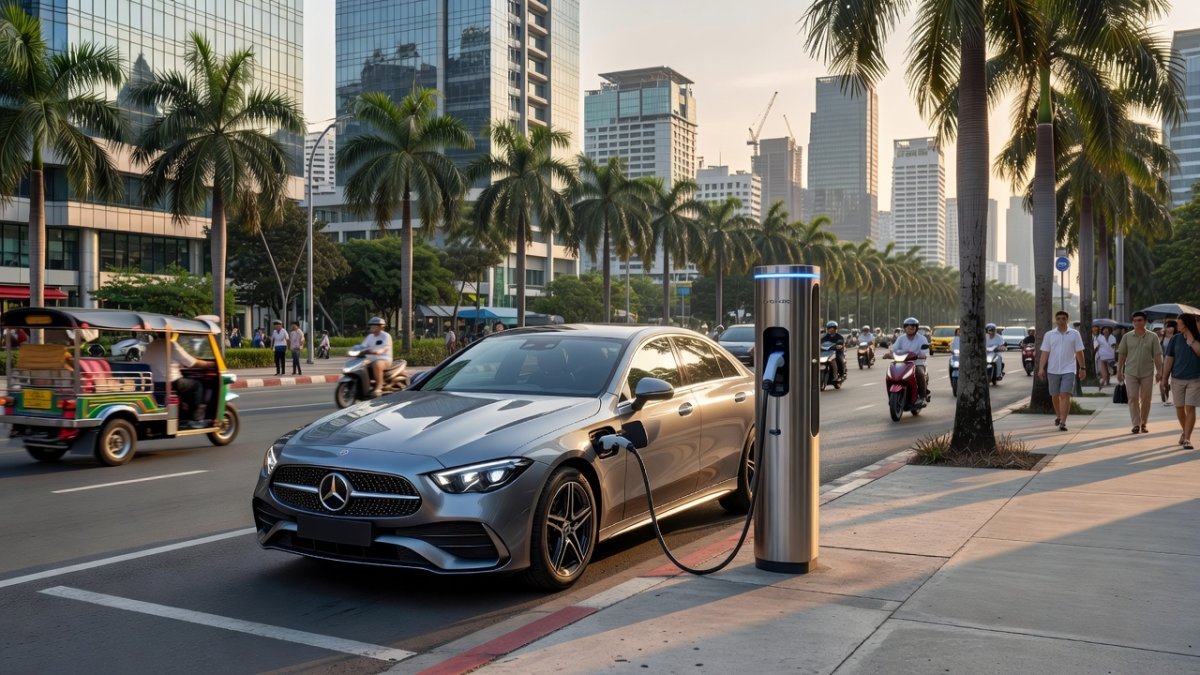
Thailand's transitional EV approach recognizes that full charging infrastructure remains uneven, making plug-in hybrids essential for buyers traveling between Bangkok's dense districts and upcountry provinces like Chiang Mai. Christian Schell explained that Mercedes-Benz plug-in hybrid models offer electric-only ranges of 50 to 100 kilometers, sufficient for daily commutes in Samut Prakan while providing gasoline backup for longer journeys to Phuket. This flexibility addresses the current 1,200 public charging stations nationwide, most concentrated in the capital.
The plug-in hybrid CLA model delivers combined system output of 218 horsepower with a 25.4 kilowatt-hour battery, allowing seamless switching between power sources during Bangkok's notorious traffic jams on Vibhavadi Rangsit Road. In contrast, the fully electric CLA variant requires reliable access to fast chargers, which remain scarce along highways connecting Rayong's industrial estates to Laem Chabang port. Thitipong Phawadee highlighted how engineers at 2C2P appreciate the hybrid's predictive maintenance features that monitor both battery and engine health.
Government incentives under the Board of Investment favor manufacturers producing plug-in hybrids locally, with import duty reductions of up to 40 percent for components assembled in Thailand. This policy supports the EV 30@30 target of 30 percent zero-emission vehicle production by 2030 while giving time for battery supply chains to mature. Young professionals in Bangkok's Sathorn district often cite lower ownership costs, including reduced excise taxes, as decisive factors when comparing the two CLA variants.
Regional comparisons reveal Indonesia's focus on nickel-based batteries for full EVs, while Malaysia emphasizes hybrid incentives through its National Automotive Policy. Thailand's middle path preserves jobs at existing plants in Rayong and maintains export competitiveness to ASEAN markets. Buddhist mindfulness encourages thoughtful resource use, aligning with hybrid technology that minimizes waste during the infrastructure build-out phase.
Commercial fleet operators at Laem Chabang port have adopted plug-in hybrids for short-haul container movements, cutting fuel expenses by 30 percent according to internal Mercedes-Benz fleet data. These vehicles maintain relevance as Thailand expands its charging network toward the 2030 deadline. The strategy ensures no segment of the market is left behind during the transition.
Mercedes-Benz Strategies for Attracting Younger Thai Buyers
Gen Z and Millennial professionals in Bangkok prioritize sustainability, advanced tech features, and predictable ownership costs when selecting vehicles, according to Mercedes-Benz Thailand market research conducted in 2023. Christian Schell outlined targeted campaigns at universities such as Chulalongkorn and Thammasat, where students test drive plug-in hybrid CLA models equipped with augmented reality head-up displays. These features resonate with tech-savvy buyers who value connectivity alongside environmental responsibility.
The electric CLA offers instant torque and zero tailpipe emissions, appealing to those concerned about air quality in densely populated areas like Nonthaburi. However, the plug-in hybrid CLA provides similar tech with added versatility for weekend trips to Hua Hin or Ayutthaya historical parks. Purchase decisions often hinge on total cost of ownership calculations that factor in home charging savings versus public fast-charger fees averaging 8 baht per kilowatt-hour.
Mercedes-Benz differentiates itself through extended battery warranties of eight years or 160,000 kilometers, coupled with access to the Ionity network expanding into Thailand via partnerships. In competitive landscapes dominated by Chinese EV brands and Japanese hybrids, the brand emphasizes German engineering tailored for tropical climates and monsoon conditions common in Phuket and the Isaan region. Local assembly at facilities near Samut Prakan ensures competitive pricing after BOI incentives.
Younger buyers in Chiang Mai appreciate Mercedes-Benz's integration of Buddhist-inspired design elements, such as serene cabin lighting that promotes mindful driving. Marketing events at Samyan Mitrtown combine test drives with discussions on sustainable mobility, fostering community around the brand. This approach builds loyalty among future decision-makers who will shape Thailand's automotive future.
Government Policies and Thailand's Role as the Detroit of Asia
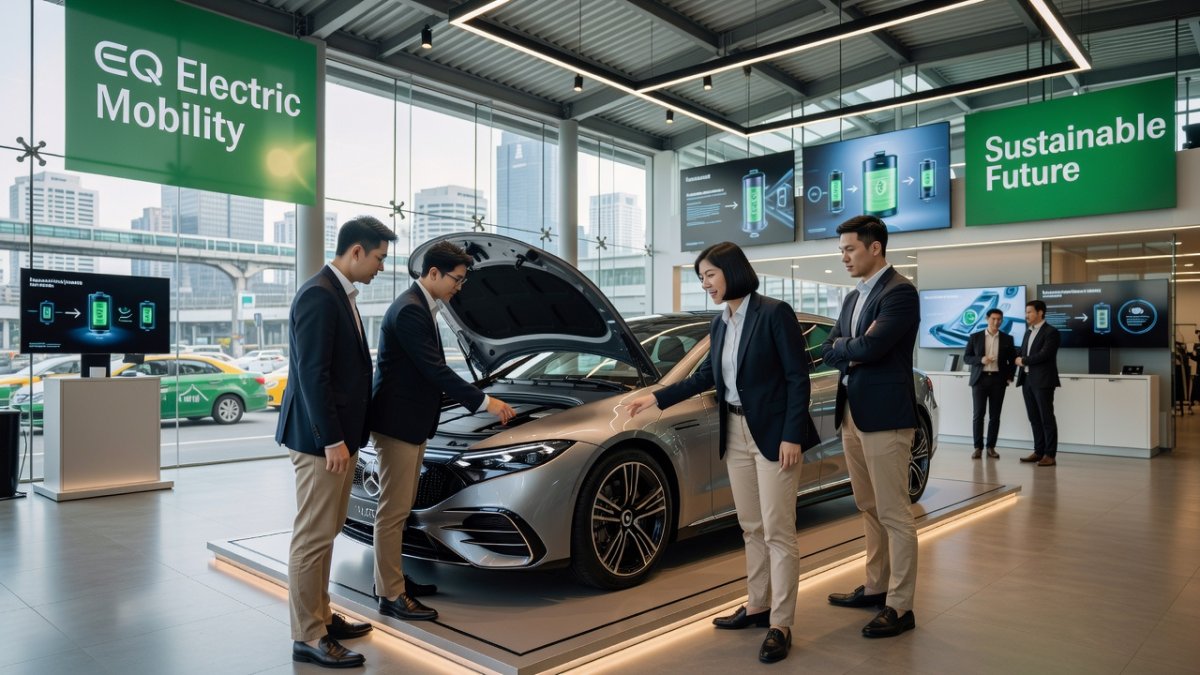
Thailand's EV 30@30 policy commits to 30 percent electric vehicle production by 2030, supported by Board of Investment tax breaks that have attracted over 150 billion baht in investments since 2021. The Board of Investment approved projects for battery gigafactories in Rayong, positioning the Eastern Economic Corridor as a key production hub. These measures reinforce Thailand's status as ASEAN's top automobile manufacturer, outpacing Indonesia and Malaysia in annual output.
Import duty reductions on EV components assembled locally have lowered prices for models like the Mercedes-Benz plug-in hybrid lineup, making them accessible to middle-income families in Bangkok suburbs. Production targets include 725,000 electric vehicles annually by the end of the decade, with Laem Chabang port serving as the primary export gateway to neighboring countries. This ambition echoes the historical "Detroit of Asia" nickname earned through decades of Japanese and American automaker presence.
Comparisons with Vietnam show VinFast's rapid full-EV push, yet Thailand benefits from deeper supplier networks in Samut Prakan and established quality standards. Malaysia's hybrid focus offers a parallel model, but Thailand's balanced incentives for both plug-in hybrids and battery electrics provide greater flexibility. Policy continuity across administrations has reassured investors despite political transitions in 2023.
Local governments in Phuket and Chiang Mai have aligned with national targets by offering additional parking privileges for EVs at municipal facilities. These coordinated efforts support tourism recovery while advancing environmental goals rooted in Buddhist stewardship of the land. The policies ensure Thailand remains central to regional automotive supply chains.
Charging Infrastructure Gaps and Regional Connectivity Challenges
Charging infrastructure remains heavily concentrated in Bangkok and the Eastern Economic Corridor, with limited stations along routes to Chiang Mai or deep into Isaan provinces such as Udon Thani. This disparity creates range anxiety for travelers using electric CLA models on journeys exceeding 300 kilometers without stops. Plug-in hybrids mitigate these gaps by allowing gasoline top-ups at remote PTT stations near the Mekong River border areas.
Mercedes-Benz Thailand has partnered with EA Anywhere to expand charger access at major destinations including Phuket International Airport and Chiang Mai's Nimmanhaemin district. Battery warranties cover degradation concerns for owners in humid climates, while predictive maintenance software alerts drivers to optimal charging windows. Thitipong Phawadee discussed how AI-driven tools could further optimize routes for commercial fleets operating out of Laem Chabang.
Upcountry provinces face additional hurdles with unstable electricity supply during peak agricultural seasons, affecting charger reliability in rural Isaan communities. Government plans aim to install 5,000 new public chargers by 2025, prioritizing highways linking Bangkok to Rayong industrial zones. These investments will gradually close the urban-rural divide.
Tourism operators in Phuket have begun offering EV rental options for airport transfers, enhancing the island's appeal to eco-conscious visitors from Europe and China. Similar pilots in Chiang Mai support temple tourism with quieter, emission-free vehicles. Closing infrastructure gaps remains essential for equitable national progress.
Automated Driving Technologies and Bangkok Traffic Realities
Engineers like Thitipong Phawadee express particular passion for AI applications in predictive maintenance and advanced driver assistance systems that adapt to Bangkok's unpredictable traffic patterns. Mercedes-Benz models feature automated driving features calibrated for frequent stop-and-go conditions on expressways such as the Don Mueang Tollway. These systems use real-time data to anticipate congestion near Victory Monument.
Plug-in hybrid and electric CLA variants incorporate ADAS that maintains safe distances in mixed traffic involving motorcycles and buses common throughout Samut Prakan. The technology reduces driver fatigue on long hauls to Isaan or southern provinces, aligning with cultural values of careful, mindful operation. Future updates will integrate with Thailand's emerging 5G networks for enhanced accuracy.
Commercial applications at Laem Chabang port include automated parking assists for container handlers, improving efficiency in high-volume operations. Younger Thai engineers contribute ideas drawn from local driving experiences, ensuring features suit tropical rain and flooding scenarios. This localization strengthens Mercedes-Benz's competitive edge.
Regional ASEAN markets watch Thailand's progress closely, as successful Bangkok-tailored ADAS could be exported to Jakarta and Kuala Lumpur. The focus remains on practical assistance rather than full autonomy given current infrastructure limitations.
Forward-Looking Perspectives on Thailand's Automotive Future
As Thailand advances toward its 2030 production targets, the interplay between plug-in hybrids and full EVs will define mobility for generations in Bangkok, Phuket, and beyond. Mercedes-Benz Thailand continues refining its offerings to meet evolving preferences of young professionals while honoring the kingdom's manufacturing heritage. Infrastructure expansion and policy support will determine how quickly gaps narrow between urban centers and rural provinces.
The insights from Christian Schell and Thitipong Phawadee underscore a thoughtful transition that balances innovation with accessibility. Buddhist mindfulness guides many Thais in weighing environmental impact against practical needs, fostering choices that sustain both economy and culture. Thailand's role as ASEAN automotive hub positions it to influence regional standards for years ahead.
Continued collaboration between government agencies, manufacturers, and local communities will ensure the road ahead remains inclusive and resilient.
By Ann Srisawat, Staff WriterThis article was produced with AI-assisted research and editorial support. Reporting is based on sources cited in the article.
What's Your Reaction?
 Like
1
Like
1
 Dislike
0
Dislike
0
 Love
0
Love
0
 Funny
0
Funny
0
 Wow
0
Wow
0
 Sad
0
Sad
0
 Angry
0
Angry
0

Southeast Asia Correspondent at Global1.News. Based in Bangkok, covering Thai and Southeast Asian politics, economy, technology, and culture. Deep regional perspective on one of the world's most dynamic regions.















Comments (0)