
Mexico in Numbers: Where did over $60 billion in remittances go in 2025?
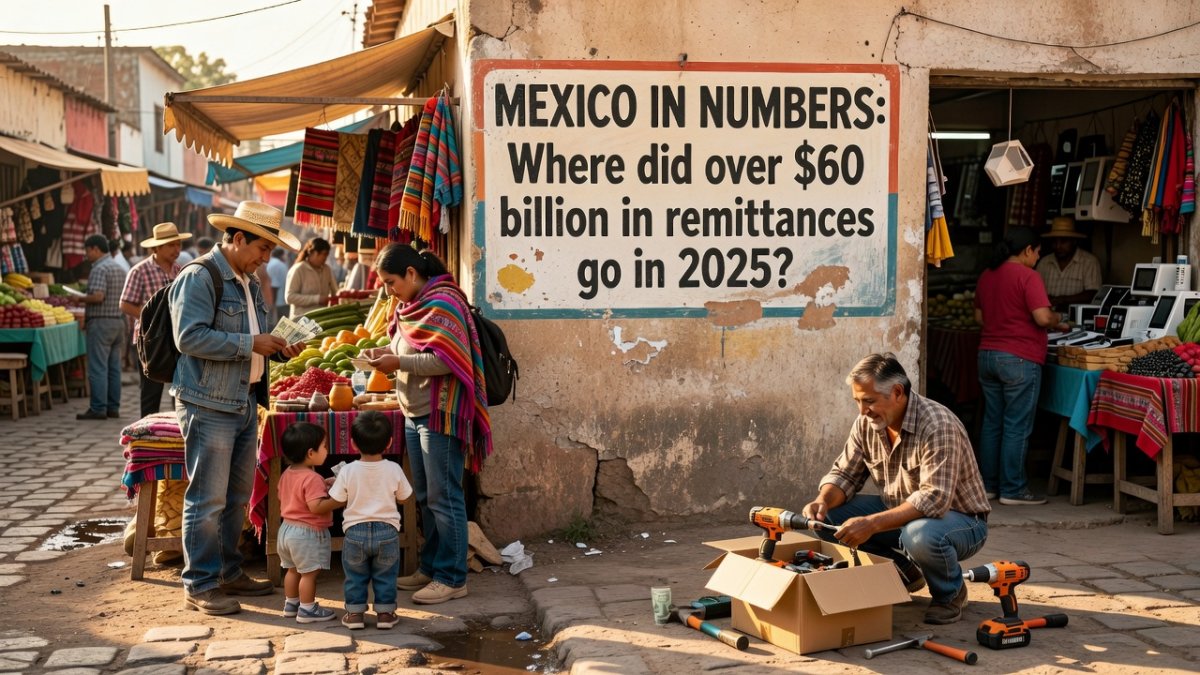
Mexico in Numbers: Where Did Over $60 Billion in Remittances Go in 2025?
By Rosa Martinez | Global1 News | Mexico City — February 12, 2026
Queridos lectores, when I sit down with families in the bustling markets of Mexico City or the quiet plazas of small towns in Michoacán, the conversation often turns to the same powerful force shaping our daily lives: the money that crosses the border from loved ones working far away. This week, fresh figures from Banco de México revealed that $61.79 billion in remittances flowed into our country in 2025. That represents a 4.6% drop from the record $64.75 billion recorded in 2024, yet it remains one of the largest annual inflows in our history. The question on everyone’s mind is not just how much arrived, but precisely where it went and what it means for communities from the northern deserts to the southern highlands.
The National Picture: A Slight Dip Amid Steady Strength
Remittances have long been the lifeblood of millions of Mexican households, often outpacing oil exports and foreign direct investment combined. In 2025, the United States remained the dominant source, accounting for roughly 95% of all transfers, according to official data. The modest decline has been attributed by analysts to a cooling U.S. labor market in sectors like construction and agriculture, coupled with stricter enforcement policies that slowed migration flows in the second half of the year. Still, the total underscores how deeply intertwined our economies remain. “Even with the dip, these flows represent nearly 4% of Mexico’s GDP,” noted economist Dr. Elena Vargas of the Universidad Nacional Autónoma de México during a recent interview. “That kind of money touches every corner of the republic.”
Breaking down the numbers further reveals patterns that tell stories of resilience. Monthly averages hovered around $5.15 billion, with peaks in December tied to holiday support for families. Digital platforms such as Wise and traditional services like Western Union handled growing shares, reflecting younger migrants’ preferences for speed and lower fees.
State-by-State: Mapping the Flow of Support
So where exactly did this $61.79 billion land? The distribution highlights regional inequalities and strong migration corridors. Michoacán led once again, receiving an estimated $5.8 billion—nearly 9.4% of the national total. Guanajuato followed closely at $5.2 billion, while Jalisco captured $4.9 billion. These three states alone absorbed almost 26% of all remittances, a concentration that has persisted for decades due to established networks in California and Texas.
Further south, Oaxaca and Guerrero each saw inflows exceeding $3.1 billion, money that often supports indigenous communities and rural economies hit hard by climate challenges. In contrast, northern states like Nuevo León and Chihuahua received smaller but still significant shares—around $2.4 billion and $2.1 billion respectively—reflecting more recent migration waves tied to manufacturing jobs. Mexico City itself absorbed $2.7 billion, much of it directed toward education and small businesses in urban neighborhoods.
These figures come with important context. Per-capita impact is often highest in smaller states. In Michoacán, remittances equated to roughly $1,150 per resident, compared to the national average of about $470. Local leaders in the state capital of Morelia described the money as funding everything from new roofs after heavy rains to university tuition for the next generation.
Voices from the Communities
Walking through the streets of Pátzcuaro in Michoacán last month, I spoke with María Elena Soto, whose son sends $600 every two weeks from Chicago. “Without that, my granddaughter wouldn’t be studying nursing,” she told me, her eyes bright with pride. Similar stories echo across Guanajuato’s industrial towns, where remittances help offset stagnant wages in auto parts factories.
Community organizations have stepped in to maximize impact. In Jalisco, groups like Remesas para el Futuro have launched financial literacy workshops teaching families how to invest portions of these funds in local cooperatives rather than solely on consumption. One such program in Tlaquepaque has already helped 1,200 households open small savings accounts, with average balances reaching $2,800 within the first year.
Economic Ripple Effects and Broader Implications
The macroeconomic story is equally compelling. Remittances continue to stabilize the peso during periods of global uncertainty and provide a buffer against inflation, which averaged 3.8% last year. Central Bank officials credit these inflows with helping maintain consumer spending even as export sectors faced headwinds. However, the 4.6% decline has sparked debate about long-term sustainability. Migration experts point to demographic shifts: many longtime senders are aging, while newer arrivals face higher living costs in U.S. cities.
On the ground, the money fuels micro-enterprises. In Oaxaca, women’s collectives have used remittance-backed loans to expand textile workshops, exporting handmade goods to markets in the U.S. and Europe. Yet challenges persist. Currency conversion fees still erode up to 5% of transfers in some rural areas lacking competitive banking options, highlighting the need for expanded digital access.
Looking Ahead: Policy and Hope
As Mexico prepares for potential policy changes north of the border, community leaders are advocating for stronger bilateral agreements that protect migrant workers’ earnings. Proposals include tax incentives for productive investments of remittance income and expanded consular services offering financial planning. “This is not just about dollars,” Dr. Vargas emphasized. “It’s about dignity and the future our diaspora is building back home.”
For families across Mexico, the $61.79 billion represents far more than statistics—it is hope delivered month after month. Whether funding a child’s first day at university in Guadalajara or a new irrigation system in the Mixteca region, these transfers knit our communities together across borders.
This is Rosa Martinez for Global1 News, reporting from Mexico City. 🇲🇽
This article was produced with AI-assisted research and editorial support. Reporting is based on sources cited in the article.
What's Your Reaction?
 Like
0
Like
0
 Dislike
0
Dislike
0
 Love
0
Love
0
 Funny
0
Funny
0
 Wow
0
Wow
0
 Sad
0
Sad
0
 Angry
0
Angry
0
Latin America/Andes Correspondent at Global1.News. Based in Bogota, covering politics, environment, energy, and social movements across the Andean region. Passionate about environmental journalism and communities protecting their land.














Comments (0)