
Sheinbaum sees risk of foreign interference in Mexican elections: Thursday’s mañanera recapped
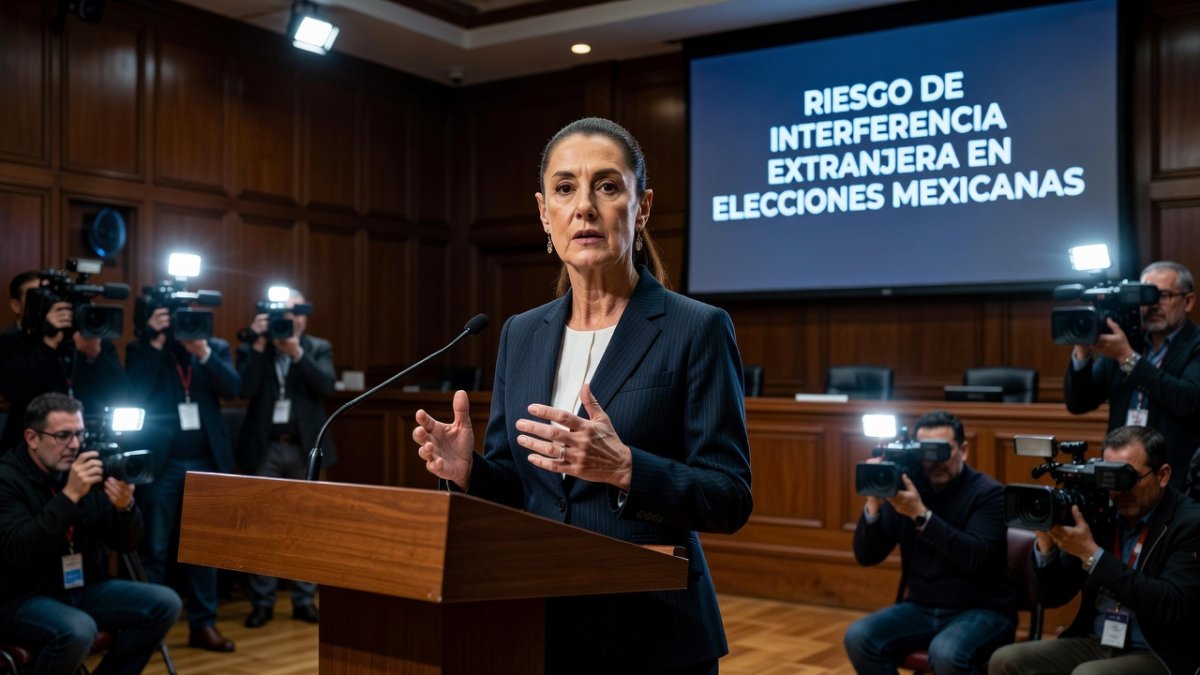
Sheinbaum Warns of Foreign Interference Risks Ahead of Midterms as She Highlights Economic Resilience in Thursday Mañanera
President Claudia Sheinbaum used her Thursday morning press conference, known affectionately here as the mañanera, to deliver a pointed warning about potential foreign meddling in Mexico’s upcoming midterm elections while simultaneously pushing back against economic pessimism with a detailed list of 12 positive indicators. Speaking from the National Palace in Mexico City, Sheinbaum addressed reporters with her characteristic directness, emphasizing that Mexico’s democracy must remain sovereign amid growing international scrutiny.
Foreign Interference Concerns Take Center Stage
Sheinbaum explicitly flagged risks of external influence, noting that certain foreign actors could attempt to sway voter sentiment through social media campaigns or funding of opposition groups. “We have seen how misinformation spreads across borders,” she stated, drawing parallels to past elections where external narratives sought to undermine national institutions. This comment comes as Mexico prepares for June midterms that will determine control of Congress and several state governorships, races viewed as critical tests for her Morena party’s legislative agenda.
Community leaders across Mexico City have echoed these concerns in recent days. In neighborhoods like Iztapalapa and Coyoacán, residents worry that outside funding could distort local priorities on issues such as water access and public safety. Sheinbaum stressed that electoral authorities, including the National Electoral Institute, are monitoring digital platforms closely to detect coordinated foreign activity.
Context from Recent Electoral History
Mexico’s 2024 presidential contest already drew international attention, and analysts note that foreign interference attempts have evolved from traditional diplomatic channels to sophisticated online operations. Sheinbaum referenced reports from the Organization of American States about disinformation patterns observed in other Latin American nations. By raising the issue now, her administration aims to build public awareness before campaign season intensifies.
Political scientist Dr. Elena Vargas from UNAM told Global1 News that such warnings serve a dual purpose: they alert citizens while also signaling to international partners that Mexico will defend its sovereignty. “The president is framing interference as a threat to everyday families, not just abstract institutions,” Vargas explained.
Economic Bright Spots Counteract Pessimism
Shifting focus, Sheinbaum listed twelve concrete economic indicators to counter recent negative headlines following a 0.6 percent contraction in first-quarter GDP and Moody’s decision to downgrade Mexico’s credit rating. She emphasized that headline figures mask underlying strengths visible in employment, investment, and trade data.
Among the highlights: formal job creation reached 850,000 new positions through April, with manufacturing and nearshoring projects leading gains. Remittances from Mexican workers abroad hit a record $65 billion last year, providing direct support to millions of households in states like Michoacán and Guerrero. Foreign direct investment in the automotive and electronics sectors surpassed $35 billion, driven by companies relocating supply chains from Asia.
Sheinbaum also cited a 4.2 percent year-over-year rise in manufacturing exports, a tourism recovery that brought 42 million visitors in 2024, and inflation holding steady at 3.8 percent—below the regional average. Public investment in infrastructure, including the Interoceanic Corridor and expanded rail lines, is projected to add 1.1 percentage points to GDP growth this year.
Expert Analysis and Market Implications
Economist Carlos Mendoza of the Mexican Institute for Competitiveness noted that while the Q1 dip reflects global slowdowns in U.S. demand, nearshoring momentum remains intact. “The 12 indicators Sheinbaum presented show resilience in labor markets and supply chains that credit agencies sometimes undervalue,” he said. Investors tracking peso stability have responded positively, with the currency holding above 18.5 per dollar despite the downgrade.
These figures matter directly to families. Lower unemployment in border states has increased household spending on education and healthcare, while sustained remittances help rural communities weather agricultural challenges. Sheinbaum argued that protecting these gains requires shielding elections from external disruption that could stall policy continuity.
Broader Implications for Mexican Democracy and Economy
The combination of interference warnings and economic data paints a picture of an administration prioritizing stability. Opposition parties have accused Sheinbaum of using foreign-threat rhetoric to deflect from domestic challenges, yet polling from Consulta Mitofsky shows 61 percent of respondents believe external actors do attempt to influence Mexican politics.
Looking ahead, the midterms could shape everything from judicial reform timelines to energy policy. If foreign interference materializes through amplified social media narratives, it risks deepening polarization in communities already focused on practical concerns like inflation and job security. Sheinbaum closed the mañanera by inviting citizens to report suspicious online activity to electoral watchdogs, reinforcing a community-first approach to safeguarding the vote.
This is Rosa Martinez for Global1 News, reporting from Mexico City. 🇲🇽
This is Rosa Martinez for Global1 News, reporting from Mexico City. 🇲🇽
This article was produced with AI-assisted research and editorial support. Reporting is based on sources cited in the article.
What's Your Reaction?
 Like
0
Like
0
 Dislike
0
Dislike
0
 Love
0
Love
0
 Funny
0
Funny
0
 Wow
0
Wow
0
 Sad
0
Sad
0
 Angry
0
Angry
0
Latin America/Andes Correspondent at Global1.News. Based in Bogota, covering politics, environment, energy, and social movements across the Andean region. Passionate about environmental journalism and communities protecting their land.












Comments (0)