
Teotihuacán gets its biggest makeover in 30 years ahead of the World Cup
Teotihuacán Gets Its Biggest Makeover in 30 Years Ahead of the World Cup
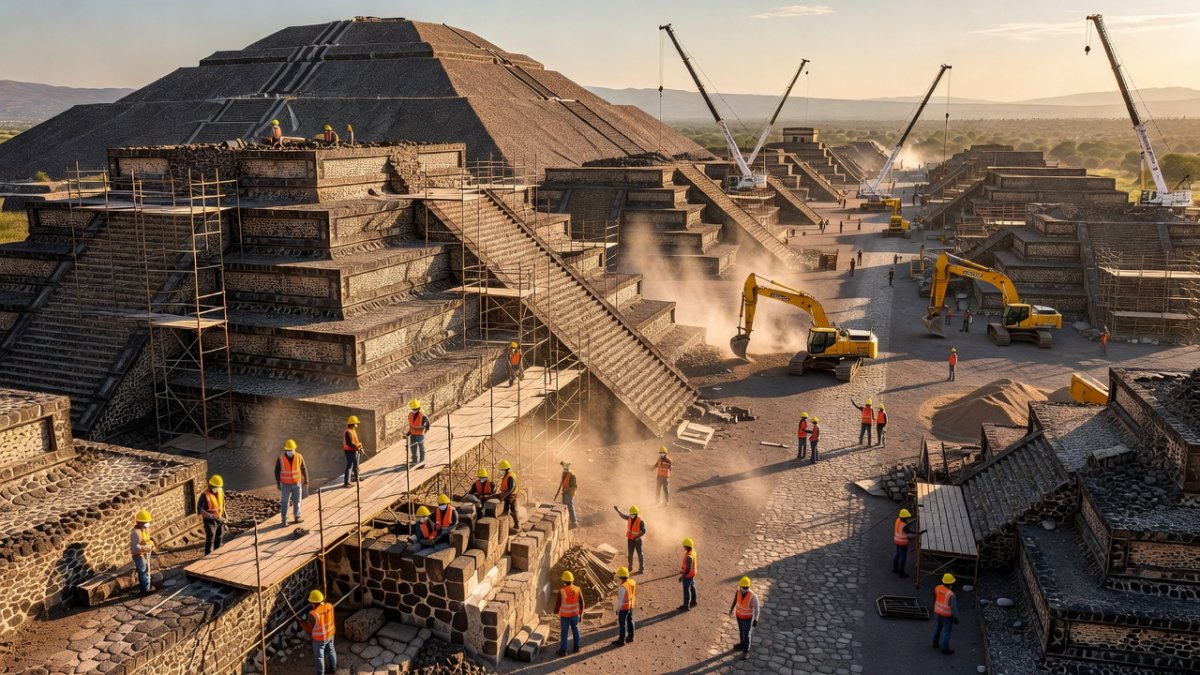
As Mexico prepares to co-host the 2026 FIFA World Cup alongside the United States and Canada, one of the country’s most iconic landmarks is receiving long-overdue attention. The ancient city of Teotihuacán, located just 45 kilometers northeast of Mexico City, has launched its most ambitious restoration project in three decades. The work aims to welcome millions of international visitors while honoring the sacred site’s deep cultural roots.
Renovation Details and Timeline
Work began in March 2025 under the coordination of Mexico’s National Institute of Anthropology and History (INAH) and the Secretariat of Tourism. Crews are restoring the Pyramid of the Sun’s facade, reinforcing the Avenue of the Dead with new drainage systems, and upgrading the visitor center with bilingual exhibits and accessible pathways. Solar-powered lighting will illuminate key structures at night for the first time, creating safe evening tours ahead of the tournament.
Officials estimate the total investment at 480 million pesos (approximately $24 million USD). This figure covers structural stabilization, new signage in Spanish, English, French, and Portuguese, and the planting of native vegetation to combat erosion. Project director Dr. Elena Vargas confirmed that 85 percent of the work will conclude by December 2025, with final touches scheduled before the World Cup opening matches in June 2026.
Security Boost After April Tragedy
The renovations coincide with heightened security measures following a deadly shooting on April 12, 2025. Two visitors and one site guard were killed during an attempted robbery near the Pyramid of the Moon. The incident shocked the tourism sector and prompted immediate federal intervention. Since May, the Mexican Army has deployed 120 additional personnel, and surveillance cameras now cover every major access point. Visitor numbers dropped 22 percent in the weeks after the shooting, according to INAH data, but have since rebounded with the visible security presence.
Local mayor Carlos Hernández noted, “Our community depends on Teotihuacán. These measures are not just about safety—they are about restoring trust so families from around the world feel welcome.”
Historical Context and Cultural Weight
Teotihuacán flourished between 100 BCE and 550 CE, once home to an estimated 125,000 residents. Its monumental pyramids and intricate murals represent one of Mesoamerica’s greatest urban achievements. Designated a UNESCO World Heritage Site in 1987, the complex attracts roughly 2.8 million visitors annually in non-pandemic years. The current project marks the first comprehensive intervention since the 1990s, when basic walkways and a small museum were added.
Archaeologist Dr. Miguel Ángel Torres emphasized the delicate balance: “We are not modernizing for modernity’s sake. Every intervention respects the original construction techniques while ensuring the site survives another millennium.”
Economic and Community Impact
Teotihuacán’s surrounding communities—San Juan Teotihuacán, San Martín de las Pirámides, and Santa María Coatlán—rely heavily on tourism revenue. Street vendors, hotel operators, and artisans anticipate a 40 percent increase in income during the World Cup period. Training programs funded by the federal government have already certified 1,200 local guides in sustainable tourism practices and emergency response.
However, some residents express concern over rising living costs. “Rents near the site have climbed 15 percent since the project was announced,” said vendor Rosa López. “We want the world to come, but we need protections so our families are not priced out.”
Expert Perspectives on Preservation Versus Access
UNESCO representatives visited the site in July 2025 and praised the emphasis on conservation. Yet they flagged potential risks from increased foot traffic. Recommendations include timed entry slots during peak World Cup months and stricter limits on group sizes at the pyramids’ summits. Mexican authorities have pledged to cap daily visitors at 4,500 during the tournament, down from the current average of 6,000 on weekends.
Environmental analysts also highlight climate considerations. Prolonged droughts have accelerated stone deterioration; the new drainage and vegetation efforts aim to mitigate this. “Teotihuacán teaches us about resilience,” reflected climate scientist Dr. Patricia Ruiz. “Our job is to ensure it continues teaching future generations.”
Implications for the 2026 World Cup
With matches scheduled in Mexico City, Guadalajara, and Monterrey, Teotihuacán is positioned as a premier day-trip destination for fans. Tourism projections suggest an additional 1.2 million international visitors to the site between June and July 2026. Enhanced transport links, including a new shuttle service from Mexico City’s airport, are already in testing phases.
The makeover also serves as a broader statement about Mexico’s capacity to host a global event while protecting its heritage. Government officials view the project as a model for other archaeological zones preparing for increased attention.
Challenges and Ongoing Monitoring
Despite progress, logistical hurdles remain. Supply chain delays for specialized limestone have pushed some facade work two weeks behind schedule. Community consultations continue weekly to address concerns about noise and restricted access during construction hours. INAH has established a 24-hour hotline for residents and visitors to report issues directly.
Long-term success will depend on sustained funding beyond 2026. Maintenance budgets historically have been inconsistent, leading experts to advocate for a dedicated endowment funded partly by ticket surcharges during major events.
From the bustling markets at the site’s entrance to the quiet plazas atop the pyramids, Teotihuacán pulses with both ancient mystery and contemporary hope. As the countdown to the World Cup continues, this renovation represents more than cosmetic upgrades—it is an investment in Mexico’s living history and its welcoming spirit to the world.
This is Rosa Martinez for Global1 News, reporting from Mexico City. 🇲🇽
This article was produced with AI-assisted research and editorial support. Reporting is based on sources cited in the article.
What's Your Reaction?
 Like
0
Like
0
 Dislike
0
Dislike
0
 Love
0
Love
0
 Funny
0
Funny
0
 Wow
0
Wow
0
 Sad
0
Sad
0
 Angry
0
Angry
0

Latin America/Andes Correspondent at Global1.News. Based in Bogota, covering politics, environment, energy, and social movements across the Andean region. Passionate about environmental journalism and communities protecting their land.













Comments (0)