
Magnitude 7.8 Quake Strikes Off Sarangani, Sparking Renewed Calls for Community Resilience
Magnitude 7.8 Quake Strikes Off Sarangani, Sparking Renewed Calls for Community Resilience The Powerful Tremor and Its Immediate Reach The magnitude 7.8 earthquake that struck off Maasim, Sarangani on Monday, June 8, 2026, sent strong shaking across parts of Mindanao and reminded families in coastal barangays of the constant need to stay prepared. Science Secretary Renato Solid
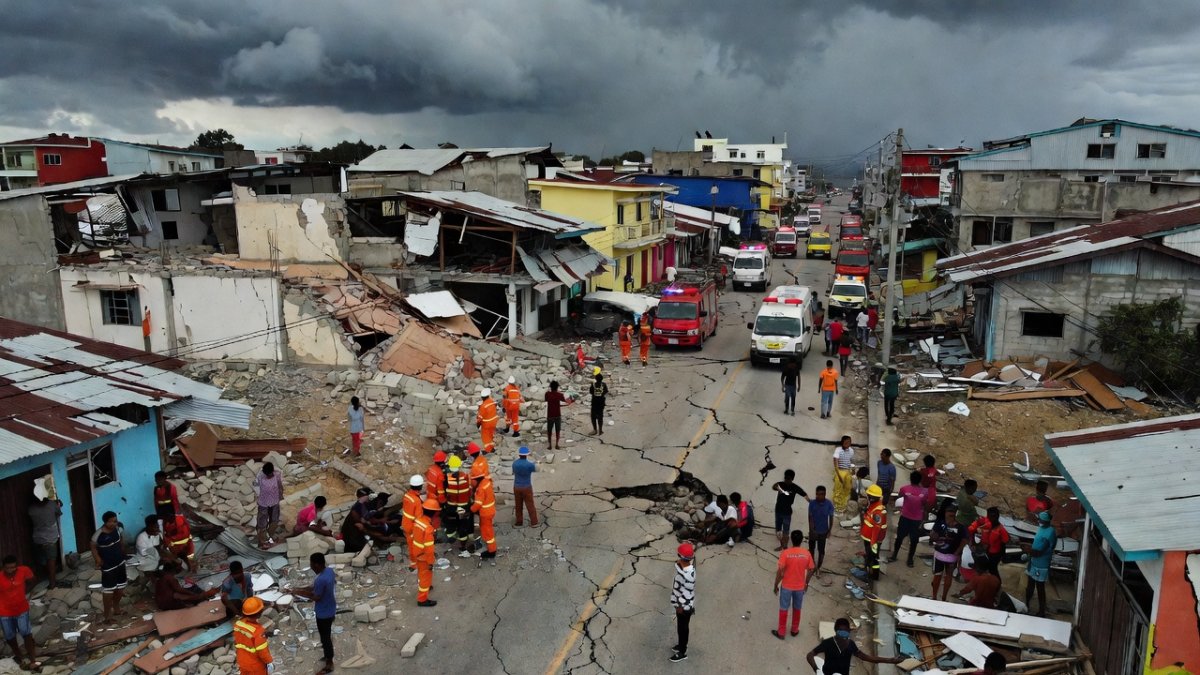
Magnitude 7.8 Quake Strikes Off Sarangani, Sparking Renewed Calls for Community Resilience
The Powerful Tremor and Its Immediate Reach
The magnitude 7.8 earthquake that struck off Maasim, Sarangani on Monday, June 8, 2026, sent strong shaking across parts of Mindanao and reminded families in coastal barangays of the constant need to stay prepared.
Science Secretary Renato Solidum Jr. explained that the event was likely caused by subduction activity along the Cotabato Trench. This undersea feature lies off the southwestern coast of Mindanao and forms part of a larger system where tectonic plates meet.
Residents in Malapatan, Sarangani, reported the strongest shaking at Intensity VIII. Intensity VII was felt in General Santos City, Koronadal City, and Santa Maria, Davao Occidental. Many families stepped outside their homes as the ground moved, while others checked on neighbors in the spirit of bayanihan that defines so many Philippine communities.
Tracing the Role of the Cotabato Trench
The Cotabato Trench has been linked to several major earthquakes that affected Mindanao over the past century. These include the magnitude 8.3 event in 1918, the magnitude 7.9 quake and tsunami in 1976, and the magnitude 7.5 earthquake in 2002.
Solidum noted that Monday’s quake fits the pattern of previous seismic activity in the area. He pointed to two recent strong events offshore of Sarangani that were also tied to subduction along the same trench: a magnitude 7.2 quake on April 29, 2017, and a magnitude 6.8 event on November 17, 2023.
All three recent quakes were shallow. Depths reached 53 kilometers in 2017, 63 kilometers in 2023, and 33 kilometers on Monday. Solidum stressed that shallower quakes can produce higher intensities when they occur closer to populated areas, though the final intensity also depends on distance from the epicenter.
Human Stories Behind the Numbers
Behind every intensity reading are ordinary Filipinos whose daily routines were interrupted. In Sarangani barangays, tricycle drivers paused their routes to check on passengers, while sari-sari store owners secured their goods before helping kapitbahay families move to safer ground.
The April 2017 quake injured five people and damaged homes and schools. The November 2023 event left 11 people dead, 37 injured, and more than 6,000 homes damaged. These figures show how repeated seismic activity affects the same coastal communities over time.
Students in affected areas wondered when classes would resume, while farmers worried about cracks in irrigation systems that could affect the next harvest. Such concerns ripple through local economies that rely on steady movement of goods along national roads and through ports.
Government Response and On-the-Ground Coordination
Public Works Secretary Vince Dizon arrived in General Santos City the day after the quake with officials from the Office of Civil Defense, Department of Education, Department of Social Welfare and Development, and Department of Health. Their task was to inspect damaged infrastructure and coordinate the response.
Dizon stated that the immediate priority was to assess the extent of the damage and keep national roads open for relief operations. “We need to conduct an assessment first, and then let’s make sure all national roads are passable for relief operations,” he said.
The Philippine Ports Authority reported only minor structural damage at the Port of General Santos. This limited impact helped keep supply lines moving for LGUs coordinating with barangay captains on the distribution of food and water.
Insurance Outlook and Long-Term Recovery Needs
The Philippine Insurers and Reinsurers Association Inc. indicated that it is too early to determine insured losses. Claims are only beginning to be reported, and a complete assessment could take several weeks.
For many families without insurance, recovery depends on government assistance and community support. Local government units in Sarangani and nearby provinces are already working with national agencies to identify priority areas for rebuilding homes and schools.
Department of Education personnel are checking school buildings so that students can return to classes safely. Department of Health teams are monitoring health facilities to ensure continued services for residents who may need medical attention after the shaking.
Building a More Prepared Future for Mindanao Communities
Solidum clarified that the Sarangani earthquake was unrelated to the twin earthquakes that struck Davao Oriental in October 2025. This distinction helps scientists and planners focus resources on the specific risks posed by the Cotabato Trench.
Communities across Mindanao have long drawn on cultural traditions of mutual aid during difficult times. Barangay-level drills and early-warning systems remain essential tools for reducing harm when the next tremor arrives.
As assessments continue, the focus stays on practical steps that protect families, workers, and students. Continued coordination between national agencies and local leaders will help ensure that roads stay open, schools reopen quickly, and support reaches those who need it most.
By Bella Reyes, Staff WriterThis article was produced with AI-assisted research and editorial support. Reporting is based on sources cited in the article.
What's Your Reaction?
 Like
0
Like
0
 Dislike
0
Dislike
0
 Love
0
Love
0
 Funny
0
Funny
0
 Wow
0
Wow
0
 Sad
0
Sad
0
 Angry
0
Angry
0

Philippines/Southeast Asia Correspondent at Global1.News. Manila-based journalist covering Philippine politics, environment, maritime security, and social issues. Passionate about marine conservation and the communities protecting the Philippines' natural heritage.














Comments (0)