
Koizumi's Seoul Trip Signals Cautious Japan-South Korea Ties
Koizumi's First Trip to Seoul: A Sign of Cautious Japan-South Korea Reconciliation The June 2026 Visit and Its Immediate Symbolism Japanese Defense Minister Koizumi Shinjiro conducted a two-day visit to Seoul on June 27-28, holding direct talks with South Korean counterpart Ahn Gyu-back. This marked Koizumi's first official trip to South Korea in his current capacity and recipr
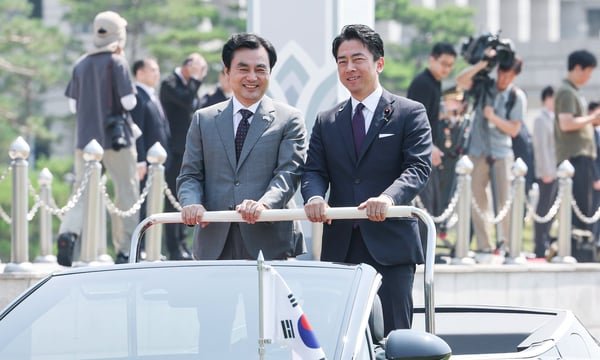
The June 2026 Visit and Its Immediate Symbolism
Japanese Defense Minister Koizumi Shinjiro conducted a two-day visit to Seoul on June 27-28, holding direct talks with South Korean counterpart Ahn Gyu-back. This marked Koizumi's first official trip to South Korea in his current capacity and reciprocated Ahn's earlier visit to Tokyo in January. The two ministers have now met face-to-face four times since last November, out of six encounters overall. Their joint appearance at the Wonju Air Base to observe the Black Eagles aerobatic team represented an unprecedented step, as no prior foreign defense minister had received such access.
(The Diplomat)
These gestures carry weight in the Korean context, where public memory of Japanese colonial rule from 1910 to 1945 continues to shape attitudes toward security cooperation. The visit occurred against the backdrop of inter-Korean tensions and Seoul's efforts to maintain balanced diplomacy with Washington, Tokyo, Beijing, and Moscow under the Lee Jae-myung administration.
Historical Precedents and the End of Diplomatic Hiatus
The last comparable visit took place in September 2025, when then-Japanese Defense Minister Nakatani Gen traveled to Seoul to meet Han Min-koo. That trip symbolized the conclusion of a decade-long diplomatic freeze. Koizumi's recent engagement repeats, after 23 years, the pattern of Japanese and South Korean defense ministers exchanging visits within a single calendar year. Such repetition underscores a deliberate normalization process rather than an abrupt breakthrough.
From a Korean institutional perspective, these exchanges intersect with longstanding concerns over sovereignty, particularly regarding the Dokdo/Takeshima islets. The 2018 incident involving a South Korean naval vessel and a Japanese Maritime Self-Defense Force patrol plane had previously stalled defense dialogue, making the current resumption noteworthy for its measured pace.
Upgraded Institutional Mechanisms in Bilateral Defense
Beyond symbolism, the talks reflect incremental upgrades in formal channels. On May 7, Japan and South Korea convened their first "2+2" vice-ministerial meeting between foreign and defense ministries in Seoul. This format elevates earlier director-general level consultations that began in 1998. The structure allows coordinated discussion of logistics, intelligence sharing, and regional contingencies without immediately triggering domestic political backlash in either capital.
Just weeks earlier, Tokyo and Seoul resumed joint maritime search-and-rescue exercises after a nine-year suspension. These steps indicate that defense authorities on both sides are rebuilding operational habits disrupted since 2018, while remaining attentive to South Korean public sensitivities rooted in historical grievances.
Aerobatic Cooperation and Lingering Territorial Sensitivities
The joint statement issued after the June talks committed both sides to further develop cooperation between Japan's Blue Impulse and South Korea's Black Eagles teams. This commitment stands in contrast to Japan's earlier refusal in November 2025 to provide refueling support for the Black Eagles, a decision tied directly to the Dokdo/Takeshima dispute. The shift suggests that defense ministries are testing limited areas of functional collaboration where political costs remain manageable.
For South Korea, such cooperation must be calibrated against domestic opinion. Historical resentments from the colonial period have not dissipated, and any perceived concession on territorial symbolism risks mobilizing public opposition. The Wonju Air Base visit therefore functions as a low-stakes confidence-building measure rather than a comprehensive thaw.
The Omission of ACSA and Political Constraints in Seoul
Most notably, the joint statement contained no reference to an Acquisition and Cross-Servicing Agreement. Japan had pursued such a logistics pact with the Lee Myung-bak administration as early as 2012, yet the proposal encountered strong domestic resistance in South Korea. Public concerns center on the possibility that ACSA could facilitate Japanese forces operating on South Korean territory, raising questions about sovereignty and historical precedent.
Although ACSA discussions have resurfaced amid regional uncertainties, Seoul proceeds with caution. The Lee Jae-myung administration must weigh potential gains in interoperability against the risk of being drawn into broader U.S.-led activities beyond the Korean Peninsula. Beijing and Pyongyang could interpret expanded trilateral coordination as a deliberate alignment, complicating Seoul's attempts to secure support for renewed engagement with Pyongyang.
Regional Security Messaging and Inter-Korean Implications
The ministers reaffirmed their shared objective of complete denuclearization of the Korean Peninsula and permanent peace in the region. Their statement came one day after a joint China-Russia air drill near the peninsula, highlighting the external pressures shaping bilateral defense talks. With the United States continuing to press allies for greater burden-sharing, Tokyo and Seoul appear to be signaling proactive coordination on shared challenges, including North Korea's nuclear program and Russia-North Korea military ties.
Yet Seoul's approach remains constrained by the need to preserve diplomatic space with China and Russia. Any perception that ACSA or similar arrangements lock South Korea into exclusive trilateral frameworks could undermine efforts to improve inter-Korean relations. The current trajectory therefore reflects incremental defense normalization tempered by political realism in Seoul, where historical memory and strategic balancing continue to limit the scope of cooperation.
By Prof. David Park, Staff WriterThis article was produced with AI-assisted research and editorial support. Reporting is based on sources cited in the article.
What's Your Reaction?
 Like
0
Like
0
 Dislike
0
Dislike
0
 Love
0
Love
0
 Funny
0
Funny
0
 Wow
0
Wow
0
 Sad
0
Sad
0
 Angry
0
Angry
0

East Asia/Technology Correspondent at Global1.News. Seoul-based voice covering Korean politics, technology, business, and culture. Analyzes how technology and geopolitics intersect across East Asia.












Comments (0)