
JAXA Hayabusa2 Torifune Flyby Advances Planetary Defense
**Keywords:** JAXA, Hayabusa2, Torifune, asteroid flyby, planetary defense, 1998 KY26, DART, Usuda Deep Space Center, space security, S-type asteroid, Ryugu samples, UN framework, H-IIA, Misasa Deep Space Station JAXA Confirms Precision Flyby of Torifune JAXA announced on July 5 2026 that the Hayabusa2 spacecraft had completed an ultra-close flyby of asteroid Torifune at approx
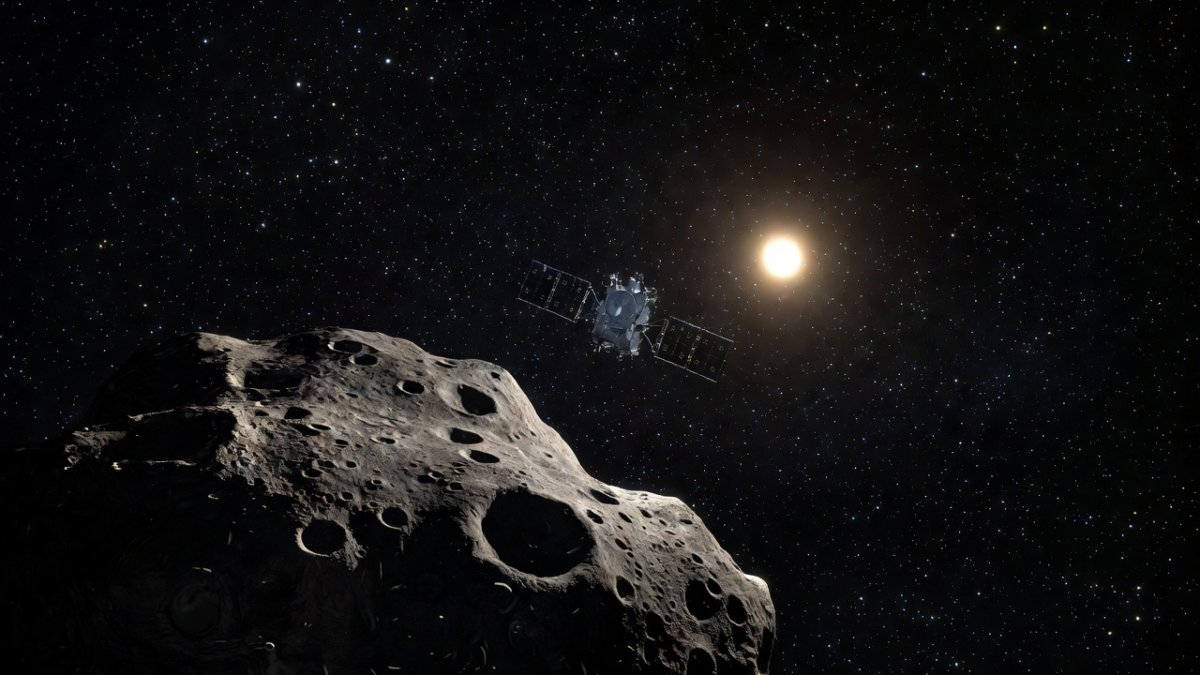
JAXA Confirms Precision Flyby of Torifune
JAXA announced on July 5 2026 that the Hayabusa2 spacecraft had completed an ultra-close flyby of asteroid Torifune at approximately 800 meters from the surface. The probe approached at a relative velocity of approximately 5 km/s, equivalent to about 18,000 km/h. Torifune, an S-type asteroid formerly designated 2001 CC21, measures roughly 450 meters in diameter and rotates with a period of about five hours.
This maneuver marked the first high-speed close approach executed by Hayabusa2 since its sample return from Ryugu in December 2020. The spacecraft, now operating under the extended Hayabusa2# or Hayabusa2-SHARP mission for Small Hazardous Asteroid Reconnaissance Probe activities, demonstrated controlled navigation at speeds far exceeding its original rendezvous design parameters.
Ground stations at Usuda Deep Space Center and Misasa Deep Space Station tracked the event, supplemented by NASA’s Deep Space Network. Data received confirmed that the spacecraft maintained the planned trajectory without deviation that would have compromised the close-approach window.
The announcement underscores Japan’s incremental progress in refining deep-space operations. Analysts note that successful execution at this distance and velocity provides measurable validation for future missions requiring similar precision.
Navigation Demands of a Non-Rendezvous Profile
Hayabusa2 was engineered primarily for rendezvous operations rather than high-speed flybys, making the Torifune encounter technically demanding. Mission planners evaluated three distinct trajectories before selecting the optimal close-approach path designated Trajectory iii. The chosen route balanced scientific return against collision risk while respecting the spacecraft’s limited attitude-control authority.
Because the onboard optical and infrared cameras remain fixed and cannot gimbal, the spacecraft had to execute attitude adjustments through its reaction wheels and thrusters. Large reorientations could not be completed in the brief time available near closest approach, restricting observations to the period immediately preceding the flyby.
Telemetry from Usuda Deep Space Center indicated that attitude commands were uploaded well in advance, allowing the probe to settle into the required orientation. Any residual angular momentum was managed to prevent image smear during the high-velocity pass.
These constraints illustrate the engineering trade-offs inherent in repurposing an existing rendezvous spacecraft. The Torifune data set will inform trajectory-design tools used by JAXA’s Institute of Space and Astronautical Sciences for subsequent small-body encounters.
Instrument Performance During the High-Speed Pass
Optical and infrared cameras collected imagery and thermal data up to the final moments before closest approach. The instruments captured surface morphology and rotation characteristics of the 450-meter S-type body despite the 5 km/s relative motion.
Because observations ceased just prior to the 800-meter minimum distance, post-flyby processing will rely on precise timing and attitude reconstruction to map features. Early indications suggest the data quality meets expectations for an unplanned high-speed profile.
Engineers at Misasa Deep Space Station verified instrument temperatures and power margins remained within limits throughout the sequence. This confirmation supports continued use of the same sensor suite during the upcoming rendezvous with asteroid 1998 KY26.
The Torifune dataset adds to the archive begun with Ryugu samples returned in December 2020. Comparative analysis of S-type and C-type surfaces will refine models of asteroid composition relevant to resource utilization and hazard assessment.
Linkages to Global Planetary Defense Initiatives
The Torifune flyby directly supports international planetary defense efforts conducted under the United Nations framework. By demonstrating controlled high-speed navigation, JAXA contributes operational experience that complements NASA’s 2022 DART impact experiment on Dimorphos.
Understanding whether small asteroids are monolithic or rubble-pile structures remains essential for impact-avoidance planning. Hayabusa2’s close-range measurements of Torifune’s rotation and surface properties supply empirical constraints that numerical models currently lack.
Japanese officials have stated that the mission also serves as a technology pathfinder for intentional small-body deflection techniques. Precision demonstrated at Torifune could translate into the capability to target a future impactor with accuracy comparable to DART while employing indigenous guidance systems.
Coordination through UN channels ensures that data from the flyby will be shared with partner agencies, strengthening collective situational awareness of near-Earth objects. This cooperative posture aligns with Japan’s broader space-security objectives.
Preparation for the 2031 Encounter with 1998 KY26
Following the Torifune test, Hayabusa2 is scheduled to rendezvous with the approximately 30-meter asteroid 1998 KY26 in 2031. That encounter would constitute the first spacecraft visit to an object of such limited size, offering unprecedented insight into the physical properties of potential impactors.
The 2026 flyby validated navigation techniques required to approach a fast-rotating target without excessive propellant expenditure. Lessons from attitude-management constraints at Torifune are being incorporated into the 2031 trajectory design.
Ground testing at Usuda Deep Space Center now includes simulated high-speed passes to refine command sequences. These rehearsals aim to maximize observation time while preserving spacecraft safety margins for the longer-duration 1998 KY26 mission.
Success in 2031 would elevate Japan’s standing in the global effort to characterize small hazardous asteroids. The resulting data would directly inform deflection strategies discussed within UN planetary-defense working groups.
Strategic Implications for Japan’s Space Posture
The Torifune operation reinforces Japan’s role as a reliable contributor to international space security. By executing a challenging flyby with an existing asset, JAXA demonstrates cost-effective reuse of flight-proven hardware launched aboard H-IIA Launch Vehicle No. 26 in December 2014.
Continued cooperation with NASA’s Deep Space Network alongside domestic stations at Usuda and Misasa provides redundant tracking that enhances mission resilience. This infrastructure supports both scientific return and potential rapid-response scenarios.
Policy analysts in Tokyo view the mission as evidence that Japan can field independent capabilities within a multilateral framework. Such positioning strengthens diplomatic leverage when negotiating technology-sharing agreements related to asteroid defense.
Future investment decisions by METI and MOFA are expected to reference the Torifune results when prioritizing funding for next-generation navigation and deflection technologies. The cumulative record—from Ryugu sample return through the 2026 flyby—establishes a credible foundation for sustained Japanese leadership in planetary defense.
Tags: JAXA, Hayabusa2, Torifune, asteroid flyby, planetary defense, 1998 KY26, DART, Usuda Deep Space Center, space security
By Kenji Tanaka, Staff Writer
This article was produced with AI-assisted research and editorial support. Reporting is based on sources cited in the article.
What's Your Reaction?
 Like
0
Like
0
 Dislike
0
Dislike
0
 Love
0
Love
0
 Funny
0
Funny
0
 Wow
0
Wow
0
 Sad
0
Sad
0
 Angry
0
Angry
0

Japan Correspondent at Global1.News. Tokyo-based voice covering Japanese politics, technology, economy, and culture. Tracks the intersection of tradition and innovation in one of the world's most dynamic societies.














Comments (0)