
Israel hits Lebanese capital in 'targeted strike'
Israel hits Lebanese capital in 'targeted strike' The Strike That Broke the Fragile Calm Beirut's southern suburbs shook at 2:17 a.m. local time when Israeli jets dropped precision munitions on a four-story building in the Dahiyeh district. Israel called it a "targeted strike" against a Hezbollah command node. Lebanese officials counted at least 14 dead, including civilians, an
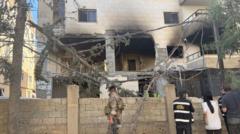
Israel hits Lebanese capital in 'targeted strike'
The Strike That Broke the Fragile Calm
Beirut's southern suburbs shook at 2:17 a.m. local time when Israeli jets dropped precision munitions on a four-story building in the Dahiyeh district. Israel called it a "targeted strike" against a Hezbollah command node. Lebanese officials counted at least 14 dead, including civilians, and more than 40 wounded. Until this hit, Beirut proper had stayed mostly off-limits even while the rest of the Lebanon-Israel frontier crackled with violations.
The attack lands one month after the U.S.-brokered ceasefire that was supposed to freeze the 2024 war. Both sides have traded accusations of breaches since day one, but this is the first time Israeli warplanes have struck inside the capital since the truce. The building housed offices linked to Hezbollah's financial unit, according to Israeli intelligence. Residents say it also contained apartments and a ground-floor pharmacy that was open late.
Ceasefire Already in Tatters
The November agreement required Hezbollah to pull heavy weapons north of the Litani River and Israel to end aerial operations over Lebanon. Neither side fully complied. Hezbollah kept small rocket teams near the border; Israel flew daily drones and conducted limited raids it labeled "thwarted attacks." Beirut stayed quiet because both capitals understood that hitting the city risked total collapse of the deal.
That calculation changed. Israeli Defense Minister Yoav Gallant said the target was "planning imminent attacks on northern Israeli communities." Hezbollah denied any such plot and called the strike "a declaration of war." Lebanese Prime Minister Najib Mikati condemned the raid as a "blatant violation" but stopped short of promising retaliation.
Why Now: Israel's Calculus
Israeli sources tell Global1 News the decision came after two weeks of mounting rocket fire from southern Lebanon that killed three civilians and injured nine. Domestic pressure on Prime Minister Netanyahu has been fierce. Far-right coalition partners threatened to bolt if the north remained under threat. The strike on Dahiyeh sends a message that Israel will not tolerate slow-motion ceasefire erosion.
Yet the choice to hit Beirut carries obvious risk. The city is crowded, international media is thick on the ground, and any civilian toll instantly becomes global news. Israel appears willing to absorb that cost to reset deterrence before Hezbollah can rebuild launch sites closer to the border.
Hezbollah's Limited Options
Hezbollah leader Hassan Nasrallah faces his own constraints. The group lost thousands of fighters and much of its senior command in the previous round. Its Iranian resupply lines are under tighter surveillance. A full-scale response could trigger another devastating Israeli ground incursion that Lebanon cannot afford.
Instead, Hezbollah fired a volley of rockets toward Israeli military positions near the border but avoided civilian areas. The message was calibrated: we will answer, but not enough to explode the truce completely. Still, the group vowed "further painful strikes" if Israel repeats attacks on the capital.
Washington's Balancing Act
The Biden administration issued a standard call for restraint while privately urging Israel to avoid further capital strikes. U.S. officials fear escalation just as they are trying to lock in a Gaza ceasefire. European diplomats echoed the line but added little leverage. Iran warned that continued Israeli raids "will not go unanswered," though Tehran has shown little appetite for direct confrontation.
France, which still holds influence in Lebanon, summoned the Israeli ambassador in Paris. Arab League foreign ministers scheduled an emergency virtual meeting. None of these moves change the military reality on the ground.
Lebanon's Fragile State
Lebanon entered the ceasefire already broken: currency in freefall, electricity sporadic, government barely functional. A new round of fighting would finish the job. The central bank warned that renewed conflict could wipe out remaining foreign reserves within weeks. Hospitals in Beirut are already reporting shortages of fuel and medicine after the single night of strikes.
Civilian sentiment in the capital is exhausted rather than militant. Many blame both Israel and Hezbollah for dragging the country back to the brink. Yet Hezbollah still commands loyalty in the Shia south and Dahiyeh because it remains the only force that can deliver social services and resist Israeli incursions.
What Comes Next
The strike exposes the ceasefire's fatal flaw: it contained no enforcement mechanism. Israel retains air superiority and the will to use it. Hezbollah retains thousands of rockets and the political need to show resistance. Without stronger international guarantees and actual disarmament steps, the pattern of accusation and retaliation will repeat.
Global1 News has confirmed Israeli aircraft remain on heightened alert over northern Israel. Hezbollah units in the Bekaa Valley have dispersed further. The next trigger could be a single rocket or another "targeted" Israeli bomb. Either way, Beirut's brief reprieve is over.
This is Jessica Ali for Global1 News. 🔥
This article was produced with AI-assisted research and editorial support. Reporting is based on sources cited in the article.
What's Your Reaction?
 Like
0
Like
0
 Dislike
0
Dislike
0
 Love
0
Love
0
 Funny
0
Funny
0
 Wow
0
Wow
0
 Sad
0
Sad
0
 Angry
0
Angry
0

Editor-in-Chief at Global1.News. Atlanta-based journalist who cuts through the BS and tells it like it is. Lead anchor, host, and the voice you hear when the spin stops and the truth starts.














Comments (0)