
Einstein’s Cosmological Constant Mystery May Be Solved
Einstein’s old regret meets new physics Albert Einstein once called the cosmological constant his biggest blunder. He added it to his equations to keep the universe static, then dropped it when observations showed expansion. Today that same term sits at the center of one of cosmology’s toughest puzzles: why the universe expands at the measured rate instead of racing apart far f
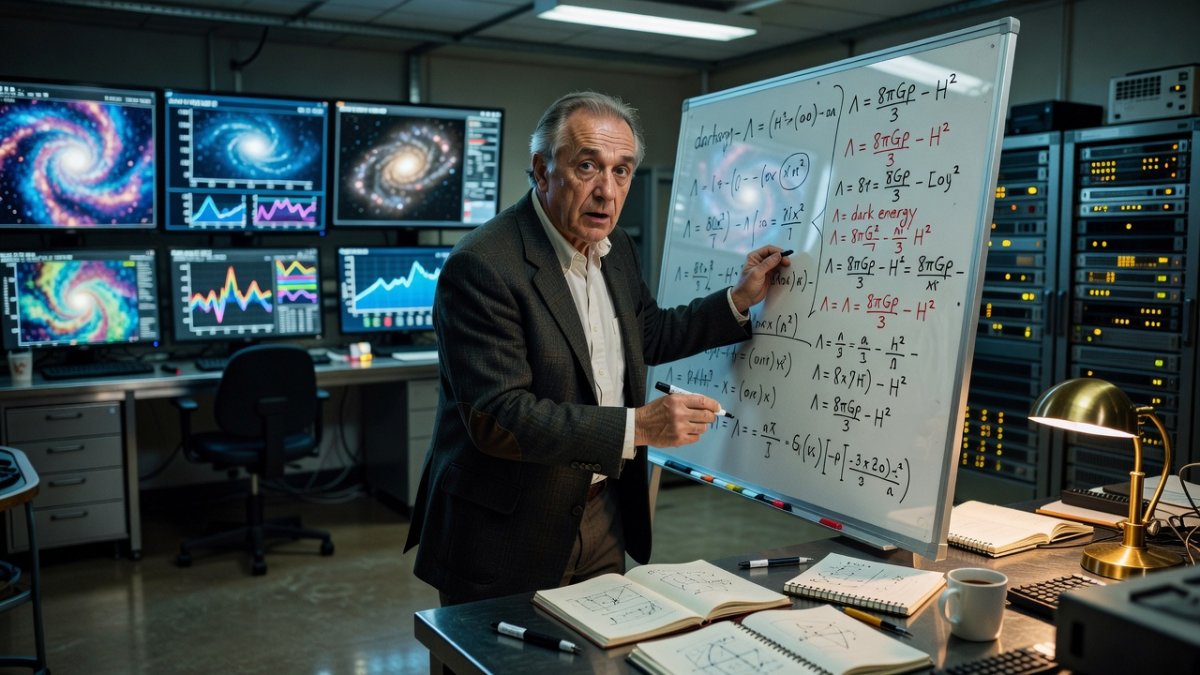
Einstein’s old regret meets new physics
Albert Einstein once called the cosmological constant his biggest blunder. He added it to his equations to keep the universe static, then dropped it when observations showed expansion. Today that same term sits at the center of one of cosmology’s toughest puzzles: why the universe expands at the measured rate instead of racing apart far faster. A recent study points to a link between quantum gravity and an unusual quantum state of matter that may finally explain the difference.
The expansion rate we actually observe
Measurements of distant supernovas and the cosmic microwave background show the universe accelerating, but only gently. Quantum field theory predicts vacuum energy should drive expansion many orders of magnitude stronger. The gap between prediction and observation has lasted decades. The new work suggests the very geometry of space-time limits how much that vacuum energy can push outward.
Quantum gravity enters the picture
Researchers examined how quantum gravity behaves near an exotic quantum state of matter. In this state, particles and fields interact in ways that normally would flood empty space with energy. Yet the curved shape of space-time appears to cancel or redirect much of that energy before it can affect large-scale expansion. The result is a natural suppression mechanism that keeps the effective cosmological constant small without fine-tuning by hand.
This protection arises because space-time curvature couples to the quantum fields in a way that redistributes their contributions. Instead of adding up constructively across all scales, many contributions interfere or shift into modes that do not source gravity at cosmic distances. The study shows this effect holds across a range of simple models, hinting it may be general.
Why the finding matters beyond theory
Understanding the cosmological constant is not only about distant galaxies. The same quantum rules that govern the vacuum also underpin technologies people use daily. Magnetic resonance imaging machines, for example, rely on precise control of quantum spins in magnetic fields. Semiconductor design depends on accurate modeling of electron behavior in materials. Advances in quantum gravity insights often feed back into better mathematical tools for these practical fields.
Health research already benefits from earlier physics breakthroughs. Positron emission tomography scanners trace their lineage to particle physics discoveries. If the new framework improves calculations of vacuum energy or quantum fields, it could eventually support more stable quantum sensors for medical imaging or environmental monitoring that tracks subtle changes linked to public health.
Space-time geometry as a safeguard
The study emphasizes that the shape of space-time itself acts like a filter. In flat space the problematic energy contributions would remain large. Once curvature is included, certain high-energy modes become less effective at gravitating. This geometric filtering offers a dynamical reason the constant stays small, rather than requiring it to be set to a tiny value from the start.
Simulations in the paper illustrate how the suppression strengthens as space-time curvature increases on small scales. The effect does not eliminate all quantum contributions, but it reduces the net impact on cosmic expansion to levels consistent with current observations. Future work will test whether the same mechanism survives in more complete theories that include all known particles and forces.
Looking ahead without overclaiming
No single study closes a question this large. The connection between quantum gravity and the exotic matter state still needs checks against additional cosmological data and laboratory analogs. Yet the approach shifts the problem from “why is the number so small” to “how does geometry enforce the smallness,” which many physicists find more promising.
For readers far from physics labs, the payoff lies in the steady improvement of tools and understanding that flow from fundamental research. Better models of space-time and quantum fields have repeatedly translated into new materials, imaging methods, and computing approaches. If this line of work holds up, it may quietly support the next generation of those practical advances while also answering one of Einstein’s lingering questions.
By Allan Ali, PublisherThis article was produced with AI-assisted research and editorial support. Reporting is based on sources cited in the article.
What's Your Reaction?
 Like
0
Like
0
 Dislike
0
Dislike
0
 Love
0
Love
0
 Funny
0
Funny
0
 Wow
0
Wow
0
 Sad
0
Sad
0
 Angry
0
Angry
0

Publisher of Global1.News. Automation architect, systems builder, and the guy making sure the truth gets published.















Comments (0)