
Constructive Strategic Stability: US-China Framework and South Korea's Navigation of Northeast Asian Rivalry
Constructive Strategic Stability: US-China Framework and South Korea's Navigation of Northeast Asian Rivalry The 2026 Summit and Emergence of a New Bilateral Framework The May 2026 summit between Presidents Donald Trump and Xi Jinping marked a deliberate effort to reposition the US-China relationship amid intensifying competition. Both leaders described the meeting in positive
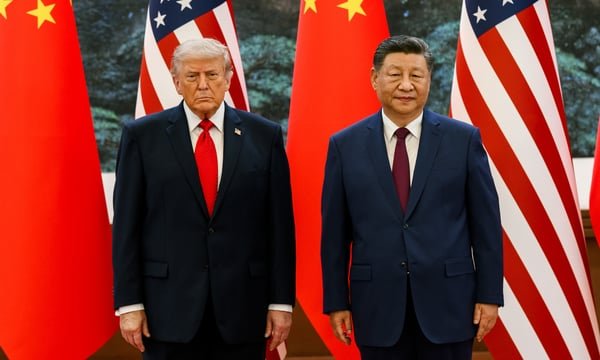
The 2026 Summit and Emergence of a New Bilateral Framework
The May 2026 summit between Presidents Donald Trump and Xi Jinping marked a deliberate effort to reposition the US-China relationship amid intensifying competition. Both leaders described the meeting in positive terms, with Trump characterizing it as very successful and Xi calling it historic and landmark. The outcome introduced the Constructive Strategic Stability framework, intended to manage economic tensions through measures that enhance stability and build confidence.
According to the Chinese Foreign Ministry, the concept centers on pursuing stability and peace with cooperation as the mainstay, while managing differences effectively and keeping competition within proper limits. Xi suggested that 2026 might open up a new chapter in China-US relations, signaling an intent to move beyond unmanaged rivalry toward structured coexistence.
Core Elements and Interpretations of Constructive Strategic Stability
US Secretary of Defense Pete Hegseth, speaking at the Shangri-La Dialogue, outlined the framework as resting on mutual respect, recognition of capabilities and power, and communication. These pillars aim to provide guardrails for strategic interaction without eliminating underlying competition. Analysts have generally viewed the approach as managed strategic competition kept within defined boundaries, though operational details remain unspecified.
The terminology deliberately echoes traditional notions of strategic stability from nuclear studies, which emphasize conditions that prevent both crisis escalation and arms-race dynamics. Yet the new framework's vagueness leaves open questions about practical implementation, particularly how Washington and Beijing will translate diplomatic language into concrete mechanisms for risk reduction and crisis management.
Nuclear Dimensions and the Question of Mutual Vulnerability
One potential entry point for operationalizing Constructive Strategic Stability lies in the nuclear domain through recognition of mutual vulnerability. This baseline would acknowledge that neither side can reliably escape catastrophic retaliation in a nuclear exchange, thereby establishing a foundation for subsequent dialogues on arms control and crisis management.
Such recognition would align with Hegseth's three factors by demonstrating respect for China's capabilities, acknowledging the survivability of its arsenal, and opening channels for communication. China's ongoing modernization, including its shell game strategy and road-mobile launchers, has strengthened the credibility of its second-strike capability. A growing body of expert analysis therefore suggests that the United States may need to reconsider damage-limitation strategies in light of these developments.
Analyst Tong Zhao has noted that China's nuclear expansion is partly driven by the belief that a stronger deterrent would compel the United States to treat Beijing as a peer equivalent. Recognition of mutual vulnerability could address this driver while fulfilling the framework's emphasis on equality and respect.
Strategic Implications for Northeast Asia
The introduction of Constructive Strategic Stability carries direct consequences for regional security architectures in Northeast Asia. Because the framework seeks to stabilize the US-China relationship without resolving underlying disputes, it creates an environment in which secondary powers must recalibrate their alignments. The emphasis on keeping competition within proper limits may reduce the risk of uncontrolled escalation, yet it also leaves room for continued pressure on alliance structures and economic dependencies.
Regional actors will need to assess whether the new bilateral understanding strengthens or weakens existing multilateral mechanisms. Historical patterns in Korean diplomacy show that periods of US-China stabilization have often required Seoul to balance alliance commitments with engagement policies toward Pyongyang, a dynamic that could reemerge under the current framework.
South Korea's Position Within the ROK-US Alliance
For South Korea, the framework introduces both opportunities and constraints in its management of the ROK-US alliance. The alliance has long served as the cornerstone of Seoul's defense posture, particularly regarding extended deterrence. Recognition of mutual vulnerability between Washington and Beijing could alter the credibility calculations that underpin US security guarantees, requiring South Korean planners to evaluate how nuclear stability dialogues might affect conventional commitments.
Seoul's strategic choices will likely reflect efforts to maintain alliance cohesion while avoiding entrapment in unmanaged US-China frictions. The framework's stress on communication channels may offer avenues for trilateral or quadrilateral consultations that include Korean perspectives, yet the absence of explicit operational guidelines leaves uncertainty about how alliance consultations will intersect with bilateral US-China mechanisms.
Navigating Growing Rivalry: Policy Options for Seoul
South Korea's navigation of the rivalry will hinge on its ability to leverage the Constructive Strategic Stability framework without compromising core security interests. Policymakers in Seoul have historically pursued a dual-track approach that combines robust alliance ties with selective economic engagement with China. The new framework may reinforce this pattern by providing rhetorical space for cooperation even as competition persists in other domains.
Inter-Korean relations add a further layer of complexity. Any US-China understanding that stabilizes the broader strategic environment could indirectly influence North Korea's calculations, particularly if Beijing perceives reduced pressure to moderate Pyongyang's behavior. Conversely, a framework that remains largely declaratory may leave room for continued North Korean nuclear advancement, forcing Seoul to accelerate its own deterrence enhancements within the alliance context.
Ultimately, the success of Constructive Strategic Stability will be measured not only by US-China interactions but also by its effects on middle-power agency in Northeast Asia. South Korea's capacity to shape outcomes will depend on sustained investment in alliance interoperability, diversified economic partnerships, and proactive diplomacy that anticipates how bilateral guardrails translate into regional realities.
By Prof. David Park, Staff WriterThis article was produced with AI-assisted research and editorial support. Reporting is based on sources cited in the article.
What's Your Reaction?
 Like
0
Like
0
 Dislike
0
Dislike
0
 Love
0
Love
0
 Funny
0
Funny
0
 Wow
0
Wow
0
 Sad
0
Sad
0
 Angry
0
Angry
0

East Asia/Technology Correspondent at Global1.News. Seoul-based voice covering Korean politics, technology, business, and culture. Analyzes how technology and geopolitics intersect across East Asia.















Comments (0)