
Trump Approves Landmark US-Saudi Nuclear Deal, Opening Door to Uranium Enrichment
President Donald Trump on July 22, 2026, approved a landmark nuclear cooperation agreement with Saudi Arabia that clears the way for U.S. companies to construct a civilian nuclear power program in the kingdom and leaves the door open to domestic uranium enrichment.
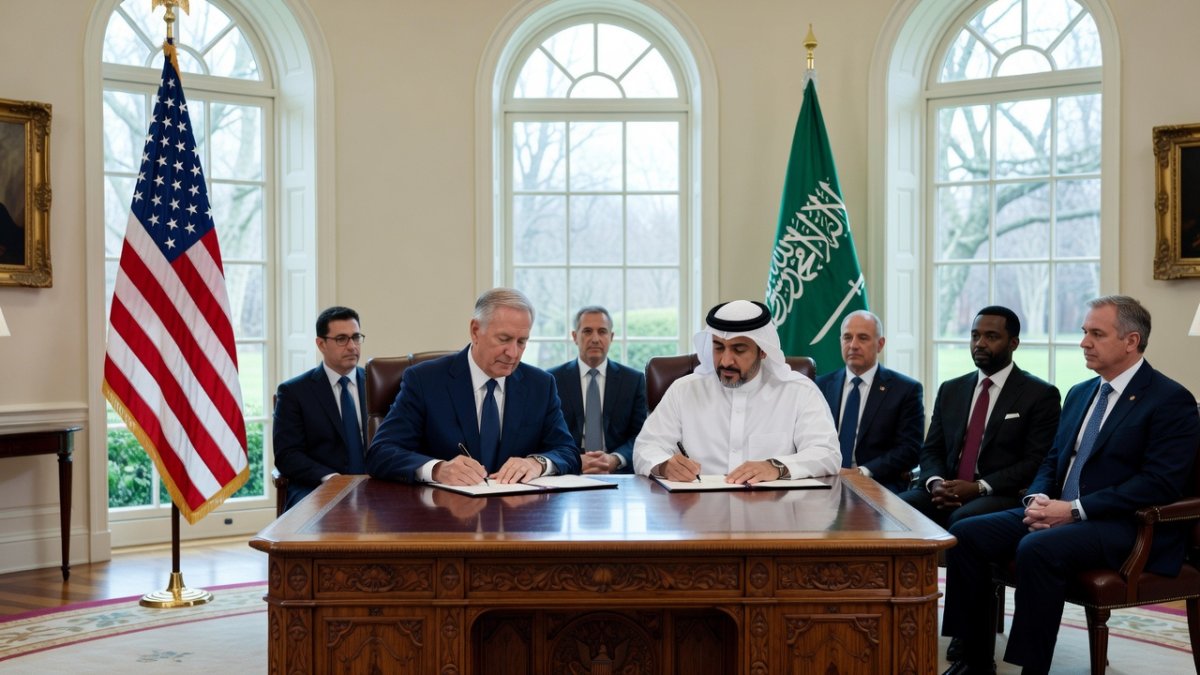
President Donald Trump on July 22, 2026, approved a landmark nuclear cooperation agreement with Saudi Arabia that clears the way for U.S. companies to construct a civilian nuclear power program in the kingdom and leaves the door open to domestic uranium enrichment. The 30-year pact, known as a 123 Agreement under Section 123 of the U.S. Atomic Energy Act of 1954, was signed by U.S. Energy Secretary Chris Wright and Saudi Energy Minister Prince Abdulaziz bin Salman Al Saud. It marks a sharp break from long-standing nonproliferation guardrails and arrives even as American and Israeli forces continue operations against Iranian nuclear sites.
The agreement does not ban uranium enrichment or the reprocessing of spent nuclear fuel. It also omits the International Atomic Energy Agency’s Additional Protocol, which would have granted inspectors broader access and stronger verification tools. A joint U.S.-Saudi study will now examine the feasibility of an enrichment facility on Saudi soil. For a region already on edge, the message is unmistakable: Washington is prepared to rewrite the rules for Riyadh while enforcing them at gunpoint elsewhere.
What a 123 Agreement Really Means for Riyadh
A 123 Agreement is the legal gateway that allows the United States to share civilian nuclear technology, reactors, and fuel-cycle know-how with another country. Without it, American firms cannot export the reactors, components, or technical services Saudi Arabia wants. This deal explicitly authorizes U.S. companies to help build the kingdom’s first nuclear power plants as part of Crown Prince Mohammed bin Salman’s Vision 2030 effort to diversify away from oil.
Unlike the 2009 agreement with the United Arab Emirates—the so-called “gold standard” that permanently forswore enrichment and reprocessing—the Saudi text contains no such prohibition. Saudi negotiators refused to accept those restrictions, and the Trump administration accepted their terms. The result is a framework that could eventually let Riyadh control the most sensitive parts of the fuel cycle.
Energy Secretary Chris Wright framed the signing as a commercial and strategic win. Saudi officials presented it as sovereign equality: if other nations enrich, why shouldn’t the kingdom? The practical effect is that Westinghouse, Bechtel, and other U.S. nuclear contractors now have a multi-decade pipeline of potential contracts that competitors in Russia, China, and South Korea had been aggressively pursuing.
Experts note that even under accelerated timelines it will take at least a decade before any Saudi reactor generates electricity. That long lead time does little to calm proliferation worries, because the knowledge, infrastructure, and trained workforce developed along the way can be redirected.
Why Domestic Enrichment Rights Set Off Alarms
Uranium enrichment is the dual-use technology at the heart of every nuclear crisis of the past twenty years. The same centrifuges that produce low-enriched fuel for power reactors can, with additional cascades and time, produce weapons-grade highly enriched uranium. By declining to forbid enrichment, the new 123 Agreement removes the clearest technical barrier between a civilian program and a latent weapons capability.
The absence of the IAEA Additional Protocol compounds the problem. Without it, inspectors lack the legal authority for short-notice access to undeclared sites and for environmental sampling that has repeatedly exposed covert work in other countries. Saudi Arabia remains under the basic comprehensive safeguards agreement, which nonproliferation specialists consider insufficient for a state that may one day enrich.
Secretary of State Marco Rubio stated flatly that the United States would not “reach any agreement with any country in the world that leads to the risk of proliferation.” Critics immediately noted the gap between that rhetoric and the text Wright signed. The administration’s answer is that a joint feasibility study and future bilateral consultations will provide sufficient oversight. Skeptics call that a political promise, not a legal constraint.
Once enrichment technology and expertise are transferred, reversing course becomes extraordinarily difficult. History shows that nations rarely surrender fuel-cycle capabilities they have already mastered.
The Glaring Irony of Bombing Iran While Enabling Saudi Ambitions
The timing is impossible to ignore. In February 2026 the United States and Israel launched military operations aimed at destroying key nodes of Iran’s nuclear program. Iranian leaders continue to insist their work is exclusively peaceful; Washington and Jerusalem concluded otherwise and used force. Now, five months later, the same U.S. government is authorizing a pathway that could give Saudi Arabia the very capabilities it went to war to deny Tehran.
NYT’s The Daily podcast captured the contradiction cleanly: America is simultaneously dismantling one Middle Eastern nuclear program and helping construct another. The Economist warned the deal “risks nuclear proliferation.” Politico reported it “risks igniting a Middle East arms race.” Those are not activist talking points; they are assessments from outlets that have covered the region for decades.
Saudi Crown Prince Mohammed bin Salman has been explicit about his red line. He has previously warned that if Iran obtains a nuclear weapon, Saudi Arabia will follow suit. That statement, delivered years ago and never retracted, now hangs over every clause of the new agreement. Riyadh is not required to normalize relations with Israel as a condition of the nuclear deal; Saudi leaders insisted that progress toward a Palestinian state must come first. The linkage that earlier U.S. administrations tried to enforce has been dropped.
The result is a policy that treats two rival Gulf powers by opposite standards. One is bombed. The other is courted with reactors and potential enrichment rights. Regional capitals are drawing the obvious conclusion.
Nonproliferation Voices and the Specter of a Regional Arms Race
Arms-control experts inside and outside government describe the agreement as a structural setback. Israel remains the only country in the region believed to possess nuclear weapons. A Saudi program that includes enrichment would put a second state on the threshold, and others would feel pressure to match it. Egypt, Turkey, and the United Arab Emirates all have the technical base and the strategic incentive to revisit their own options.
Saudi Arabia’s September 2025 mutual defense pact with Pakistan—the only Muslim-majority nuclear-weapon state—adds another layer. The pact does not automatically transfer warheads, but it creates a political and military channel that did not previously exist. Combined with an expanding civilian nuclear infrastructure, the arrangement looks to many analysts like deliberate hedging.
Israeli officials have expressed private and public alarm, warning that the deal could accelerate exactly the cascade they have spent decades trying to prevent. Their concern is not abstract. If Riyadh masters enrichment and later faces a crisis with Tehran or a collapse of the nonproliferation regime, the breakout timeline shrinks from years to months.
The administration counters that Saudi Arabia is a partner, not an adversary, and that U.S. involvement is the best way to shape the program’s trajectory. That argument only holds if future presidents maintain the same level of scrutiny and if Saudi priorities never shift. Neither condition is guaranteed over a 30-year agreement.
Congress Gets 90 Days and a High Bar to Stop It
Under the Atomic Energy Act the agreement now goes to Congress for a 90-day review period. Lawmakers can pass a resolution of disapproval, but blocking the deal outright requires a veto-proof majority. In the current political alignment that threshold is steep. Supporters will emphasize jobs for American nuclear workers and the strategic value of locking Saudi Arabia into U.S. technology rather than Chinese or Russian alternatives.
Opponents will focus on the missing enrichment ban and the absent Additional Protocol. They will quote Rubio’s own nonproliferation pledge back to him and highlight the February 2026 war against Iran as proof that Washington understands the danger of fuel-cycle capabilities in the wrong hands. Whether those arguments can assemble a supermajority is doubtful, but the debate will be fierce and public.
During the review window the joint U.S.-Saudi feasibility study on enrichment is expected to begin its work. That study will not be binding, yet its conclusions will shape the next round of negotiations and the political narrative in both capitals. If it deems an enrichment plant “feasible and desirable,” pressure will mount to move from study to construction.
For companies such as Westinghouse and Bechtel the congressional clock is also a commercial clock. They need clarity before committing hundreds of millions of dollars to site surveys, supply-chain agreements, and workforce planning. A clean path through Congress would unlock the largest potential nuclear export package the United States has seen in years.
Vision 2030, Energy Diversification, and the Long Build Timeline
Saudi Arabia’s interest in nuclear power is not new. Under Vision 2030 the kingdom aims to reduce domestic oil consumption, free more crude for export, and build a modern energy mix that includes renewables and nuclear. Officials have studied reactor vendors from multiple countries; the 123 Agreement tilts the field decisively toward American suppliers.
Even with political approval, physics and engineering impose their own schedule. Site selection, environmental reviews, construction, training, and fuel supply mean that no Saudi reactor is likely to reach commercial operation before the mid-2030s at the earliest. That decade-plus horizon is both a comfort and a danger: comfort because weapons-relevant capabilities will not appear overnight, danger because the institutional knowledge will accumulate steadily and become harder to reverse.
The lucrative nature of the contracts is not in dispute. Nuclear power plants are multi-billion-dollar projects. A fleet of reactors, plus potential fuel-cycle facilities, would represent one of the largest energy infrastructure transfers in the history of U.S.-Saudi relations. American labor unions and export-import financiers are already calculating the domestic job impact.
Yet the same dollar flows that excite industry raise the stakes for nonproliferation. Once billions are sunk into Saudi nuclear infrastructure, the political cost of later imposing stricter conditions rises dramatically. Path dependency is real.
Israel, Pakistan, and the New Regional Security Map
Israel’s discomfort is strategic, not merely rhetorical. For decades Israeli doctrine has treated a nuclear-armed Iran as an existential threat and has acted accordingly. A Saudi program that keeps the enrichment option alive creates a second potential threshold state on its periphery. Israeli planners must now game scenarios in which both Tehran and Riyadh possess latent or actual weapons capabilities.
The September 2025 defense pact between Saudi Arabia and Pakistan further complicates the picture. Pakistan has a mature nuclear arsenal and a history of sensitive technology transfers. Even if the pact never moves beyond conventional mutual defense, it signals that Riyadh is assembling multiple layers of strategic insurance. Nuclear cooperation with the United States becomes one pillar; the Pakistan relationship becomes another.
Other regional players are watching. If the Saudi precedent stands, pressure will grow on Washington to offer similar terms to additional partners, eroding the remaining force of the gold-standard approach. Alternatively, rivals may simply turn to suppliers who ask fewer questions. Either path leads to more nuclear infrastructure in the world’s most volatile region.
The administration’s bet is that deep U.S. involvement buys influence and transparency that would otherwise be absent. That bet may prove correct in the short term. Over a 30-year horizon, influence is only as strong as the next president’s willingness to use it.
What Readers and the Region Should Understand Next
This agreement is not a done deal in operational terms—reactors will not pour concrete tomorrow—but it is a decisive political and legal turning point. It tells every capital from Ankara to Abu Dhabi that the United States is prepared to accept enrichment potential in a major Arab state while using military force to deny it to Iran. That double standard will shape threat perceptions and proliferation decisions for years.
Congress now has its 90-day window. The joint enrichment study will produce findings that either reassure or inflame. Westinghouse, Bechtel, and their suppliers will lobby hard for smooth approval. Nonproliferation advocates will highlight Mohammed bin Salman’s earlier warning that Saudi Arabia will seek a bomb if Iran gets one. Israeli officials will continue to register alarm. Pakistani and Saudi militaries will keep building their new defense relationship.
For ordinary citizens the implications are straightforward. Nuclear technology once transferred is almost never fully recalled. Agreements that omit the toughest safeguards create latent capabilities that future leaders—American, Saudi, or otherwise—may use differently than today’s signatories intend. The Middle East already lives under the shadow of one opaque nuclear arsenal. This deal makes a second, and possibly a third, more plausible.
The Trump administration has chosen commercial opportunity and great-power competition with China and Russia over the stricter nonproliferation orthodoxy of previous decades. Whether that trade-off enhances American security or undermines it will be tested in the only arena that matters: the years ahead, when the reactors rise and the centrifuges—if they come—begin to spin.
By Jessica Ali, Staff Writer Trump approved a 30-year US-Saudi 123 nuclear deal on July 22, 2026, letting American firms build reactors and potentially enabling Saudi uranium enrichment without an IAEA Additional Protocol or enrichment ban, raising arms-race fears amid US-Iran strikes.This article was produced with AI-assisted research and editorial support. Reporting is based on sources cited in the article.
What's Your Reaction?
 Like
0
Like
0
 Dislike
0
Dislike
0
 Love
0
Love
0
 Funny
0
Funny
0
 Wow
0
Wow
0
 Sad
0
Sad
0
 Angry
0
Angry
0

Editor-in-Chief at Global1.News. Atlanta-based journalist who cuts through the BS and tells it like it is. Lead anchor, host, and the voice you hear when the spin stops and the truth starts.














Comments (0)