
Carney Says 'Strands' of a New World Order Could Be Woven at G7 Summit
Carney Says 'Strands' of a New World Order Could Be Woven at G7 Summit Prime Minister Mark Carney has signalled that next week's G7 summit in Évian-les-Bains, France, could serve as a pivotal moment for reshaping global governance, as Canada pushes for a broader coalition of nations to tackle challenges ranging from artificial intelligence regulation to geopolitical instability
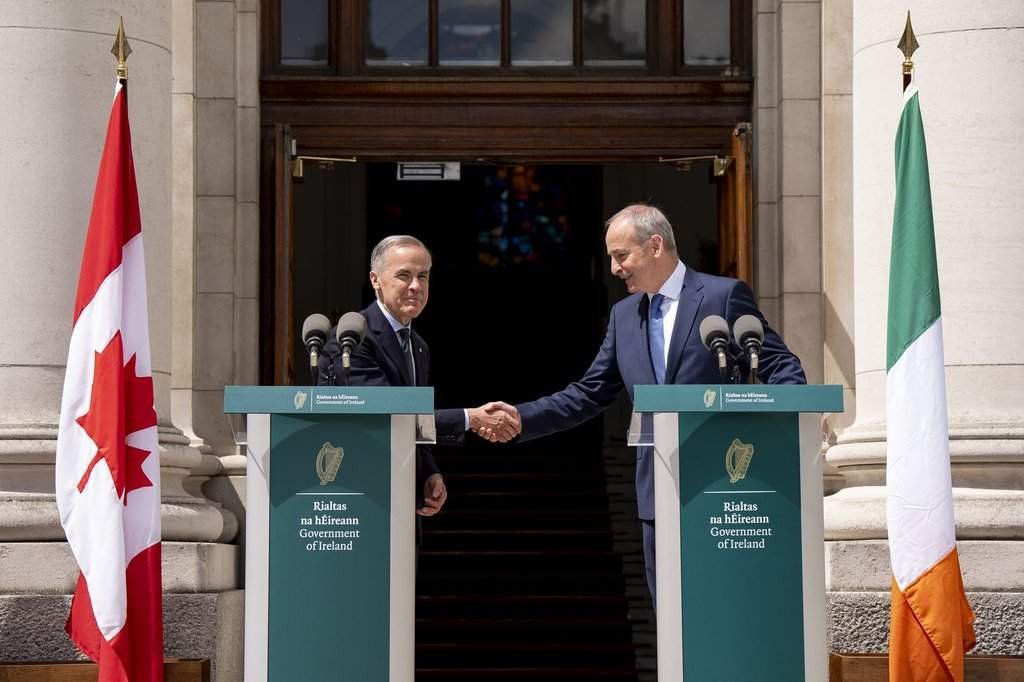
Carney Says 'Strands' of a New World Order Could Be Woven at G7 Summit
Prime Minister Mark Carney has signalled that next week's G7 summit in Évian-les-Bains, France, could serve as a pivotal moment for reshaping global governance, as Canada pushes for a broader coalition of nations to tackle challenges ranging from artificial intelligence regulation to geopolitical instability.
Tags: Mark Carney, G7 summit 2026, Canada foreign policy, middle powers, AI regulation, Bill C-34, online safety, Évian-les-Bains, world order, Canada Europe relations
The Prime Minister's Vision for a Broader G7
Ottawa – June 14, 2026 — Speaking during a discussion at Trinity College Dublin as part of a six-day trip to Europe, Prime Minister Mark Carney suggested the G7 summit scheduled for June 15 to 17 could lay the groundwork for a new international order. Carney said the "strands" of a new world order could be woven at the summit, which will include a broader group of nations beyond the traditional seven members.
In January, Carney delivered a speech in Davos calling on middle powers to band together in the face of great powers — a message that has received global reception. He reiterated that theme in Dublin, arguing that the G7 alone is no longer sufficient to address the complex challenges facing the international community.
"It's a recognition that the G7, if it ever did run the world, no longer runs the world or pretends to," Carney said.
An Expanded Table: Guest Nations and Broader Perspectives
This year's summit, hosted by France, will include representatives from Gulf states, Kenya, Brazil, Egypt and India alongside the traditional G7 members — Canada, France, Germany, Italy, Japan, the United Kingdom and the United States. Carney said these additional partners bring a "broader perspective and a broader element of the solution" to the table.
The inclusion of guest nations reflects a recognition that many of the most pressing global challenges — from climate change to economic instability to digital governance — cannot be resolved by a small group of wealthy democracies alone. France's presidency has emphasised the need for inclusive dialogue, particularly as macroeconomic imbalances continue to widen between developed and developing economies.
Recent reports by the International Monetary Fund and France's G7 presidency indicate that global macroeconomic imbalances keep getting worse and cannot be solved without the participation of China. Leaders at the summit are expected to discuss the future of the global economy, with China's industrial overcapacity likely to be a central topic.
Artificial Intelligence and Online Safety at the Forefront
Carney identified artificial intelligence as one of the issues moving "quite rapidly" that demands international co-operation. He noted that AI is effectively unregulated at the global level, which creates a host of risks including threats to child safety and systemic vulnerabilities to cyber attacks and hacking.
"The importance of sharing the defences, having common standards, not releasing models that have that power before others are ready, that is an imperative," Carney said. "That is something I'm certain we will be discussing at the G7."
Canada has already begun to take domestic action in this space. This week, the Liberal government introduced Bill C-34 in the House of Commons — an online safety bill that would force social media platforms to block access for children under 16. The legislation would also regulate companies behind AI chatbots by imposing on them a duty to act responsibly, including measures to lower the risk of chatbots communicating harmful content and implementing crisis intervention protocols for cases involving self-harm, suicide or violence.
France, meanwhile, has taken its own approach. Earlier this year, French lawmakers approved a bill banning social media for children under 15, reflecting a growing consensus across Europe that minimum age requirements for social media access are necessary to protect young people.
Canadian Context: Parliament Hill, Federal-Provincial Dynamics and the Path Forward
The G7 summit comes at a significant moment for Canadian foreign policy. Carney's push to weave a new world order builds on his earlier Davos address, which positioned Canada as a bridge-builder among middle powers — nations that are not global superpowers but carry substantial economic and diplomatic weight.
Observers on Parliament Hill have noted that Carney's emphasis on middle-power co-operation represents a departure from traditional Canadian foreign policy, which has historically leaned heavily on multilateral institutions like the United Nations and NATO. By advocating for an expanded G7 that includes nations from the Global South, Carney is signalling a more pragmatic, coalition-based approach to international relations.
A Canadian government official said this week that there will likely not be a comprehensive final communiqué from leaders at the end of the summit. Instead, people can expect to see issue-specific statements issued by leaders throughout the event. This format allows leaders to make progress on individual issues without being held back by disagreements on others — a diplomatic strategy that has become increasingly common at multilateral summits.
The Question of a Carney-Trump Meeting
Carney is expected to hold meetings with world leaders at the summit, though it remains unclear whether he will meet with U.S. President Donald Trump. The relationship between Canada and the United States has been under scrutiny since Trump returned to office, particularly on matters of trade, defence spending and border security.
The uncertainty around a potential Carney-Trump bilateral underscores the broader challenges facing Canada-U.S. relations. The two leaders have not yet held a formal one-on-one meeting, and the G7 summit could provide the first opportunity for direct dialogue between them since Carney became prime minister. The outcome of any such meeting — or the absence of one — will be closely watched in Ottawa and by Canadian businesses that depend on cross-border trade.
What Happens Next
The G7 summit in Évian-les-Bains is scheduled to run from June 15 to 17. Carney will arrive in France following his six-day European trip, which included stops in Ireland and other undisclosed locations for bilateral meetings. The government has indicated that Carney intends to use the summit to advance Canada's priorities on AI regulation, global economic stability, and support for Ukraine.
Back in Ottawa, Bill C-34 will continue to make its way through the legislative process in the House of Commons, where it is expected to face scrutiny from opposition parties and stakeholder groups over its implications for free expression and platform liability. The bill's fate will depend on the balance between protecting children online and ensuring that regulatory measures do not overreach.
For Canadians, the G7 summit represents an opportunity to see their prime minister take a leading role on the world stage at a time when the international order is in flux. Whether the "strands" Carney speaks of will indeed be woven into a coherent new framework remains to be seen, but the summit in Évian will offer an early indication of whether Canada's middle-power vision can gain traction among both traditional allies and emerging partners.
By Alex Thompson, Staff Writer
This article was produced with AI-assisted research and editorial support. Reporting is based on sources cited in the article.
What's Your Reaction?
 Like
0
Like
0
 Dislike
0
Dislike
0
 Love
0
Love
0
 Funny
0
Funny
0
 Wow
0
Wow
0
 Sad
0
Sad
0
 Angry
0
Angry
0
Canada Correspondent at Global1.News. Based in Toronto, covering Canadian politics, energy, trade, and US-Canada relations. Provides the Canadian perspective on North American and global affairs.









Comments (0)