
Bharat Innovates 2026: Modi-Macron Deep Tech Summit in Nice
On June 14, 2026, Prime Minister Narendra Modi and French President Emmanuel Macron jointly inaugurated Bharat Innovates 2026 at the Palace of Exposition in Nice, France. The event marked the centerpiece of the India-France Year of Innovation and placed 120 Indian deep tech startups from 13 frontier sectors before 500-plus global investors and venture capitalists. Fifteen highe
On June 14, 2026, Prime Minister Narendra Modi and French President Emmanuel Macron jointly inaugurated Bharat Innovates 2026 at the Palace of Exposition in Nice, France. The event marked the centerpiece of the India-France Year of Innovation and placed 120 Indian deep tech startups from 13 frontier sectors before 500-plus global investors and venture capitalists. Fifteen higher education institutions, including multiple IITs and the Indian Institute of Science, participated alongside the startups.
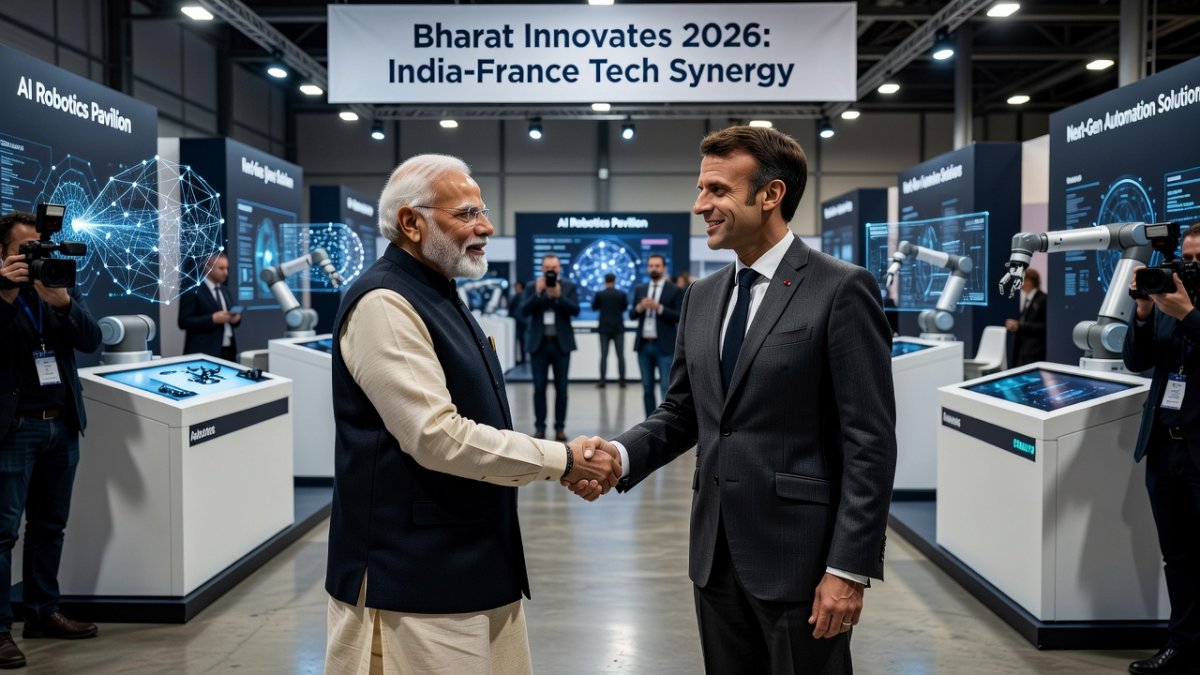
Strategic Context of the 2026 India-France Year of Innovation
The June 14 inauguration occurred during Prime Minister Modi’s six-day Europe tour that also included Slovakia and the G7 Summit. President Macron had visited India in February 2026 for the India AI Impact Summit, setting the stage for expanded technology cooperation. The bilateral talks held at Villa Kedros are expected to yield approximately 12 memoranda of understanding covering research, manufacturing, and investment frameworks.
120 Startups Across 13 Frontier Sectors on Global Display
The 120 deep tech startups represented sectors including artificial intelligence, semiconductors, space technology, biotechnology, robotics, and clean technology. India’s registered startup base now exceeds 230,000 companies, with these 120 firms selected for their readiness to scale through international partnerships. The showcase directly supports the Startup India initiative by connecting domestic innovators with French capital and supply-chain expertise.
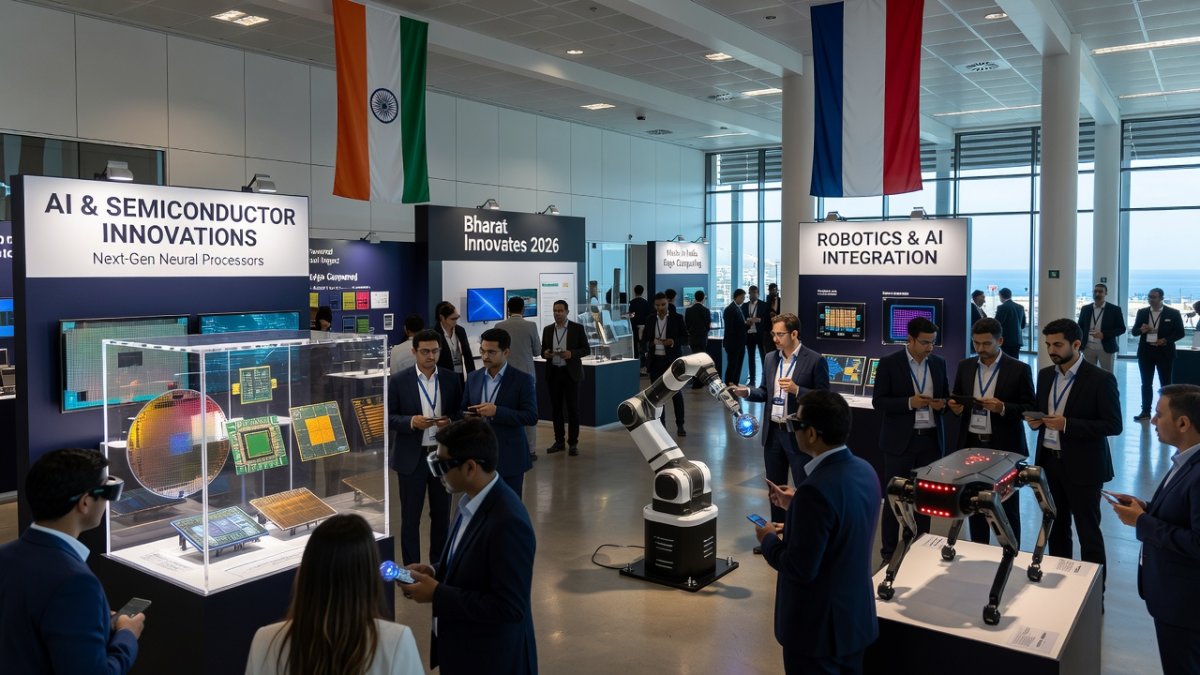
Role of 15 Higher Education Institutions Including IITs and IISc
Fifteen Indian higher education institutions participated, with IIT Bombay, IIT Madras, IIT Delhi, and the Indian Institute of Science Bangalore among the prominent names. These institutions presented joint research prototypes and talent pipelines in semiconductors and robotics. Their presence underscores the government’s push to translate academic research into commercial products under the Atmanirbhar Bharat framework.
Investor Interest and Capital Inflow Prospects
More than 500 global investors and venture capitalists attended the two-day program. Early indications point to term-sheet discussions in AI hardware and clean-tech manufacturing. The presence of these investors aligns with the Make in India objective of attracting design and production facilities to Indian industrial corridors.
Defense and Energy Cooperation: Rafale and Jaitapur Tracks
Parallel government-to-government discussions addressed integration of indigenous weapon systems on Rafale aircraft and expanded cooperation on the Jaitapur nuclear power project. These talks complement the technology showcase by opening pathways for Indian startups to supply components and software for both defense and civilian nuclear programs.
Implications for Indian Startups, Researchers, and Taxpayers
The event provides Indian startups with direct access to French testing facilities and certification pathways, reducing time-to-market for semiconductor and space-tech products. Researchers at IITs and IISc gain structured channels for collaborative patents, while taxpayers benefit from increased foreign direct investment that offsets public R&D expenditure. The 12 expected MoUs are projected to accelerate technology transfer in areas where India currently imports critical components.
Long-Term Positioning in Global Technology Supply Chains
By hosting Bharat Innovates 2026 in France and inviting partners to invest, design, and manufacture in India, the government has reinforced its strategy of embedding domestic firms in European value chains. The combination of 120 curated startups, 15 premier institutions, and high-level political engagement positions India as a reliable alternative source for AI, semiconductor, and clean-tech solutions in an increasingly fragmented global market.
— By Dr. Raj Patel, Staff WriterThis article was produced with AI-assisted research and editorial support. Reporting is based on sources cited in the article.
What's Your Reaction?
 Like
0
Like
0
 Dislike
0
Dislike
0
 Love
0
Love
0
 Funny
0
Funny
0
 Wow
0
Wow
0
 Sad
0
Sad
0
 Angry
0
Angry
0

India/South Asia Correspondent at Global1.News. Analytical voice with a background in science and health journalism. Based in New Delhi, covering Indian politics, education, healthcare, technology, and policy. Breaks down complex data into clear, actionable reporting.










Comments (0)