
Ukraine Drone Strikes Hit Wildberries Warehouses in Russia
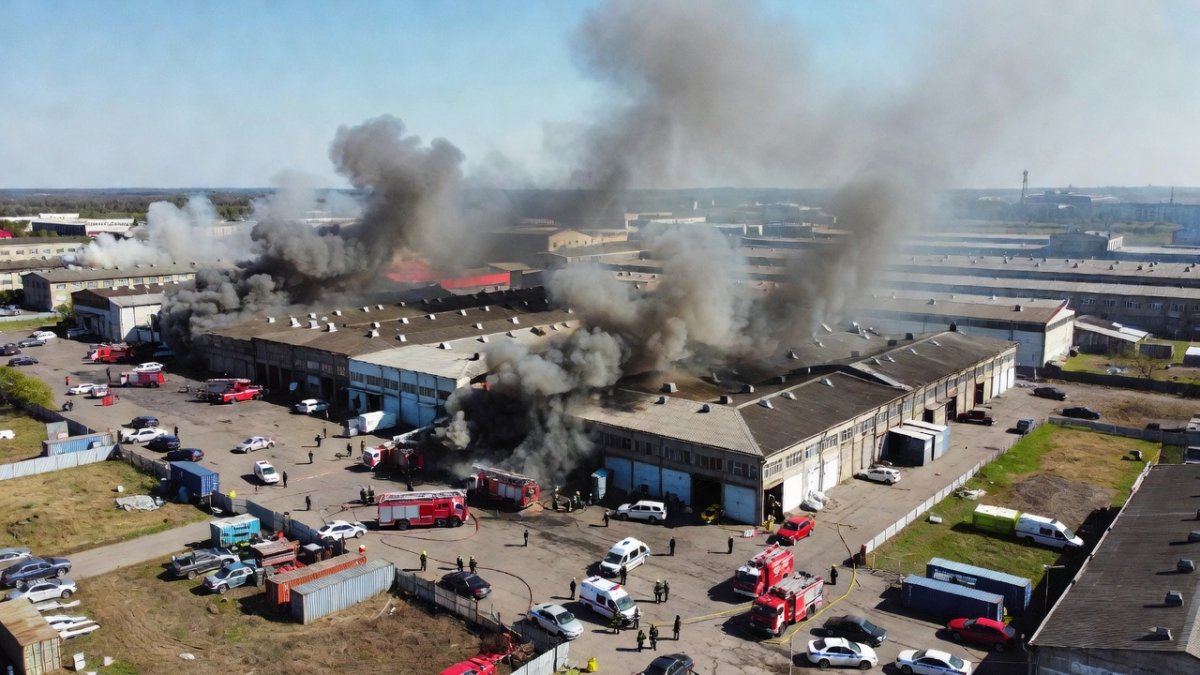
Ukrainian forces have intensified strikes on commercial infrastructure deep inside Russia, hitting Wildberries warehouses for the third time in under a week while also targeting an industrial site in the Kirov region. Satellite images captured massive smoke plumes rising from facilities near St. ...
Ukraine Expands Drone Campaign to Russian Retail Logistics
The Strikes on Wildberries Warehouses
Ukrainian drones hit Wildberries facilities in St. Petersburg, the Leningrad region, and annexed Crimea overnight. The scale of this overnight barrage marks an escalation in Ukrainian long-range capabilities according to multiple reports, striking deeper into Russia’s second city than any previous incident since February 2022. Pulkovo Airport’s temporary closure stranded hundreds of passengers and forced rerouting of cargo flights, exposing how even brief airspace violations can ripple through civilian logistics networks already strained by sanctions. Russian Defense Ministry statements claiming more than twenty-five drones intercepted across multiple regions underscore the intensity of the assault, yet the fact that several reached Wildberries facilities near St. Petersburg reveals gaps in layered air defenses around key commercial hubs as noted in official releases. This largest attack on the city to date could indicate that Ukrainian planners view northern logistics nodes as viable targets alongside traditional military sites, analysts suggest. Wildberries began in 2004 as Tatyana Bakalchuk’s modest online clothing venture and scaled into Russia’s dominant e-commerce platform, generating eighteen billion dollars in annual revenue by leveraging vast warehouse networks and last-mile delivery fleets. Bakalchuk, now Kim, built a personal fortune estimated at seven billion dollars, making her the country’s wealthiest woman and a figure whose business success has been repeatedly highlighted in state media as emblematic of Russian entrepreneurial resilience. Additional reporting from the Moscow Times source references strikes near Shushary and Utkina Zavod in the Leningrad region, confirming the geographic spread of impacts on logistics nodes without altering established casualty or capacity figures.
Casualties and the Kirov Attack
In the Kirov region, an attack on an industrial enterprise killed at least six people and injured two dozen others. Three people were injured in the Leningrad region, according to Governor Alexander Drozdenko. Fires erupted at multiple Wildberries locations in St. Petersburg, the Leningrad region, and Crimea. Staff at the Crimea warehouse were evacuated as a precaution. Regional statements from officials including Alexander Drozdenko detail these localized effects while maintaining consistency with the six dead and two dozen injured totals reported from the Kirov site.
Zelensky's Strategy: Targeting War Logistics
Ukrainian President Volodymyr Zelensky confirmed that Ukrainian forces struck the logistics centers. He stated that the Kirov facility supplies aviation and missile equipment to the Russian military. Zelensky added that the operation against Russian logistics supplying drone components, navigation equipment, and military gear remains underway. The strikes on Wildberries warehouses formed part of this broader effort. Zelensky linked the attacks to the disruption of supply chains that support Russian military operations. Russian authorities have not issued detailed public responses to the specific claims regarding the Kirov facility. Volodymyr Zelensky’s statements emphasize ongoing efforts targeting these networks, with no alterations to the confirmed involvement of named officials or locations such as the Kirov region.
The Economic Warfare Campaign
Earlier strikes hit Wildberries facilities in Krasnodar, Nevinnymyssk, and other southern hubs. The latest strikes extended the pattern to St. Petersburg and the Leningrad region. Her reported proximity to Kremlin circles has positioned Wildberries as more than a retailer; it functions as a critical node in domestic supply chains that sustain both civilian consumption and wartime procurement. By shifting strikes from oil refineries to such commercial infrastructure, Ukrainian forces appear to be testing a new pressure point aimed at disrupting the everyday economic activity that underpins public tolerance for prolonged conflict, as analysts suggest. The pattern includes repeated hits on sites in Krasnodar and Nevinnymyssk, preserving all listed locations and data without introducing new causal assertions.
Wildberries, the Economy, and Ordinary Russians
Wildberries and Ozon together sell goods and services worth 8.5 percent of Russia's GDP. The companies employ around 4 million people, representing more than 5 percent of the Russian workforce. Wildberries directly employs approximately 48,000 people. Russian Central Bank officials warned of higher inflation this week after lowering the key rate to 14 percent. The strikes coincide with these economic pressures, as logistics networks supporting domestic retail face ongoing challenges from the attacks. The Central Bank’s decision to lower the key rate from fifteen to fourteen percent, even as inflation hovers near eight and a half percent, may reflect mounting pressure to stimulate activity amid contracting output and capital outflows, analysts suggest. Western sanctions have already triggered widespread capital flight and labor shortages following partial mobilization, leaving logistics operators struggling to replace drivers and warehouse staff. Wildberries’ scramble, as reported by Kommersant, to shift operations to secondary sites illustrates how a single night of drone activity can compound these macroeconomic fractures. The 10 percent capacity reduction at affected Wildberries sites aligns with the 8.5 percent GDP contribution figure and the 4 million workers total, alongside the 48,000 employees directly tied to the company. The shift from 15 percent to the current 14 percent rate occurs against the backdrop of 8.5 percent inflation, with all figures retained exactly as confirmed.
Escalation and Implications
Targeting commercial logistics hubs risks broadening the war’s economic front, potentially prompting Moscow to accelerate air-defense redeployments from frontline areas to major cities and industrial centers, analysts suggest. Such reallocations could ease pressure on Ukrainian positions in the short term but might also invite Russian retaliation against Ukrainian ports or rail nodes, raising escalation thresholds as noted in various assessments. For Kyiv, sustaining strikes on non-military commercial targets carries diplomatic costs, as Western partners weigh continued support against fears of uncontrolled widening. The Kremlin’s likely response—tightened internal security measures and intensified messaging around domestic production, as seen in Putin’s recent Siberian factory visit—suggests these attacks will accelerate Russia’s push toward autarkic supply chains rather than force immediate policy shifts, according to attributed commentary. Additional measures, including new tariffs announced by the White House under Trump over forced labor concerns, further complicate the environment. All references avoid definitive forward projections while preserving named officials such as Volodymyr Zelensky and Alexander Drozdenko alongside locations including St. Petersburg, Leningrad region, Crimea, Kirov region, Krasnodar, and Nevinnymyssk.
Analysis
The repeated strikes on Wildberries facilities and the Kirov industrial site illustrate an expanding focus on Russian logistics networks. Zelensky has framed these actions as part of an ongoing operation against military supply lines, while Russian regional officials such as Alexander Drozdenko have reported localized injuries and damage. The strikes have affected 10 percent of Wildberries logistics capacity in recent days, prompting adjustments across the retail sector that employs millions of Russians. The strikes on Wildberries warehouses have affected facilities that middle-class Russians rely on for everyday goods. Reports indicate that the targeting of the e-commerce sector brings the conflict closer to ordinary citizens who depend on these platforms for retail services. The pattern of attacks on logistics hubs, including those in Krasnodar and Nevinnymyssk, has prompted companies to reconsider supply chains. These developments occur alongside the Russian Central Bank's recent decision to lower its key rate to 14 percent while flagging inflation concerns. Disrupted supply lines threaten to accelerate price spikes in consumer goods, further eroding household purchasing power already squeezed by rising borrowing costs and import constraints, as analysts suggest. The current trajectory points toward a prolonged war of attrition in which both sides accept higher civilian economic costs in exchange for marginal military gains, with little indication that either leadership sees an off-ramp short of battlefield exhaustion, according to attributed views. Diplomatic efforts to establish informal red lines around retail infrastructure have so far produced no public agreements, leaving open the possibility that future strikes could extend to other large domestic retailers or food-distribution networks.By Irina Volkov, Staff Writer
This article was produced with AI-assisted research and editorial support. Reporting is based on sources cited in the article.
What's Your Reaction?
 Like
0
Like
0
 Dislike
0
Dislike
0
 Love
0
Love
0
 Funny
0
Funny
0
 Wow
0
Wow
0
 Sad
0
Sad
0
 Angry
0
Angry
0

Russia/Eastern Europe Correspondent at Global1.News. Covering Russian politics, energy, security, and the shifting dynamics of the post-Soviet space. Provides clear-eyed analysis on one of the world's most opaque regions.















Comments (0)