
Açaí's Hidden Cost: Amazon Bird Diversity Plunges as Superfood Demand Soars
Açaí's Hidden Cost: Amazon Bird Diversity Plunges as Superfood Demand Soars By Elena Vasquez, Staff Writer Baskets of freshly harvested açaí in Pará, where intensified cultivation is reshaping floodplain forests. (Mongabay) The Study and Its Findings in Estuarine Forests The study published in Biological Conservation titled Acai management intensification impoverishes Amazonian

Açaí's Hidden Cost: Amazon Bird Diversity Plunges as Superfood Demand Soars
By Elena Vasquez, Staff Writer
Baskets of freshly harvested açaí in Pará, where intensified cultivation is reshaping floodplain forests. (Mongabay)
The Study and Its Findings in Estuarine Forests
The study published in Biological Conservation titled Acai management intensification impoverishes Amazonian avian assemblages in estuarine forests documents a 28% decline in bird species richness across 36 forest sites. Researchers surveyed locations including Belem, Barcarena, Abaetetuba, and Igarape-Miri in Pará state, where estuarine forests form critical floodplain habitats. Data collection involved 127 hours of recordings that documented 3,580 individual birds, revealing clear patterns tied to intensified açaí management. These estuarine forests support traditional floodplain cultivation but face pressure from rising superfood demand.
Freitas MAB and Nunes RV led the work with co-authors, focusing on how understory clearing removes shrubs, leaf litter, and hollow trees essential for nesting. This practice directly alters the structure of estuarine forests that have sustained both biodiversity and local communities for generations. The 28% richness drop occurs specifically where açaí clumps are managed at higher densities than traditional levels. Such changes threaten the ecological balance that defines these Amazonian floodplain environments.
Comparisons within the study highlight that intensified sites lose structural complexity compared to areas with lower management pressure. Estuarine forests around the Amazon estuary provide seasonal flooding cycles that support diverse plant layers, yet intensification simplifies these layers. The recorded 3,580 birds across 127 hours underscore the scale of sampling that captured both common and rare species responses. Local fishers and farmers in Abaetetuba and Igarape-Miri have long relied on these forests for açaí blended with fish and cassava flour.
The research underscores that estuarine forests differ from upland Amazon habitats by their proximity to tidal influences and nutrient-rich sediments. This context makes the 28% decline particularly concerning for regional avian assemblages. Data from the 36 sites show consistent impoverishment linked to management practices rather than other Amazon threats such as outright deforestation. Continued monitoring in Barcarena and Belem will be needed to track further shifts.
Declining Bird Species in Estuarine Forests

The purple-throated fruitcrow has vanished from multiple intensively managed açaí sites in Pará. (Mongabay)
Specific species illustrate the impact of açaí intensification on estuarine forest birds. The long-tailed hermit (Phaethornis superciliosus) shows marked declines where understory vegetation is removed. In contrast, the great kiskadee (Pitangus sulphuratus) adapts well to the simplified habitats created by denser açaí clumps. These contrasting responses highlight how management alters resource availability in floodplain forests near Abaetetuba.
The purple-throated fruitcrow (Querula purpurata) and razor-billed curassow (Pauxi tuberosa) disappear entirely from intensified sites. White-throated toucan (Ramphastos tucanus) loses nesting sites as hollow trees are cleared during understory management. Across the 36 sites in Belem, Barcarena, Igarape-Miri, and surrounding areas, these losses contribute to the overall 28% reduction in species richness. Estuarine forests once provided layered vegetation that supported fruit and insect resources for these birds.
Traditional cultivation maintained shrubs and leaf litter that sustained understory specialists, while intensified practices prioritize açaí yield. The 3,580 birds recorded during 127 hours of sampling captured these shifts in real time across Pará's estuarine zone. Species such as the razor-billed curassow require intact forest structure that conflicts with current clump densities. Local cultural practices in Pará have historically balanced açaí harvest with forest complexity, yet economic pressures are changing that balance.
These avian changes occur alongside the loss of 200-300+ plant species noted in the study, further reducing habitat options. Estuarine forests in the Amazon estuary support migratory and resident birds that depend on seasonal fruiting cycles. The disappearance of the purple-throated fruitcrow from multiple sites signals broader assemblage simplification. Continued intensification risks additional losses compared to other regional pressures like selective logging.
Understanding Biotic Homogenization in Managed Forests
Biotic homogenization describes the process by which diverse biological communities become more similar over time due to human management. In the study, Freitas explains that açaí intensification drives this outcome through the documented loss of 200-300+ plant species. Estuarine forests normally host complex understories that support varied bird guilds, but clearing creates uniform conditions favoring only a few adaptable species. This homogenization reduces the unique character of floodplain forests around Igarape-Miri and Barcarena.
The 28% decline in bird species richness serves as a measurable indicator of homogenization across the 36 surveyed sites. When understory shrubs and leaf litter disappear, the resources that once sustained specialists like the long-tailed hermit are eliminated. Generalists such as the great kiskadee persist, leading to assemblages that resemble each other more than they differ. Researchers recorded these patterns through 127 hours of audio that captured 3,580 birds in estuarine settings.
Floodplain forests matter because they integrate tidal and riverine processes that maintain high plant diversity essential for avian food webs. The study shows how intensified açaí clumps replace this diversity with monoculture-like stands, accelerating homogenization. Local communities in Pará have used these forests for generations, blending açaí with cassava flour and fish in traditional diets. The shift toward higher densities disrupts both ecological and cultural relationships.
Compared to outright deforestation, biotic homogenization from açaí management leaves forest cover intact yet functionally impoverished. The loss of 200-300+ plant species directly correlates with reduced nesting opportunities for species such as the white-throated toucan. Estuarine forests in the Amazon estuary thus face a quieter form of degradation that still erodes biodiversity. Future work by the Emilio Goeldi Museum team aims to quantify long-term homogenization effects.
The Surge in Açaí Production Across Pará
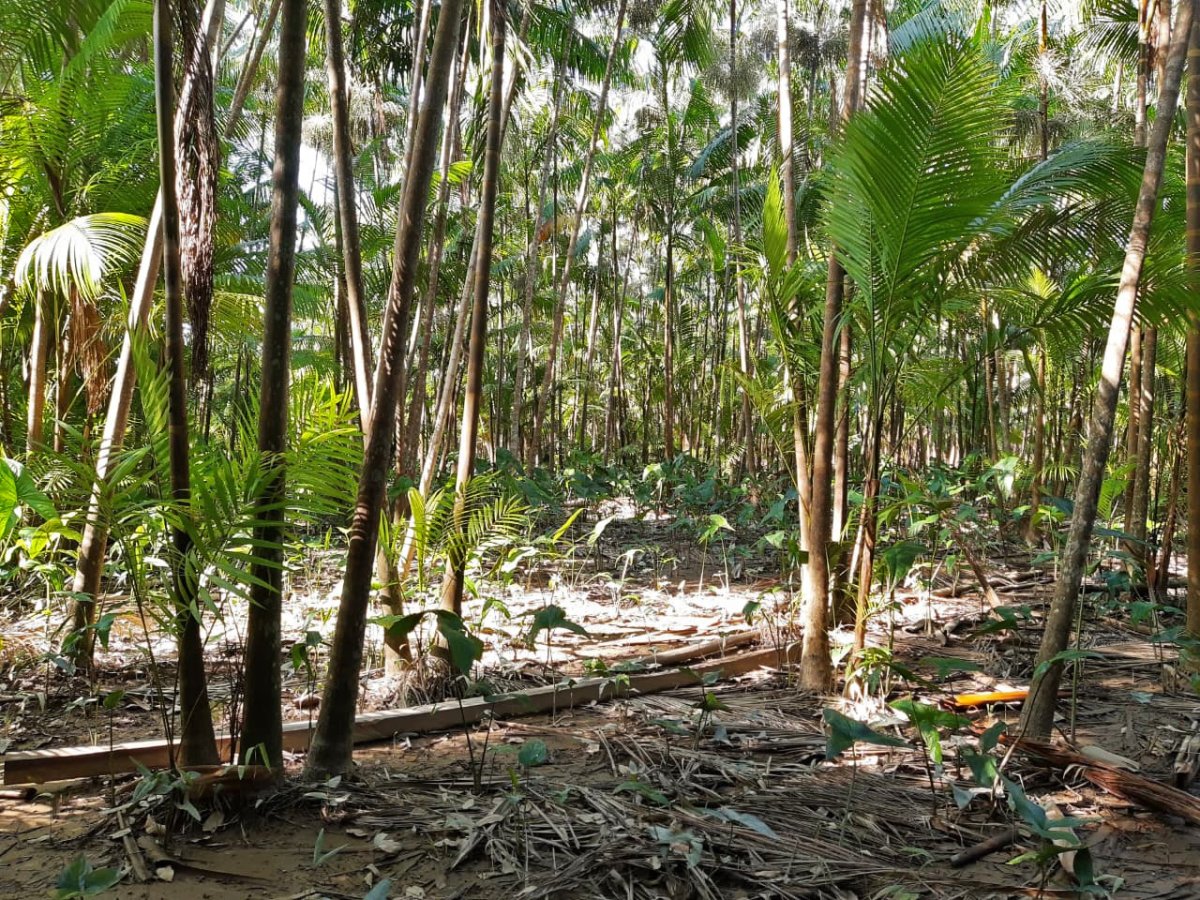
Intensified açaí cultivation replaces diverse floodplain forests with near-monoculture stands in Pará. (Mongabay)
Açaí production in Brazil has increased 14-fold since 1987, reaching 1.9 million metric tons in 2024. Pará state accounts for 95% of national output, with estuarine forests supplying the majority of this volume. The intensification documented in the study occurs precisely in the floodplain zones surrounding Belem and Abaetetuba where traditional clump densities are exceeded. This growth trajectory directly links rising global demand to local forest changes.
International sales have risen 885% to reach $177.2 million in 2025, with major markets in the United States, Australia, Japan, and the Netherlands. The 36 study sites reflect management practices scaled up to meet this export volume. Estuarine forests that once supported mixed cultivation now prioritize açaí at densities that regulators attempt to limit. The 28% bird richness decline coincides with this production expansion in the same regions.
Traditional estuarine forest management allowed 200-300+ plant species to coexist with açaí palms, sustaining both birds and local livelihoods. Intensified systems remove understory elements to boost yields, contributing to the homogenization described by Freitas. Pará's cultural reliance on açaí as a dietary staple blended with fish and cassava flour persists, yet the ecological foundation is eroding. The 1.9 million metric tons produced in 2024 represent a scale far beyond historical levels.
Other Amazon threats such as cattle ranching cause outright clearing, whereas açaí intensification preserves canopy while simplifying understory. The study data from 127 hours of recordings across 36 sites isolate management intensity as the key driver. Estuarine forests in Barcarena and Igarape-Miri illustrate how production growth translates into measurable avian losses. Continued expansion without adjusted practices risks further homogenization.
Economic Impact and Global Markets
The economic value of açaí exports reached $177.2 million in 2025 after an 885% increase, driven by demand from the United States, Australia, Japan, and the Netherlands. Pará's 95% share of Brazil's 1.9 million metric tons underscores the state's central role in this trade. Local economies in Belem and Abaetetuba depend on açaí income, yet the study reveals hidden biodiversity costs borne by estuarine forests. These revenues flow from intensified management that the research links to the 28% species richness decline.
Global markets reward higher yields, encouraging clump densities that exceed traditional levels in floodplain forests. The loss of species such as the razor-billed curassow and purple-throated fruitcrow occurs alongside this economic expansion. Researchers note that 200-300+ plant species disappear under intensified regimes, reducing the long-term resilience of production areas. Estuarine forests thus provide both immediate income and the ecological services now being compromised.
Comparisons to other Amazon commodities show açaí generates revenue while retaining forest cover, unlike soy or cattle that drive deforestation. However, the avian data from 3,580 recorded birds across 127 hours indicate that homogenization carries its own economic risks through reduced ecosystem stability. Communities in Igarape-Miri maintain cultural practices around açaí consumption even as export pressures intensify. The $177.2 million figure reflects only market value, not the biodiversity losses documented in the study.
Policy discussions in the Amazonia 2030 report highlight the need to internalize these ecological costs into economic planning. Estuarine forests around the 36 sites support both export volumes and local food security. The 14-fold production increase since 1987 has transformed regional economies while altering bird assemblages. Sustaining the $177.2 million export level will require addressing the understory changes driving homogenization.
Regulatory Challenges in Pará
Pará state maintains regulations that cap the number of açaí clumps per hectare to protect estuarine forest structure. These limits aim to preserve the shrubs, leaf litter, and hollow trees needed by species such as the white-throated toucan. However, the study finds that caps are widely ignored across sites in Belem, Barcarena, Abaetetuba, and Igarape-Miri. Enforcement gaps allow intensification that produces the observed 28% decline in bird richness.
The 36 surveyed locations demonstrate that exceeding recommended densities correlates with the disappearance of the purple-throated fruitcrow and razor-billed curassow. Estuarine forests require balanced management to maintain the 200-300+ plant species that support diverse avian communities. Current regulations exist but lack the monitoring resources needed in remote floodplain areas. Local producers face economic incentives to maximize clumps despite official limits.
Compared to federal Amazon protections focused on deforestation, Pará's clump caps target a subtler threat within existing forest cover. The 127 hours of recordings that captured 3,580 birds provide evidence that ignored regulations translate directly into biotic homogenization. Traditional cultivation practices in Pará historically aligned with these caps, preserving cultural uses of açaí blended with cassava flour. Strengthened enforcement could reconcile production goals with forest integrity.
Without compliance, the 1.9 million metric tons produced annually will continue to drive understory simplification. Researchers emphasize that regulatory support must accompany any push for higher yields in estuarine zones. The gap between policy and practice in Barcarena and surrounding municipalities illustrates implementation challenges common to Amazon resource management. Addressing these gaps remains essential for conserving remaining bird diversity.
Voices from Researchers and Local Context
Raphael de Vasconcelos Nunes of the Federal University of Pará and Madson Freitas of the Emilio Goeldi Museum contributed key expertise to the study. Danielle Leal Ramos from the University of Exeter and Salo Coslovsky of New York University provided additional analysis, including references to the Amazonia 2030 report released in October 2025. Their combined work documents how estuarine forests in Pará experience homogenization through intensified açaí practices. Local fishers and farmers in Abaetetuba continue traditional blending of açaí with fish and cassava flour amid these changes.
Freitas notes that the loss of 200-300+ plant species underpins the 28% bird richness decline recorded across 36 sites. Nunes highlights the importance of estuarine forests for both biodiversity and regional economies that produce 95% of Brazil's açaí. The 127 hours of field recordings yielding 3,580 bird detections ground these conclusions in direct observation. Cultural continuity in Pará depends on maintaining forest features that intensification currently removes.
Other Amazon threats such as mining receive more public attention, yet açaí-driven homogenization operates within standing forests. Researchers stress that estuarine zones around Belem and Igarape-Miri require tailored approaches distinct from upland conservation strategies. The great kiskadee thrives while specialists decline, illustrating the selective pressure exerted by current management. Local knowledge of floodplain cycles informs the call for diversified practices that respect both ecology and tradition.
The Amazonia 2030 report underscores the need for integrated policies that value the full range of estuarine forest services. Experts from the Emilio Goeldi Museum continue monitoring sites where the purple-throated fruitcrow has already vanished. These voices emphasize that the 14-fold production increase since 1987 carries measurable consequences for avian assemblages. Sustaining both cultural practices and export revenues will depend on incorporating researcher insights into future management.
Pathways to Sustainable Solutions
Researchers propose cacao and andiroba diversification as alternatives that maintain estuarine forest complexity while supporting incomes. These approaches could reduce pressure on açaí clump densities that currently exceed regulatory caps in Pará. The study shows that preserving shrubs and leaf litter would help retain species such as the long-tailed hermit and white-throated toucan. Local communities in Barcarena and Abaetetuba already possess knowledge of mixed cultivation systems suited to floodplain conditions.
Effective solutions require both stronger regulation enforcement and technical support for producers transitioning away from monoculture-like açaí stands. The 28% bird richness decline and associated loss of 200-300+ plant species demonstrate the urgency of such shifts. Estuarine forests can continue supplying the 1.9 million metric tons of annual production if management incorporates understory retention. International buyers in the United States and Europe could incentivize certified practices that avoid homogenization.
Compared to other Amazon interventions focused on fire or logging, açaí solutions center on refining existing cultivation rather than halting activity. The 885% export growth to $177.2 million creates both challenges and opportunities for sustainability programs. Traditional estuarine forest uses, including blending açaí with cassava flour, provide cultural models for diversified systems. Implementation of cacao and andiroba integration would directly address the drivers of avian assemblage impoverishment documented across the 36 sites.
Long-term success depends on combining the expertise of institutions such as the Federal University of Pará and the Emilio Goeldi Museum with community participation. The 127 hours of recordings that captured 3,580 birds offer a baseline for measuring recovery under improved practices. Estuarine forests remain vital to both biodiversity and the economy of Pará, provided intensification is moderated. These pathways offer concrete steps toward reconciling superfood demand with the integrity of Amazonian floodplain ecosystems.
By Elena Vasquez, Staff WriterThis article was produced with AI-assisted research and editorial support. Reporting is based on sources cited in the article.
What's Your Reaction?
 Like
0
Like
0
 Dislike
0
Dislike
0
 Love
0
Love
0
 Funny
0
Funny
0
 Wow
0
Wow
0
 Sad
0
Sad
0
 Angry
0
Angry
0

Latin America Correspondent at Global1.News. Based in Mexico City, covering politics, economics, energy, and culture across the region. Brings an on-the-ground perspective to stories spanning from the Rio Grande to Patagonia.















Comments (0)