
South Korea AI Diplomacy: President Lee Jae Myung Engages Tech Leaders in San Francisco
President Lee Jae Myung’s arrival in San Francisco on July 24, 2026, marks a decisive turn in South Korean foreign policy, as the leader pursues multibillion-dollar AI partnerships with Nvidia, OpenAI, Anthropic, and Broadcom while extending the same technology-first approach to lithium-rich South American nations.
President Lee Jae Myung’s arrival in San Francisco on July 24, 2026, marks a decisive turn in South Korean foreign policy, as the leader pursues multibillion-dollar AI partnerships with Nvidia, OpenAI, Anthropic, and Broadcom while extending the same technology-first approach to lithium-rich South American nations. The two-day California stop, part of an 11-day tour that also includes Brazil, Chile, Argentina, and Germany, signals Seoul’s determination to embed its semiconductor and manufacturing strengths inside American AI ecosystems. Early indications point to roughly $950 billion in prospective cooperation projects and a new San Francisco AI declaration that could reshape supply-chain alignments across the Pacific.
South Korea AI Diplomacy: $950 Billion Deals in San Francisco
Seoul, South Korea — President Lee Jae Myung’s California engagements have produced a dense web of technology, investment, and diplomatic commitments that extend well beyond traditional alliance management.
The San Francisco AI Summit and Declaration
The centerpiece of the visit was a high-level AI summit that drew approximately 150 executives, investors, researchers, and startup founders. President Lee issued the San Francisco AI declaration, which sets out principles for responsible development and cross-border collaboration. The presidential office highlighted South Korea’s $500 billion domestic commitment to AI industry development as evidence of sustained public investment, positioning the country as both a manufacturing powerhouse and an emerging model developer.
Meetings with Nvidia, OpenAI, Anthropic, and Broadcom
Lee conducted separate sessions with Jensen Huang of Nvidia, Sam Altman of OpenAI, Dario Amodei of Anthropic, and Hock Tan of Broadcom. Discussions focused on hardware supply, large-model training, and the infrastructure required for widespread AI deployment. The presidential office reported that the meetings yielded concrete pathways for joint projects, although detailed implementation timelines remain under negotiation. Huang later described South Korea as entering a “golden era” under Lee’s leadership, while Altman called the country one of the world’s most important AI players.
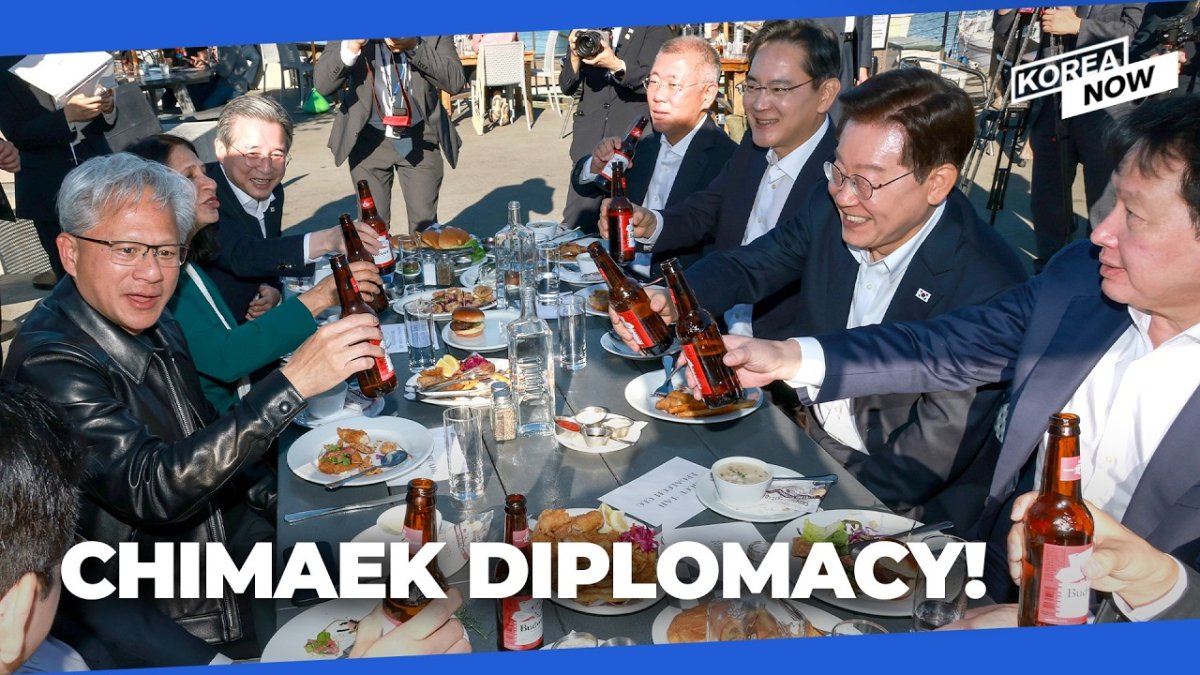
Chimaek Dinner: Soft-Power Diplomacy in Practice
An informal waterfront dinner at The Ramp restaurant featured chimaek-style fare of fried chicken, burgers, fish and chips, and Budweiser. Participants included Huang, Samsung Electronics Chairman Lee Jae-yong, SK Group Chairman Chey Tae-won, Hyundai Motor Group Executive Chair Chung Euisun, and Microsoft Azure Hardware Corporate Vice President Rani Borkar. Chimaek, the Korean tradition of pairing fried chicken with beer, has evolved into a deliberate instrument of soft-power diplomacy that humanizes high-stakes negotiations and signals cultural confidence. By reviving the format first popularized during the Moon Jae-in administration, Lee underscores that Seoul’s AI outreach rests on personal rapport rather than protocol alone.
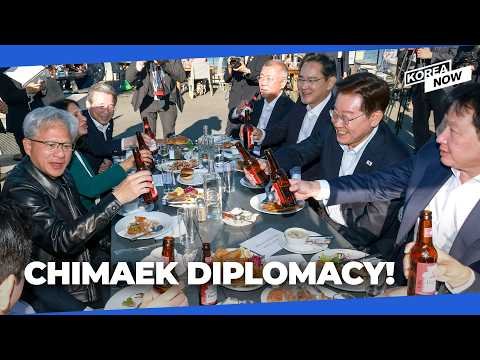
The presence of the three chaebol leaders alongside Microsoft’s Rani Borkar illustrates Korea Inc.’s coordinated approach. Their attendance signals that the conglomerates view the president’s AI agenda as a collective national project rather than competing corporate interests, enabling rapid translation of diplomatic openings into joint ventures spanning memory chips, cloud infrastructure, and autonomous-driving software.
$950 Billion Cooperation Framework and Key Agreements
South Korean conglomerates and global technology firms agreed to pursue cooperation projects valued at approximately US $950 billion, according to a senior presidential official. Anthropic and the Ministry of Science and ICT will sign a memorandum of understanding covering AI security and the cyber industry. These arrangements demonstrate the chaebols’ role in converting diplomatic openings into commercial pipelines across semiconductors, cloud infrastructure, and model training. Analysts note that such scale reflects both the depth of U.S.–Korea technological complementarity and the urgency of securing diversified supply chains amid intensifying global competition.
Broader Diplomatic Context: The South America Leg
Following San Francisco, Lee will conduct a state visit to Brazil for a summit with President Luiz Inacio Lula da Silva and attend the Korea-Brazil Business Roundtable in Sao Paulo. Additional stops include talks with President Jose Antonio Kast in Chile and President Javier Milei in Argentina. Lee’s itinerary deliberately links AI hardware ambitions to upstream resource security. Chile and Argentina together hold the world’s largest lithium reserves, critical for the batteries that power data-center backup systems and electric vehicles produced by Korean automakers. Securing long-term supply agreements in these countries complements the semiconductor and AI deals struck in California.
Brazil offers complementary opportunities in agricultural technology and smart infrastructure, sectors where Korean firms already operate large-scale projects. The Korea-Brazil Business Roundtable will likely advance precision-farming platforms and 5G-enabled logistics networks that generate data for AI optimization models. These engagements extend technology-focused diplomacy into emerging markets, converting resource partnerships into stable demand for Korean AI solutions while diversifying supply chains away from Northeast Asian flashpoints.
Looking Ahead: Implementation Challenges and Metrics
Implementation of the $950 billion cooperation framework will be measured by concrete milestones: the Anthropic-MoU on AI security expected within ninety days, joint pilot data centers in Gyeonggi Province by mid-2027, and quarterly progress reports from the presidential AI task force. Observers will also track whether the $500 billion domestic investment plan attracts matching private capital from the chaebols at the promised ratio of three-to-one. The Brazil summit outcomes will reveal how effectively Lee translates San Francisco momentum into resource and market access. Success metrics include finalized lithium offtake contracts, new agricultural AI demonstration projects, and a bilateral technology fund. Failure to convert declarations into signed contracts within six months would signal limits to the chimaek-and-chaebol model when applied to more distant and institutionally complex partners.
South Korea’s San Francisco engagements position the country as a pivotal node between U.S. innovation and Northeast Asian manufacturing scale, distinguishing it from Japan’s software-centric strategy and Taiwan’s foundry specialization. While Japan leverages its materials science edge and Taiwan dominates logic-chip fabrication, Korea retains unmatched dominance in high-bandwidth memory essential for AI training clusters. President Lee’s emphasis on domestic AI data centers and the $500 billion public investment plan aims to convert this memory advantage into full-stack leadership across model development and deployment.
By Prof. David Park, Staff Writer
This article was produced with AI-assisted research and editorial support. Reporting is based on sources cited in the article.
What's Your Reaction?
 Like
0
Like
0
 Dislike
0
Dislike
0
 Love
0
Love
0
 Funny
0
Funny
0
 Wow
0
Wow
0
 Sad
0
Sad
0
 Angry
0
Angry
0
East Asia/Technology Correspondent at Global1.News. Seoul-based voice covering Korean politics, technology, business, and culture. Analyzes how technology and geopolitics intersect across East Asia.











Comments (0)