
Yazidi Doctor Nagham Nawzat: Healing IS Captivity Survivors
Dr Nagham Nawzat with a survivor at the Duhok Survivors Centre (Global 1 News) The Yazidi Genocide and Its Lasting Scars On 3 August 2014, Islamic State group militants seized control of Sinjar in northern Iraq, as part of a campaign that the United Nations has described as an ongoing genocide against the Yazidi religious minority. At least 12,000 Yazidis were killed or kidnapp
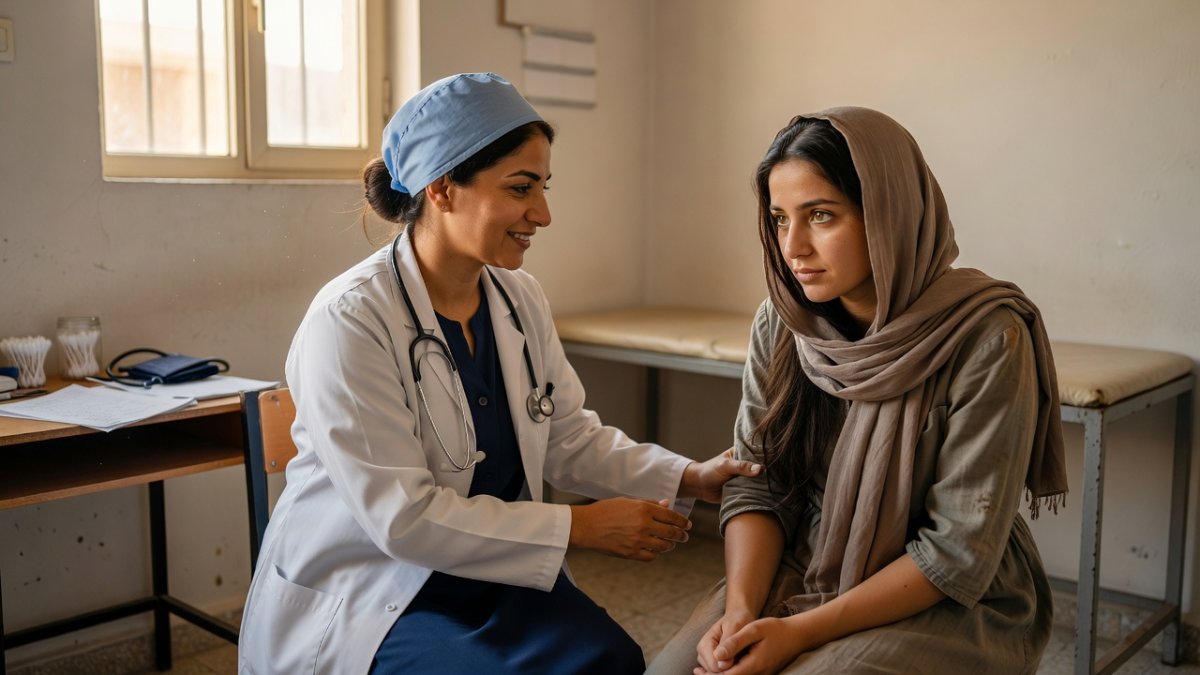
Dr Nagham Nawzat with a survivor at the Duhok Survivors Centre (Global 1 News)
The Yazidi Genocide and Its Lasting Scars
On 3 August 2014, Islamic State group militants seized control of Sinjar in northern Iraq, as part of a campaign that the United Nations has described as an ongoing genocide against the Yazidi religious minority. At least 12,000 Yazidis were killed or kidnapped during this period, when the group seized almost a third of Iraq. Yazidi women and girls faced systematic sexual violence, forced conversions, and enslavement, experiences that continue to shape the need for specialised support years later.
Shireen, then 19, was studying for a high school examination at her home in Sinjar when militants broke in and abducted her. She was sold as a sex slave to an Islamic State fighter in Tal Afar, and three months later sold again to Abu Omar in Mosul. These events form part of thousands of similar accounts from Yazidi survivors, highlighting the scale of gender-based violence that followed the 2014 attacks.
Shireen’s Account of Captivity and Survival
Shireen recounts that Abu Omar told her, “I love you,” yet she notes, “when you love someone, you don’t rape her. It destroyed my life.” Abu Omar already had two Iraqi wives who lived in a separate house, and Shireen says they beat her whenever they gathered. For more than two years she was confined to the house in Mosul, forced to cook, wash dishes, and clean daily, with two guards at the entrance preventing her from stepping outside or even into the garden for fresh air.
Islamic State militants told her that Melek Tawwus, the Peacock Angel revered by Yazidis as part of their belief in Yasdan, was the devil, and they forced her to convert to Islam. Later, Abu Omar brought two other Yazidi girls to the house, one aged six who was made to clean and another aged 10. Shireen says she was raped frequently and tried to intervene on behalf of the younger girls, but her pleas were ignored. In 2016, during the Iraqi forces’ campaign to retake Mosul, she was released after more than two years in captivity.
Upon release, Shireen faced depression and constant nightmares that prevented sleep. Her uncle and many friends were killed by Islamic State, while her father and one sister remain missing since 2014. She reflects, “It’s too horrible, the skeletons of my uncle and my friends are under the ground.”
Dr Nagham Nawzat’s Path to Supporting Survivors
Dr Nagham Nawzat, a Yazidi gynaecologist born in Mosul in 1976, has provided care to an estimated 1,200 of the 2,023 Yazidi women liberated from Islamic State territories as of July 2018, according to Hussein al-Qaidi, director of the Kidnapped Affairs department at the Kurdistan Regional Government in Duhok. After graduating with a degree in gynaecology from Mosul’s Medical College in 2002, she focused on women’s health issues, stating, “I wanted to better understand issues related to women’s health, teach women about health care and provide support for them.”
In 2015, Dr Nawzat joined the Duhok Survivors’ Centre, where she volunteers to deliver healthcare and psychological support. When Shireen visited for a check-up after her release, Dr Nawzat conducted a physical examination and offered emotional support, telling her she was brave. Shireen says, “Dr Nawzat helped all of us. Without her help, I wouldn’t be here today. After I came back from captivity, Dr Nawzat sat down with me and told me that I was brave. I love her so much.”
Dr Nawzat’s work addresses both the physical and mental health consequences faced by survivors, many of whom endured prolonged isolation, repeated sexual violence, and the loss of family members during the genocide.
The Duhok Survivors’ Centre and UNFPA Support
The Duhok Survivors’ Centre, funded by the United Nations Population Fund, stands as the only facility in Iraq that specialises in gender-based violence. Established to meet the needs of women who survived Islamic State captivity, it combines medical examinations with psychological care in a single location. Dr Nawzat’s involvement since 2015 has allowed the centre to reach more than half of the liberated Yazidi women documented by the Kurdistan Regional Government by July 2018.
Survivors arrive with complex health concerns stemming from years of captivity, including the trauma described by Shireen of being denied fresh air and subjected to daily forced labour. The centre’s integrated approach, supported by UNFPA resources, enables consistent follow-up that addresses both immediate medical needs and longer-term mental health effects such as depression and nightmares.
Hussein al-Qaidi has noted the centre’s role in coordinating with government efforts to track the 2,023 women liberated by mid-2018, underscoring how specialised facilities fill gaps left by the scale of the 2014 genocide, when at least 12,000 Yazidis were killed or taken.
International Recognition Through the Women of Courage Award
In March 2016, Dr Nawzat received the International Women of Courage Award from then-US Secretary of State John Kerry. The award recognised her provision of psychological support to traumatised Yazidi survivors and her efforts to combat gender-based violence. At age 42, she had already treated hundreds of women by that point, work that continued to expand in the following years.
The recognition highlighted the importance of local medical professionals in responding to systematic violence against Yazidi women, many of whom, like Shireen, returned with both physical injuries and profound emotional distress. Dr Nawzat’s acceptance of the award drew attention to the ongoing needs of survivors two years after the initial attacks on Sinjar.
Implications for Human Rights and Accountability
The experiences of Yazidi women, documented through accounts such as Shireen’s and supported by figures like Dr Nawzat, illustrate the deliberate targeting of a religious minority through sexual enslavement and forced conversion. The United Nations characterisation of these acts as an ongoing genocide points to the requirement for sustained international attention to both immediate survivor care and longer-term accountability measures.
Facilities such as the UNFPA-funded Duhok Survivors’ Centre demonstrate how specialised medical and psychological services can mitigate some effects of gender-based violence, yet the liberation of 2,023 women by July 2018 represents only a portion of those affected. Dr Nawzat’s care for an estimated 1,200 survivors shows the direct link between individual clinical work and broader human rights protection.
Accountability efforts must address the systematic nature of the crimes, including the killing of family members and the separation of children as young as six, as described in survivor testimonies. Without continued support for centres that combine gynaecological care with mental health services, many women risk remaining without the resources needed to rebuild their lives after the 2014 genocide.
The work of professionals like Dr Nagham Nawzat connects policy discussions on genocide recognition with the daily realities faced by survivors in Duhok and beyond, emphasising that effective human rights responses require both justice mechanisms and accessible healthcare infrastructure.
By Fatima Al-Rashid, Staff WriterThis article was produced with AI-assisted research and editorial support. Reporting is based on sources cited in the article.
What's Your Reaction?
 Like
0
Like
0
 Dislike
0
Dislike
0
 Love
0
Love
0
 Funny
0
Funny
0
 Wow
0
Wow
0
 Sad
0
Sad
0
 Angry
0
Angry
0
Gulf/MENA Correspondent at Global1.News. Based in Doha, covering Gulf politics, energy markets, diplomacy, and development across the Middle East and North Africa. Tracks the economic transformation of the Gulf states.










Comments (0)