
Xi Jinping and Kim Jong Un Vow Stronger Ties as North Korea Visit Wraps Up
The Symbolic Weight of Xi Jinping's Return to Pyongyang Chinese President Xi Jinping concluded his two-day visit to Pyongyang, marking his first official trip to North Korea since 2019. This engagement underscores Beijing's determination to maintain influence over a partner whose strategic location borders China's northeast provinces and serves as a buffer against external mili
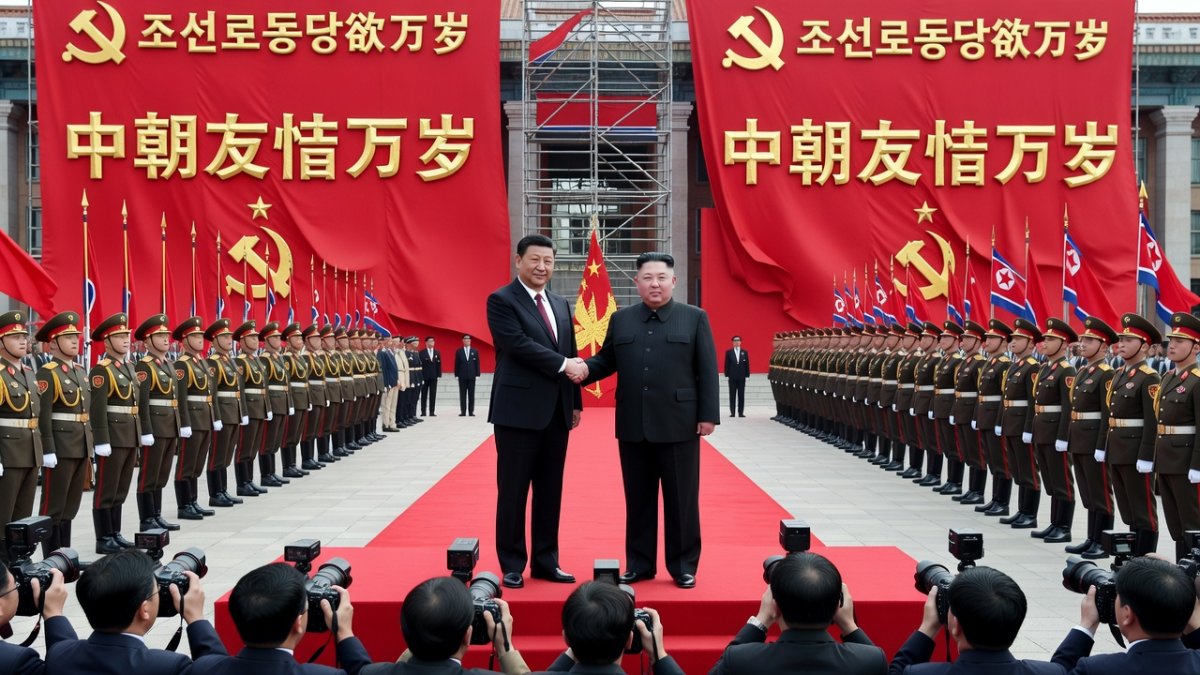
The Symbolic Weight of Xi Jinping's Return to Pyongyang
Chinese President Xi Jinping concluded his two-day visit to Pyongyang, marking his first official trip to North Korea since 2019. This engagement underscores Beijing's determination to maintain influence over a partner whose strategic location borders China's northeast provinces and serves as a buffer against external military presence. North Korean leader Kim Jong Un orchestrated elaborate welcomes, including red-carpet ceremonies and performances, which state media portrayed as affirmations of enduring alliance.
Kim highlighted that Xi selected Pyongyang for his initial state visit of the year, signaling the "utmost importance" attached to bilateral relations according to KCNA reports. From China's perspective, such optics help reinforce the narrative of socialist solidarity at a time when North Korea has pursued closer coordination with Russia. The visit allows Beijing to project continuity in its foreign policy doctrine of prioritizing neighborhood stability.
Analysts note that these displays serve China's broader interest in preventing any vacuum that external powers might exploit. The timing, shortly after Xi's engagements with other major leaders, further illustrates Pyongyang's value in China's diplomatic calendar. Overall, the trip reflects calculated efforts to sustain leverage without immediate transactional outcomes.
High-Level Accompaniment and Institutional Coordination
Xi Jinping traveled with senior figures including his de facto chief of staff Cai Qi, Defence Minister Dong Jun, Foreign Minister Wang Yi, and Commerce Minister Wang Wentao. Their presence signals the integration of security, diplomatic, and economic channels in managing the relationship. Wang Yi's involvement, in particular, aligns with the Ministry of Foreign Affairs' role in sustaining dialogue frameworks established over decades.
Wang Wentao's participation points to potential MOFCOM oversight of trade mechanisms that sustain North Korea amid sanctions. These officials collectively embody the Chinese leadership's multi-ministry approach to a neighbor whose economic dependence remains pronounced. Such delegations ensure that discussions encompass both immediate protocol and longer-term strategic alignment.
The composition also reflects domestic political signaling within China, where coordination across party and state organs reinforces unified messaging on foreign policy. This structured presence differentiates the visit from purely ceremonial exchanges. It positions the engagement as a substantive review of shared interests rather than isolated optics.
Commemorative Acts and the 1961 Defence Pact Anniversary
Both leaders visited the Friendship Tower honoring Chinese soldiers from the Korean War and planted a fir tree at Pyongyang's top cadre school. These acts symbolize the historical foundation of ties dating to the 1961 mutual defence agreement, whose 65th anniversary falls in 2026. State outlets such as Xinhua framed the gestures as evidence of an "evergreen friendship" rooted in shared sacrifice.
The pact remains China's sole formal defence commitment with any nation, highlighting North Korea's unique position in Beijing's security architecture. Commemorations serve to remind domestic and international audiences of enduring obligations without specifying new commitments. They also provide visual reinforcement of the "common destiny" rhetoric employed at the Monday banquet.
By engaging in these rituals, China signals continuity in its approach to historical alliances amid evolving regional dynamics. The events avoid forward-looking pledges that might constrain policy flexibility. Instead, they anchor the relationship in established precedent while allowing room for pragmatic adjustments.
Economic Lifelines and the Absence of Denuclearization References
China continues to function as North Korea's primary economic partner, supplying essential goods and political cover against multilateral sanctions tied to the nuclear programme. During the talks, state media readouts omitted any discussion of denuclearization, consistent with Beijing's recent pattern of de-emphasizing the issue publicly. This omission reflects a pragmatic assessment that pressing the matter yields limited returns given Pyongyang's entrenched positions.
Xi expressed hope for jointly advancing the socialist cause, yet underlying differences persist regarding market-oriented reforms. North Korea has shown reluctance to adopt elements of China's developmental model, preferring centralized control over expanded foreign investment. Such divergences illustrate the limits of influence despite economic interdependence.
Beijing's calculus prioritizes stability on its border over ambitious transformation agendas that could destabilize the regime. The visit therefore focused on reaffirming political alignment rather than introducing new economic conditionalities. This approach preserves China's role as the indispensable interlocutor while managing expectations about rapid change.
Kim Jong Un's Diplomatic Balancing and Regional Context
Kim Jong Un's hosting of Xi shortly after meetings involving other major powers demonstrates Pyongyang's strategy of cultivating multiple relationships to offset sanctions pressure. The North Korean leader reaffirmed support for Beijing's "One China" principle, securing symbolic reciprocity on core sovereignty concerns. Such gestures help maintain the flow of Chinese assistance that underpins regime resilience.
From China's viewpoint, the engagement counters any perception that North Korea has pivoted exclusively toward alternative partners. MFA and NDRC coordination ensures that economic and diplomatic tracks remain synchronized to protect strategic interests along the border. The visit thus functions as a reminder of Beijing's foundational role without requiring explicit concessions.
Second-order effects include strengthened signaling to domestic constituencies in both capitals about the durability of the alliance. Kim gains domestic prestige from hosting a high-profile guest, while Xi demonstrates proactive management of a volatile periphery. These dynamics reinforce mutual utility even amid occasional frictions.
Geopolitical Calculus and Long-Term Strategic Implications
Beijing's engagement reflects a broader doctrine of managing alliances to prevent encirclement and maintain influence in Northeast Asia. By reasserting presence in Pyongyang, China seeks to shape the environment in which North Korea interacts with Russia and other actors. This approach carries risks, as over-reliance on economic leverage alone may not fully align Pyongyang's security choices with Chinese preferences.
For North Korea, the optics of the visit provide leverage in negotiations with other states by showcasing continued high-level access to Beijing. The absence of new agreements suggests both sides favor incremental confidence-building over ambitious packages that could invite external scrutiny. Future interactions will likely hinge on how regional tensions evolve and whether additional sanctions relief materializes.
Overall, the trip illustrates China's preference for steady-state management of the relationship rather than dramatic breakthroughs. It positions Beijing to respond flexibly to developments while upholding the narrative of unbreakable socialist bonds. Such measured engagement aligns with long-standing foreign policy principles emphasizing stability and non-interference in internal affairs.
By Prof. Marcus Chen, Staff WriterThis article was produced with AI-assisted research and editorial support. Reporting is based on sources cited in the article.
What's Your Reaction?
 Like
0
Like
0
 Dislike
0
Dislike
0
 Love
0
Love
0
 Funny
0
Funny
0
 Wow
0
Wow
0
 Sad
0
Sad
0
 Angry
0
Angry
0

World Politics Analyst at Global1.News. Based in Beijing, covering US-China relations, global trade, and geopolitical strategy. Brings deep analytical perspective to the power dynamics shaping international affairs.















Comments (0)