
Xi Jinping's 2026 Pyongyang Summit: Northeast Asia Shifts
Xi Jinping's 2026 Pyongyang Summit: Recalibrating Northeast Asia's Strategic Alignments The Limited Yield of the Kim-Xi Encounter The June 2026 meeting between Xi Jinping and Kim Jong Un in Pyongyang marked the Chinese leader's first visit to North Korea since 2019 and his initial overseas engagement that year. Both sides issued familiar rhetoric about deepening ties, with Kim
The Limited Yield of the Kim-Xi Encounter
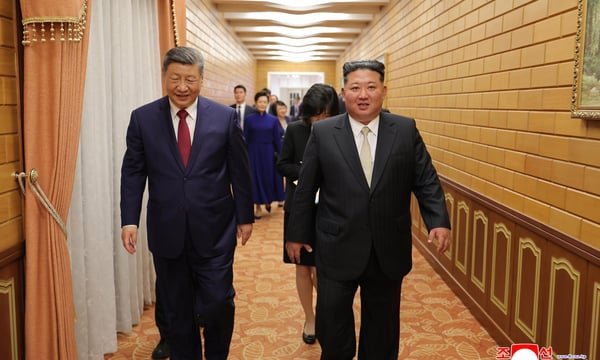
The June 2026 meeting between Xi Jinping and Kim Jong Un in Pyongyang marked the Chinese leader's first visit to North Korea since 2019 and his initial overseas engagement that year. Both sides issued familiar rhetoric about deepening ties, with Kim describing the relationship as "solid" and Xi pledging to elevate bilateral links to "new heights." Concrete deliverables remained sparse, however, as the two-day summit produced only general commitments to future exchanges rather than signed agreements on specific projects or security arrangements.
North Korea's state media emphasized political, social, cultural, and economic cooperation alongside high-level visits. Reports from KCNA highlighted Kim's pledge to treat the China relationship as Pyongyang's "most important top-priority strategic work." South Korea's Chosun Daily noted that North Korean coverage omitted references to diplomacy, law enforcement, and military affairs that apparently featured in the discussions, suggesting Pyongyang sought to control the narrative around sensitive security topics.
Inter-Korean Relations Under Renewed Beijing-Pyongyang Coordination
The summit carries direct consequences for inter-Korean dynamics. By reaffirming traditional friendship without any mention of denuclearization, the meeting reinforces Pyongyang's ability to engage Seoul from a position of nuclear strength. Kim's public unveiling of a new nuclear material production facility and Kim Yo Jong's description of nuclear weapons as the "core force" for sovereignty occurred just before Xi's arrival, signaling that North Korea views its arsenal as non-negotiable.
South Korean policymakers must now assess whether enhanced China-North Korea exchanges will translate into greater Chinese leverage over Pyongyang's behavior toward the South. Historical precedent shows that Beijing has occasionally moderated North Korean provocations during periods of close coordination, yet the current emphasis on military and law-enforcement ties raises the possibility of reduced Chinese willingness to restrain Pyongyang's actions along the demilitarized zone or in maritime disputes.
South Korean Foreign Policy Under President Lee Jae-myung
President Lee Jae-myung's administration faces a more complex diplomatic environment following the summit. Lee's approach has sought balanced engagement with both Washington and Beijing while maintaining deterrence against North Korea. The omission of denuclearization from the Kim-Xi agenda undercuts Seoul's efforts to build multilateral pressure on Pyongyang and complicates Lee's attempts to revive dialogue channels with the North.
Seoul will likely respond by accelerating security consultations with the United States and Japan while exploring limited economic confidence-building measures that do not compromise alliance commitments. The summit also highlights the limits of South Korean influence over China-North Korea relations, reminding policymakers that Beijing retains structural economic leverage over Pyongyang that no amount of inter-Korean outreach can fully offset.
The China-Russia-North Korea Triangle and Its Korean Implications
North Korea's growing alignment with Russia adds another layer to the regional equation. Foreign Minister Choe Son-hui's characterization of Pyongyang-Moscow ties as corresponding to "the level of an alliance" indicates concrete military benefits flowing from that partnership. Xi's decision to visit Pyongyang can be read as an effort to reassert China's position as North Korea's primary interlocutor at a moment when Russian arms and technology offer Kim an alternative path to military modernization.
For South Korea, this triangular dynamic raises concerns about technology transfers that could enhance North Korean capabilities in ways that directly affect the peninsula's military balance. While most of North Korea's trade continues to run through China, the Russian connection provides Pyongyang with diversification that reduces the effectiveness of any future Chinese economic pressure. Seoul must therefore calibrate its own Russia policy carefully to avoid secondary effects on its northern border security.
Potential Military Exchanges and Regional Stability
The reported agreement on military affairs exchanges represents the most consequential element not publicized in North Korean domestic media. Should these exchanges involve joint exercises, intelligence sharing, or equipment transfers, they could alter the operational environment around the Korean Peninsula. Past patterns of China-North Korea military contact have remained limited, yet any expansion would occur against the backdrop of heightened U.S. and Japanese vigilance in the region.
South Korean defense planners will monitor the scope of such activities closely. Expanded military coordination between Beijing and Pyongyang could constrain Seoul's options in a crisis and complicate extended deterrence arrangements with Washington. At the same time, China's repeated appeals for "strategic coordination" suggest Beijing seeks influence over North Korean actions rather than simply enabling greater adventurism.
Strategic Landscape for Northeast Asia
The summit underscores the persistence of Cold War-era alignments even as economic interdependence continues across the region. Xi's statement in Rodong Sinmun that the traditional friendship remains "invincible" regardless of international shifts reflects China's determination to maintain its role on the peninsula. The absence of any denuclearization discussion, confirmed by the PRC Foreign Ministry's avoidance of the topic, further entrenches the nuclear status quo.
Japan and the United States will interpret the meeting as evidence that diplomatic initiatives toward North Korea must account for both Chinese and Russian equities. For South Korea, the challenge lies in preserving alliance cohesion while preventing the consolidation of a de facto China-Russia-North Korea axis from isolating Seoul diplomatically. The coming months will reveal whether the general commitments made in Pyongyang translate into sustained institutional contacts or remain largely symbolic.
By Prof. David Park, Staff WriterThis article was produced with AI-assisted research and editorial support. Reporting is based on sources cited in the article.
What's Your Reaction?
 Like
0
Like
0
 Dislike
0
Dislike
0
 Love
0
Love
0
 Funny
0
Funny
0
 Wow
0
Wow
0
 Sad
0
Sad
0
 Angry
0
Angry
0

East Asia/Technology Correspondent at Global1.News. Seoul-based voice covering Korean politics, technology, business, and culture. Analyzes how technology and geopolitics intersect across East Asia.















Comments (0)