
US Strikes Iran After Apache Downed Near Strait of Hormuz
In a recent BBC News report, the escalation between the US and Iran entered a dangerous new phase this week after an Iranian drone downed a US Army Apache helicopter patrolling the Strait of Hormuz. The incident triggered immediate US retaliation through CENTCOM strikes on Iranian air defense infrastructure and prompted a broad Iranian response involving drone attacks on US pos
In a recent BBC News report, the escalation between the US and Iran entered a dangerous new phase this week after an Iranian drone downed a US Army Apache helicopter patrolling the Strait of Hormuz. The incident triggered immediate US retaliation through CENTCOM strikes on Iranian air defense infrastructure and prompted a broad Iranian response involving drone attacks on US positions in Bahrain and Jordan. Regional states including Jordan, Kuwait, and Bahrain found themselves directly involved as interceptors or alert zones. The Strait of Hormuz, which carries roughly 20 percent of global oil supplies, has remained closed to commercial traffic since late February following earlier US and Israeli operations against Iranian targets. This latest cycle of strikes raises fresh questions about the viability of ongoing US-Iran negotiations and the wider impact on energy routes vital to Europe and Asia. Russian analysts note that prolonged closure of the waterway could force Moscow to recalibrate its own energy export strategies amid shifting great-power alignments in the Gulf.
Introduction — The New Phase of US-Iran Hostilities
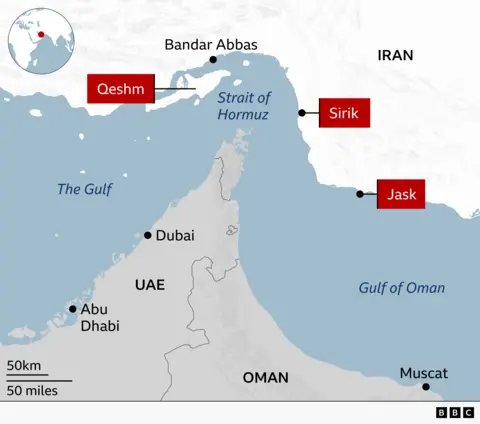
The sequence unfolded rapidly. On Monday an American AH-64 Apache helicopter came under attack from an Iranian drone while operating over the Strait of Hormuz. Two crew members survived and were recovered by a US sea drone in what officials described as the first confirmed military rescue using such a platform. President Donald Trump publicly accused Iran of the downing and stated that the United States “must, of necessity” respond. CENTCOM then launched multiple waves of self-defense strikes against Iranian air defense systems, ground control stations, and radar sites near Jask, Sirik, and Qeshm island. The Islamic Revolutionary Guard Corps (IRGC) answered by targeting 21 sites at US installations in Bahrain, home to the US Fifth Fleet, and in Jordan, while also claiming to have shot down a US MQ-9 drone over Bushehr province. Jordan’s military reported shooting down five incoming missiles, Kuwait’s army confirmed active interception efforts, and Bahrain issued air raid alerts. Iran’s Foreign Minister Abbas Araghchi warned that Tehran “will leave no attack or threat unanswered” and urged foreign forces to “leave our region if you want to be safe.” Parliament Speaker Mohammad Baqer Qalibaf added that Iran prefers diplomacy but can “speak other languages far more fluently.” US House Speaker Mike Johnson, present when President Trump authorized renewed strikes, remarked that officials “lament that it became necessary.”
The Apache Downing and the US Response
The Apache incident occurred during a routine patrol over the narrow waterway that has served as a persistent flashpoint since late February. Iranian forces employed a drone to strike the helicopter, forcing both crew members to eject. They were subsequently rescued by an American sea drone operating in the area, marking the first verified instance of such a vessel conducting a combat rescue. President Donald Trump immediately attributed responsibility to Iran and signaled that a US response was unavoidable. CENTCOM characterized the helicopter’s mission as standard maritime security operations linked to protecting freedom of navigation. The downing took place against the backdrop of sustained hostilities that began earlier this year and have already disrupted commercial traffic through the Strait of Hormuz. US officials emphasized that the crew’s survival demonstrated effective coordination between air and maritime assets, while Iranian statements framed the drone strike as a defensive measure against perceived encroachment. The episode immediately raised the temperature of an already volatile standoff, prompting allied capitals in the Gulf to heighten alert levels.
CENTCOM's Retaliatory Strikes
CENTCOM executed multiple successive waves of strikes aimed at neutralizing Iranian air defense systems, ground control stations, and surveillance radar installations positioned along the approaches to the Strait of Hormuz. The targets included coastal areas around Jask and Sirik as well as Qeshm island, locations chosen for their proximity to critical maritime chokepoints. US officials described the operation as a measured, proportional action taken under existing rules of engagement to neutralize immediate threats. The IRGC later stated that the strikes had damaged a telecommunications tower and two water tanks, characterizing the US action as an escalation against civilian-adjacent infrastructure. American statements stressed that only military assets were engaged and that collateral effects were minimized. The strikes represented a direct application of self-defense authorities following the helicopter incident and reflected the broader US commitment to safeguarding navigation through the vital energy corridor. Regional observers noted that the choice of targets near the Strait underscored Washington’s determination to keep the waterway secure despite Iranian countermeasures.
Iran's Retaliation and the Regional Fallout
The IRGC responded by directing drone strikes against 21 designated targets at US military facilities in Bahrain and Jordan. Additional claims included the downing of a US MQ-9 Reaper drone over Bushehr province. Jordan’s armed forces confirmed they successfully intercepted and destroyed five missiles originating from Iranian territory. Kuwait’s army reported ongoing interception operations against incoming projectiles, while Bahrain activated air raid sirens and later announced that incoming threats had been repelled. These developments illustrated how the conflict has drawn in neighboring states that host US military infrastructure. Bahrain, as the headquarters of the US Fifth Fleet, faced particular exposure, while Jordan and Kuwait balanced alliance obligations with domestic security concerns. Iranian messaging portrayed the retaliation as a legitimate response to US aggression, whereas US and allied statements condemned the widening of the battlefield. The involvement of these Gulf states highlights the risk that further exchanges could destabilize the entire region and complicate evacuation or reinforcement plans for American forces.
Diplomatic Language Meets Military Action
Iran’s Foreign Minister Abbas Araghchi issued pointed statements asserting that Tehran “will leave no attack or threat unanswered” and advising foreign powers to depart the region for their own safety. He had previously cautioned that external forces operating near Iranian territory remain vulnerable to miscalculation or accidental engagement. Parliament Speaker Mohammad Baqer Qalibaf reinforced the message by noting Iran’s preference for diplomacy while underscoring its readiness to employ alternative means when commitments are broken. On the American side, House Speaker Mike Johnson recounted being present during President Trump’s decision-making process and expressed regret that renewed military action had become necessary. These statements reveal a persistent gap between diplomatic rhetoric and operational reality. Both sides continue to frame their actions as defensive, yet the pattern of retaliation shows little sign of de-escalation. The presence of high-level US officials in the decision loop indicates that Washington views the current posture as sustainable for the immediate term, while Iranian leaders signal that further pressure will be met with equivalent force.

Analysis — A Conflict Without Off-Ramps
The latest round of exchanges indicates that months of negotiations have yet to produce a durable ceasefire mechanism. With the Strait of Hormuz effectively closed to commercial shipping since late February, global energy markets face sustained uncertainty that affects importers from Europe to East Asia. Russian officials have privately expressed concern that prolonged disruption could shift leverage in energy negotiations and force adjustments in Moscow’s own export calculus amid competition with Gulf producers. For Jordan, Kuwait, and Bahrain, the expanding theater creates immediate operational challenges as they manage air defense responsibilities while maintaining alliance commitments. Analysts suggest that neither Washington nor Tehran currently possesses a clear off-ramp that would allow both sides to claim success without appearing to concede ground. The cycle of drone and missile strikes risks normalizing low-level conflict that could spiral if a miscalculation occurs near the sensitive maritime corridor. Great-power observers, including Russia and China, continue to monitor whether the United States will sustain its forward posture or seek a negotiated pause that restores at least partial traffic through the Strait. Until such an arrangement emerges, the region remains locked in a pattern of retaliation with few visible diplomatic exits.
Additional context from energy analysts underscores that any reopening of the Strait would require verifiable de-escalation steps from both the United States and Iran, steps that have so far proved elusive. The involvement of multiple regional actors further complicates mediation efforts, as each state weighs its own security guarantees against the costs of hosting US forces. In this environment, the risk of accidental escalation remains elevated, particularly given the density of military assets operating in close proximity. Russian strategic commentary emphasizes that the current impasse also affects broader Eurasian energy corridors, potentially accelerating alternative pipeline projects that bypass the Gulf altogether. The absence of clear communication channels between the principal antagonists leaves little room for rapid crisis management should another incident occur. Observers therefore view the present stalemate as fragile, with the potential for wider confrontation if either side interprets restraint as weakness.
By Irina Volkov, Staff WriterThis article was produced with AI-assisted research and editorial support. Reporting is based on sources cited in the article.
What's Your Reaction?
 Like
0
Like
0
 Dislike
0
Dislike
0
 Love
0
Love
0
 Funny
0
Funny
0
 Wow
0
Wow
0
 Sad
0
Sad
0
 Angry
0
Angry
0

Russia/Eastern Europe Correspondent at Global1.News. Covering Russian politics, energy, security, and the shifting dynamics of the post-Soviet space. Provides clear-eyed analysis on one of the world's most opaque regions.












Comments (0)