
Typhoon Bavi 1,000km Superstorm Hits Taiwan, Southern China
Typhoon Bavi: 1,000km-Wide Superstorm Targets Taiwan and Southern China After 15 Killed in Philippines Storm Trajectory and Human Toll Typhoon Bavi, measuring approximately 1,000 kilometres across at its widest point, has moved through the western Pacific with sustained intensity that distinguishes it from more compact systems. Landslides triggered by its outer bands have alrea
Storm Trajectory and Human Toll
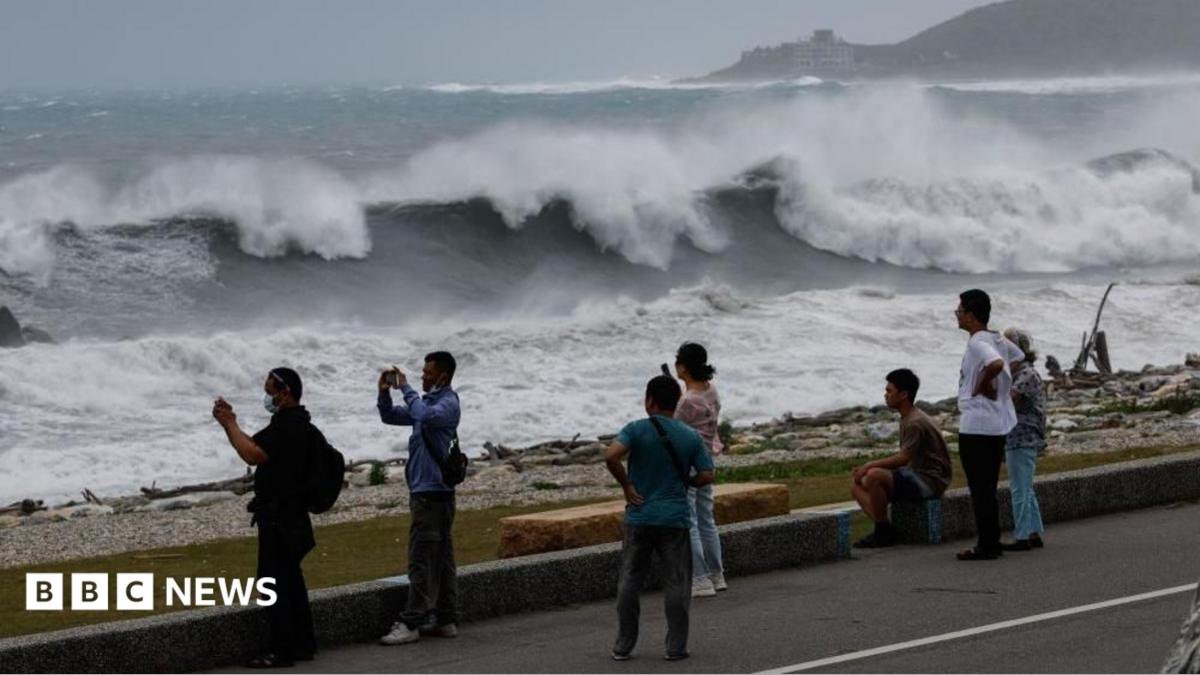
Typhoon Bavi, measuring approximately 1,000 kilometres across at its widest point, has moved through the western Pacific with sustained intensity that distinguishes it from more compact systems. Landslides triggered by its outer bands have already claimed at least 15 lives on the Philippine island of Mindanao, where families were buried overnight and rescue teams continue searching for the missing. The storm’s scale allows it to affect multiple jurisdictions simultaneously, first delivering heavy rainfall to Taiwan’s northern and eastern counties before brushing remote Japanese islands and then making landfall in south-eastern China on Saturday.
Forecasts from Taiwan’s Central Weather Administration indicate the possibility of up to one metre of rainfall in vulnerable catchments, raising risks of flash flooding and additional landslides. Because Bavi is the largest storm by areal extent to approach the island since 1987, its rainbands will remain influential even after the centre passes. The human toll in the Philippines underscores how outer circulation can produce lethal secondary hazards hundreds of kilometres from the eye. Chinese meteorological services have similarly warned of significant impacts once the system crosses the Taiwan Strait, with residual moisture potentially tracking northward toward Jiangsu, Anhui and eventually the Bohai Sea region. These successive exposure zones illustrate the storm’s capacity to test preparedness across contrasting administrative and topographic settings within a compressed timeframe.
Preparations Across Affected Regions
Taiwanese authorities have mobilised 29,000 soldiers for relief and recovery operations, the largest such deployment since the late 1980s. Commercial aviation has been curtailed, with dozens of flights cancelled and schools closed across the north and east. Local governments have distributed thousands of sandbags to flood-prone districts while farmers have accelerated harvests and fishermen have secured vessels in harbours. One sixty-year-old fisherman, Chen Ming-hui, cautioned that calm conditions preceding the arrival should not induce complacency, describing the coming system as potentially the most terrifying in recent memory.
Across the strait, Fujian province has activated its own contingency plans ahead of Saturday’s expected landfall. Supermarket inventories have been depleted as households stock essential supplies. Japanese carriers Japan Airlines and All Nippon Airways have each cancelled more than one hundred flights through the weekend, affecting nearly 40,000 passengers, while Thai Airways and Malaysia Airlines have suspended services to and from Taipei. These coordinated but separate measures reflect the practical constraints imposed by a single meteorological event on tightly interconnected transport networks. The emphasis on pre-positioning military assets and civilian supplies demonstrates how regional governments translate forecast uncertainty into concrete logistical decisions without relying on external assistance.
Testing China's Disaster Management Framework
China’s response to Bavi occurs against the recent memory of Typhoon Maysak, which left 39 people dead and prompted the evacuation of more than 130,000 residents, primarily in Guangxi. Ma Jun, director of the Institute of Public and Environmental Affairs, has noted that Bavi’s size and energy could allow its remnants and outer rainbands to reach the Bohai Sea region after landfall in Fujian. Northern provinces, he observed, possess less institutional experience with typhoon impacts and must therefore strengthen preparations. This assessment highlights an asymmetry in domestic disaster-management capacity between southern coastal administrations that routinely confront such systems and inland or northern jurisdictions that encounter them infrequently.
The Ministry of Emergency Management and the National Development and Reform Commission will coordinate resource allocation, yet the storm’s northward trajectory after landfall introduces coordination challenges across provincial boundaries. Fujian’s experience with Maysak provides a recent operational template, but the transfer of lessons to Jiangsu and Shandong remains incomplete. By naming specific provinces and invoking the Bohai industrial corridor, Ma Jun’s warning underscores the need for vertical integration between central ministries and local governments rather than ad-hoc measures. The episode therefore serves as a live test of whether existing frameworks can accommodate an unusually large storm whose effects extend beyond traditional typhoon corridors.
Cross-Strait Dynamics Amid Natural Threats
Taiwan’s decision to place 29,000 troops on standby represents the largest military mobilisation for a weather event since 1987. While the primary mission is domestic relief, the scale inevitably intersects with cross-strait security calculations. Chinese authorities have issued parallel warnings for Fujian, creating a rare situation in which both sides of the strait simultaneously prepare for the same meteorological hazard. Historical patterns show that natural disasters occasionally produce limited, technical exchanges even when political relations remain strained.
The absence of formal coordination mechanisms means each side manages its own evacuations, flight cancellations and supply distributions. Nevertheless, the shared exposure to Bavi’s rainbands illustrates how environmental risks can generate de facto interdependence. Taiwan’s Central Weather Administration and China’s meteorological services already exchange data through regional networks; the current storm may reinforce the utility of such channels without requiring new political agreements. At the same time, the large Taiwanese deployment signals resolve to protect infrastructure and populations, a message that resonates beyond immediate humanitarian needs. The episode therefore reveals both the persistence of separate command structures and the practical pressures that encourage minimal information sharing when lives and economic assets are at stake.
Climate Resilience and Regional Cooperation
Bavi’s exceptional width aligns with observed trends of increasing tropical-cyclone size in a warming Pacific. ASEAN members have already experienced supply-chain interruptions from earlier storms this season, and the present system threatens further delays to semiconductor and electronics shipments routed through Taiwan and southern China. The Ministry of Commerce has monitored inventory levels at key ports, yet the storm’s timing coincides with peak production cycles, amplifying potential downstream effects on global manufacturing.
Regional cooperation remains largely technical. The ASEAN Coordinating Centre for Humanitarian Assistance and China’s bilateral disaster-relief agreements provide frameworks for information exchange, but operational integration is limited. Climate-adaptation financing discussions within multilateral development banks have gained urgency, yet concrete projects in northern Chinese provinces lag behind those in the south. Bavi therefore functions as a reminder that resilience investments must extend beyond traditional typhoon corridors if economic corridors linking the Bohai rim to Southeast Asian markets are to remain stable under more energetic storm regimes.
Strategic Implications for East Asia
The storm’s projected path through Taiwan, Fujian and potentially the Bohai Sea industrial zones places critical manufacturing and energy infrastructure in a single meteorological footprint. Chinese planners have long treated the Bohai corridor as a strategic counterweight to southern coastal concentrations; any disruption there carries implications for national industrial policy. Taiwan’s semiconductor clusters face parallel exposure, raising questions about redundancy in global supply chains that neither side can resolve unilaterally.
Multilateral forums such as the East Asia Summit and APEC have discussed disaster-risk reduction, yet concrete mechanisms for joint exercises across the Taiwan Strait remain absent. Bavi demonstrates that large-scale weather systems can generate simultaneous demands on military logistics, civil aviation and provincial governance, thereby testing the region’s capacity for parallel rather than integrated responses. Over time, repeated exposure to such events may encourage incremental confidence-building measures focused on meteorological data and port management, even as broader geopolitical competition continues. The storm thus serves as a reminder that environmental hazards operate on a different timetable from political calendars and can shape strategic calculations irrespective of prevailing diplomatic conditions. By Prof. Marcus Chen, Staff Writer
This article was produced with AI-assisted research and editorial support. Reporting is based on sources cited in the article.
What's Your Reaction?
 Like
0
Like
0
 Dislike
0
Dislike
0
 Love
0
Love
0
 Funny
0
Funny
0
 Wow
0
Wow
0
 Sad
0
Sad
0
 Angry
0
Angry
0

World Politics Analyst at Global1.News. Based in Beijing, covering US-China relations, global trade, and geopolitical strategy. Brings deep analytical perspective to the power dynamics shaping international affairs.













Comments (0)