
Xi Jinping's Ethnic Unity Law: Forging a Singular Chinese National Consciousness
Xi Jinping's Ethnic Unity Law: Forging a Singular Chinese National Consciousness The Law's Core Provisions and Historical Context China's new law on Promoting Ethnic Unity and Progress, which came into effect on July 1, 2026, marks a decisive consolidation of long-standing party-state efforts to reshape ethnic minority governance. Article 63 of the legislation states that organ
The Law's Core Provisions and Historical Context
China's new law on Promoting Ethnic Unity and Progress, which came into effect on July 1, 2026, marks a decisive consolidation of long-standing party-state efforts to reshape ethnic minority governance. Article 63 of the legislation states that organizations and individuals outside the territory of the People's Republic of China who commit acts that undermine ethnic unity and progress or create ethnic division shall be held legally responsible according to law. This clause codifies existing practices of transnational oversight rather than introducing an entirely novel mechanism. The statute as a whole advances the Chinese Communist Party's preferred narrative of the zhonghua minzu, the Chinese nation, in which all 56 officially recognized ethnic groups are presented as interconnected by history, culture, and blood.
The measure builds on decades of policy evolution that began with the nominal restoration of ethnic autonomy after the Cultural Revolution. It now shifts emphasis toward the active construction of a common national consciousness. The law repeatedly frames all ethnic groups as forming a single historical community united by shared territory, history, culture, and political future. This framing replaces earlier tolerance for ethnocultural heterogeneity with an explicit project of forging a shared spiritual home under centralized direction.
Educational Requirements and Language Standardization
Chapter 2 of the law, titled Building a New Spiritual Home, sets out concrete mechanisms for achieving this objective. Schools and other educational institutions at all levels and types must integrate the requirement of forging a strong sense of community of the Chinese nation throughout the entire education process. Implementation relies on nationally unified textbooks, the national common language and script as the basic language and teaching language, and the construction of a discourse system that explains the history and connotations of the multi-ethnic unity pattern of the Chinese nation and civilization.
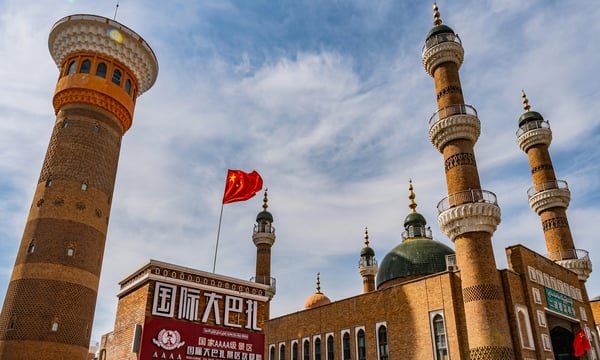
While the statute notes that the state respects and guarantees the study and use of minority languages and scripts, their role remains subordinate to the national common language. State organs, social organizations, enterprises, institutions, and other social organizations are directed to highlight the national common language and script in everyday use, publications, and public signage. These provisions operationalize the concept of forging, which, as scholars have observed, conveys both the casting of identity into a fixed mold and the stabilization of that identity under party-state oversight.
Economic Integration and Population Mobility Mechanisms
Chapters 3 and 4, titled Promoting Exchange, Exchange, and Integration and Promoting Common Prosperity and Development, position social and economic development as instruments for advancing all ethnic groups toward socialist modernization together. The core theme is integration of ethnic minorities with the majority Han Chinese population through coordinated economic and social development that emphasizes the construction of interconnected community environments.
People's governments at or above the county level are tasked with developing joint construction of population mobility service platforms between ethnic regions and between ethnic regions and other regions. The law also supports two-way cross-regional enrolment in higher education institutions in ethnic minority regions and other regions, and promotes the joint learning, living, and growth and progress of students of all ethnic groups in schools and other educational institutions at all levels and types. These measures extend the logic of integration into everyday social spaces, aiming to reduce linguistic, cultural, or religious barriers through sustained contact in Han Chinese-dominated settings.
Implications for the Korean-Chinese Community
China's approximately 1.7 million ethnic Koreans, known as Chaoxianzu and concentrated primarily in Yanbian Korean Autonomous Prefecture, face direct consequences from these provisions. The requirement to prioritize the national common language in education and public life will accelerate the marginalization of Korean-language instruction and signage in Yanbian. Cross-border cultural exchanges with South Korea, which have historically sustained Korean identity through media, literature, and family ties, now operate under heightened scrutiny pursuant to Article 63.
The emphasis on joint learning and population mobility platforms suggests that Chaoxianzu students may increasingly be directed toward educational environments outside traditional Korean autonomous areas. Such shifts risk eroding the distinct linguistic and cultural resources that have allowed the community to maintain connections with both North and South Korea. Over time, these policies could narrow the space for expressions of Korean identity that do not align with the zhonghua minzu framework.
Consequences for Inter-Korean Relations and Seoul's Diplomacy
The law's assimilationist thrust carries implications for inter-Korean relations and South Korean foreign policy. Yanbian has long served as a conduit for cultural and economic interactions across the peninsula. As educational and linguistic standardization intensifies, the prefecture's role in preserving Korean-language heritage and facilitating people-to-people contacts may diminish. This development complicates Seoul's efforts to maintain soft-power influence among ethnic Koreans in China and could constrain informal channels that have occasionally supported dialogue between the two Koreas.
Seoul's diplomatic posture toward Beijing must now account for the extraterritorial reach asserted in Article 63. South Korean civil society organizations, academic institutions, and media outlets that engage with Chaoxianzu communities risk being characterized as undermining ethnic unity if their activities are deemed to promote division. Policymakers in Seoul will therefore need to calibrate public support for Korean cultural preservation in China with the practical requirement of sustaining stable bilateral economic and security relations.
Strategic Significance and Long-Term Trajectory
The Promoting Ethnic Unity and Progress law represents the most systematic attempt yet to translate Xi Jinping's vision of ethnic governance into binding legal obligations. By subordinating minority-language use, directing population mobility, and extending oversight beyond China's borders, the statute seeks to eliminate what the party-state views as persistent barriers to full assimilation. For the Chaoxianzu and other groups, the measure signals that cultural distinctiveness will be tolerated only insofar as it reinforces rather than challenges the overarching narrative of a singular Chinese nation.
Over the coming years, implementation through county-level governments and educational institutions will determine how rapidly these changes reshape daily life in autonomous prefectures such as Yanbian. The law's provisions on cross-regional enrollment and population mobility platforms merit particular attention, as they may extend practices previously observed in other regions to additional ethnic minority populations. South Korean observers and policymakers should monitor these developments closely, as they directly affect the future of Korean cultural continuity inside China and the parameters within which Seoul can engage Beijing on issues of shared heritage.
By Prof. David Park, Staff WriterThis article was produced with AI-assisted research and editorial support. Reporting is based on sources cited in the article.
What's Your Reaction?
 Like
0
Like
0
 Dislike
0
Dislike
0
 Love
0
Love
0
 Funny
0
Funny
0
 Wow
0
Wow
0
 Sad
0
Sad
0
 Angry
0
Angry
0

East Asia/Technology Correspondent at Global1.News. Seoul-based voice covering Korean politics, technology, business, and culture. Analyzes how technology and geopolitics intersect across East Asia.














Comments (0)