
Trump Signs Iran Peace Deal at Versailles — and the GOP Is Furious
Versailles, France – June 19, 2026 — Let me be real with you, folks. If you told me a year ago that Donald Trump would be sitting at the Palace of Versailles, signing a peace deal with the Islamic Republic of Iran while half his own party called him a sellout, I'd have asked what you were smoking. But here we are. June 2026. And the world just changed. President Donald Trump si
Versailles, France – June 19, 2026 — Let me be real with you, folks. If you told me a year ago that Donald Trump would be sitting at the Palace of Versailles, signing a peace deal with the Islamic Republic of Iran while half his own party called him a sellout, I'd have asked what you were smoking.
But here we are. June 2026. And the world just changed.
President Donald Trump signed a Memorandum of Understanding with Iran on Wednesday at the Palace of Versailles, flanked by French President Emmanuel Macron. The document — which both sides are calling a framework agreement — is supposed to end the war that the US and Israel launched against Iran on February 28 of this year. And I mean "supposed to" with full emphasis, because the fine print is where things get complicated.
The Deal: What's Actually in the MOU
The MOU runs 14 points across multiple pages, and here's what we know from leaked copies circulating on Capitol Hill. First and most immediately: the guns stop. A ceasefire that was fragile as tissue paper now has a formal framework behind it. Both sides have agreed to halt military operations — a full stop to one of the most devastating conflicts the Middle East has seen in decades.
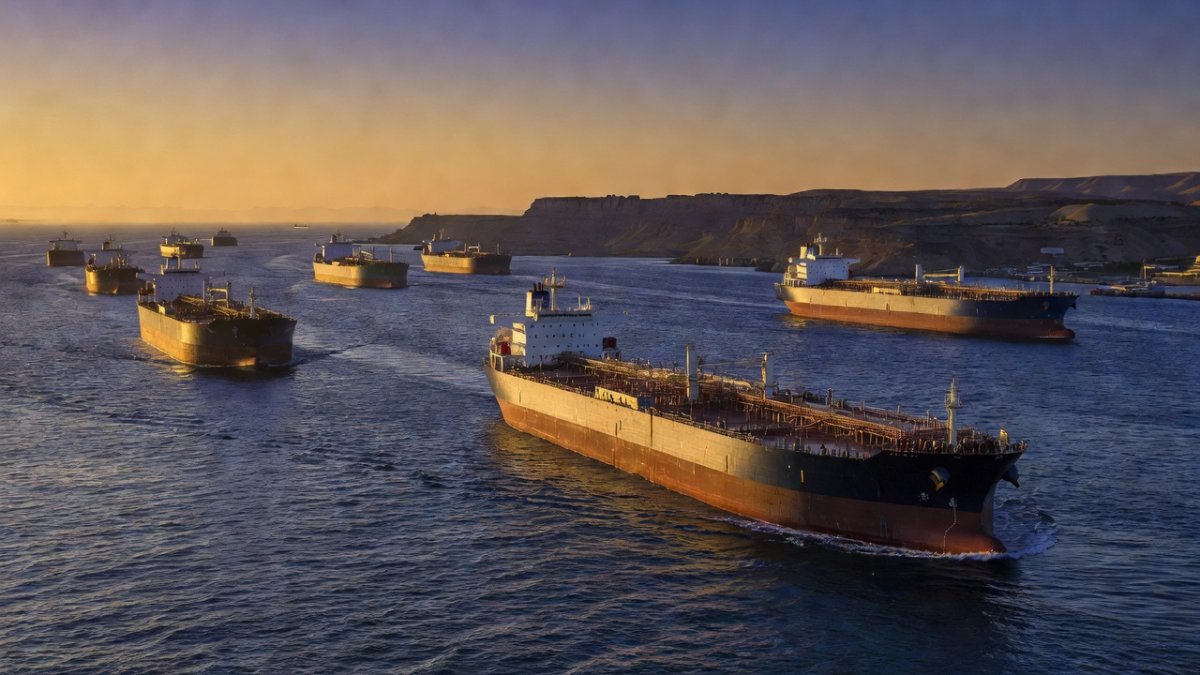
Second: the Strait of Hormuz reopens. This is massive. We're talking about the single most critical chokepoint for global oil supplies — 20 million barrels a day flow through that narrow stretch of water between Iran and Oman. By Wednesday evening, at least 12 tankers had already passed through, according to ship-tracking data reported by the New York Post and confirmed by Reuters. Saudi-flagged supertankers were among the first through.
Brent crude dropped about 1 percent to $78.79 a barrel in early Asian trading Thursday. Still about $8 higher than before the war started, but the direction is clear: markets like this deal.
Third: the US naval blockade on Iran is being lifted. The MOU says it ends fully within 30 days. During that window, the number of vessels the US allows through Iranian ports will be proportional to the traffic Iran restores through the Strait. It's a carefully choreographed dance — each side gives a little, takes a little.
Fourth: a $300 billion reconstruction fund for Iran. This is the part that's got everybody hot under the collar. The fund is described as "private" — a pool of international investment money designed to rebuild Iran's war-damaged infrastructure. More than half of it, roughly $150 billion, has already been committed, according to a source with direct knowledge who spoke to Reuters. Trump has publicly distanced himself from this provision, but the text of the MOU is right there on paper.
Fifth: temporary waiver of Iranian oil sanctions. Iran gets to sell oil again, at least for the 60-day negotiation window. Considering Iran sits on the world's fourth-largest proven oil reserves, this is a multibillion-dollar lifeline.
Sixth: a pathway toward a comprehensive peace agreement. The MOU kicks off 60 days of negotiations in Geneva, Switzerland, where both sides will try to turn this framework into something permanent. Nuclear talks are on the table but punted to later rounds — the deal explicitly sets aside questions about what to do with Iran's nuclear program.
Where It Was Signed — and Why That Matters
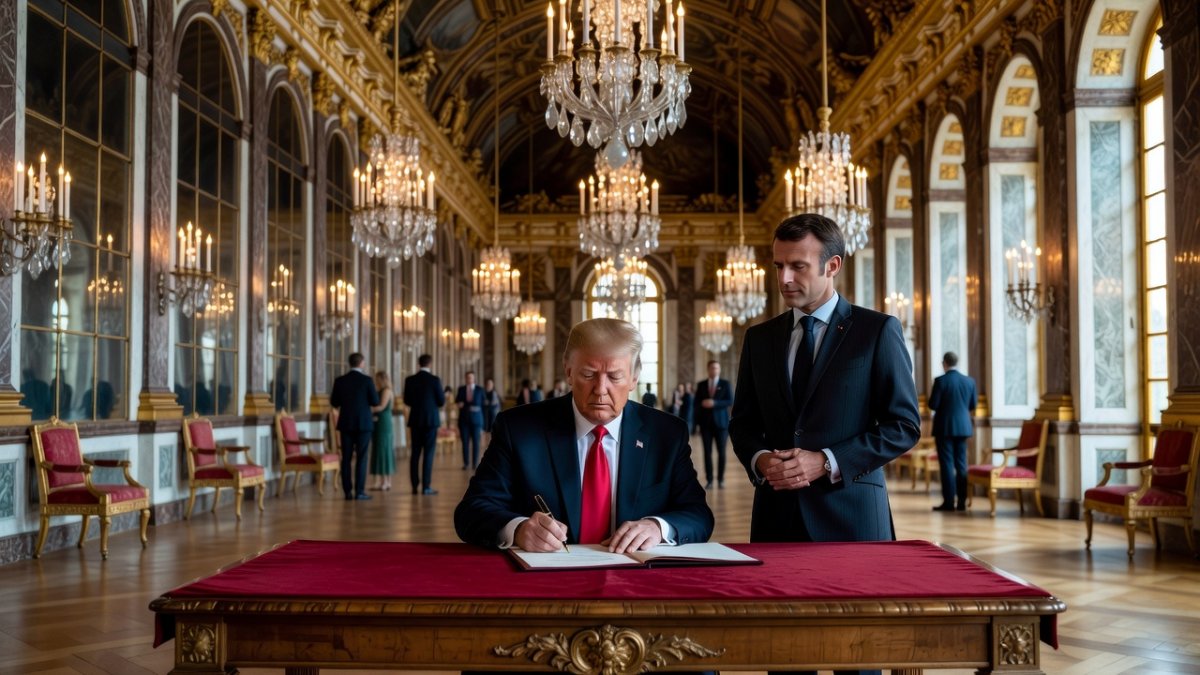
The signing ceremony at the Palace of Versailles wasn't an accident. Trump was at the G7 summit, and Macron — who has positioned himself as a mediator throughout the conflict — hosted the event. Video footage shows Trump signing the document at an ornate table, with the gilded Hall of Mirrors in the background. It was the kind of visual that defines presidencies: a wartime commander in chief, in the seat of European royalty, putting ink to paper on a peace deal.
But here's the thing. The White House billed it as a "Trump deal" — his signature achievement, ending a war he started. Iran's chief negotiator, Mohammad Bagher Ghalibaf, had a very different take. "The agreement is a record of US failure," he said. "People will see it and judge."
Same document. Radically different interpretations. That's the Middle East for you.
The Republican Backlash — This Is Where It Gets Wild
Now, folks, if you think the Democrats are the ones throwing fits, you haven't been watching Capitol Hill the last 48 hours. The loudest voices calling this deal a disaster are coming from Trump's own party.
Senator Bill Cassidy of Louisiana stood on the Senate floor and called the MOU — I quote — "the worst foreign policy blunder in decades." Not a bad deal. Not a compromise. The worst. In decades.
And he wasn't alone. The New York Times reported Wednesday that the deal "opened new fissures in the GOP," with Republicans on Capitol Hill questioning whether the administration secured adequate concessions after months of a costly, unpopular war. Republican hawks warned that the agreement "could leave Tehran richer, stronger and still able to threaten the region," according to RTE.
The Malay Mail reported Thursday that copies of the signed agreement circulating on Capitol Hill triggered "scorching public criticism" from Trump's fellow Republicans. And Trump? He fired back, calling his critics "these fools" and insisting that no president had ever been as tough on Iran as he has.
"There is nothing as smart as the market — and the market loves it," Trump said in defense of the deal, as reported by The Guardian.
What This Means for the Region
The Lebanon piece is still unresolved. The MOU extends the ceasefire to Lebanon, but Hezbollah has already rejected the terms of the US-backed ceasefire between Israel and Lebanon. The BBC reported Thursday that upcoming negotiations in Switzerland between the US and Iran explicitly do not include Hezbollah. That's a loose thread that could unravel a lot of things.
Meanwhile, Britain and France have expressed interest in assisting with demining the Strait of Hormuz once the conflict is paused. The White House confirmed Trump is expected to discuss demining operations with allied leaders at the G7.
And China? The Asia Times reported that the peace deal "rattles China's energy strategy." Beijing had a favorable position in Middle East energy markets during the war. A reopened Strait — with Iran controlling passage and a rebuilt economy — changes the calculus completely.
The $300 Billion Elephant in the Room
Let me zero in on this, because it's the detail that's going to dominate the next 60 days. A $300 billion reconstruction fund for Iran — the country the United States has been bombing for four months. Al Jazeera called it "the latest political flashpoint in Washington," and they're not wrong.
The Jerusalem Post, citing a source with direct knowledge, confirmed that "more than half that sum has already been committed." Private money, earmarked for Iran's rebuilding. Republicans see it as a payoff. The administration calls it reconstruction. Iran's supreme leader, per BBC, said "Trump made a mistake" by agreeing to it.
Whichever way you slice it, $300 billion is real money. And in a political season where every dollar spent on foreign policy is scrutinized, this number is going to follow Trump through the rest of his term.
The Bottom Line
Here's what I think, and I don't sugarcoat things on this channel. The US-Iran MOU is a historic document — there's no denying that. Ending a war that has cost thousands of lives, destabilized the entire Middle East, and driven oil prices to multi-year highs is objectively significant.
But this deal is also deeply, profoundly fragile. The questions it doesn't answer are louder than the ones it does. What happens to Iran's nuclear program? What about Hezbollah? What about the $300 billion? What about the Republican revolt that's already brewing?
The next 60 days in Geneva will determine whether this is the beginning of peace or just a pause before round two. And I'll be watching every single minute of it.
By Jessica Ali, Lead Anchor — Global 1 News
This article was produced with AI-assisted research and editorial support. Reporting is based on sources cited in the article.
What's Your Reaction?
 Like
0
Like
0
 Dislike
0
Dislike
0
 Love
0
Love
0
 Funny
0
Funny
0
 Wow
0
Wow
0
 Sad
0
Sad
0
 Angry
0
Angry
0

Editor-in-Chief at Global1.News. Atlanta-based journalist who cuts through the BS and tells it like it is. Lead anchor, host, and the voice you hear when the spin stops and the truth starts.









Comments (0)