
Trump Declares Iran Will 'Never Have a Nuclear Weapon' as G7 Leaders Endorse Fragile Peace Framework
In a recent BBC News report from the G7 summit in Évian-les-Bains, US President Donald Trump declared that Iran will "never have a nuclear weapon" under the preliminary peace deal that ended months of devastating war in the Middle East, as world leaders gathered to assess the agreement's implications. Trump Declares Iran Will 'Never Have a Nuclear Weapon' as G7 Leaders Endorse
In a recent BBC News report from the G7 summit in Évian-les-Bains, US President Donald Trump declared that Iran will "never have a nuclear weapon" under the preliminary peace deal that ended months of devastating war in the Middle East, as world leaders gathered to assess the agreement's implications.
Trump Declares Iran Will 'Never Have a Nuclear Weapon' as G7 Leaders Endorse Fragile Peace Framework
Évian-les-Bains, France – 17 June 2026 — The 52nd G7 summit in Évian-les-Bains, France, the largest gathering of the world's leading industrialised democracies, has been dominated by the aftermath of Trump's preliminary peace deal with Iran.
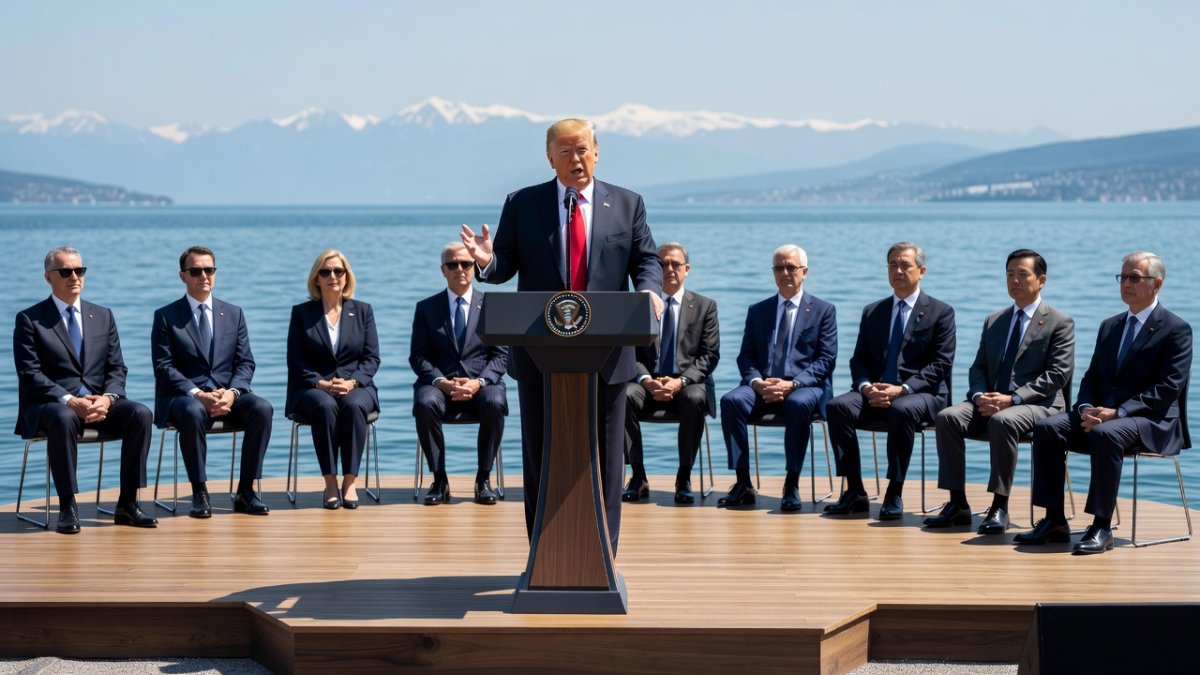
The G7 Summit in Évian: A Fragile Peace Takes Centre Stage
Leaders from Canada, France, Germany, Italy, Japan, the United Kingdom, and the United States, joined by the European Union, convened at the Hotel Royal on the shores of Lake Geneva against a backdrop of dramatic geopolitical shifts. Trump arrived in Évian having just announced the MOU, declaring the Strait of Hormuz would reopen under the agreement. For the G7, the summit represented a critical moment to assess and endorse the framework, while confronting the deeper structural instability the war exposed in global energy markets and the Middle Eastern order. Trump's bilaterals with French President Emmanuel Macron, UK PM Keir Starmer, and UAE President Sheikh Mohammed bin Zayed set the tone for the discussions.
The G7 joint statement on geopolitical issues formally welcomed the US-Iran agreement, praising Trump's strong leadership. Macron characterised the deal as "very important," saying it would fix the nuclear issue. However, questions lingered over the agreement's lack of detail, its reception in the US Congress, and its implications for Israel's ongoing operations in Lebanon. The presence of additional regional figures, including Egyptian President el-Sissi and Qatar's emir, underscored the summit's expanded focus on Middle East stability beyond the core G7 membership.
This summit marks a historic moment — the first time a sitting US president has signed a peace deal with Iran while attending a G7 summit. The irony is not lost on diplomats who recall the 2003 Évian G8 summit, where transatlantic divisions over Iraq dominated proceedings. Analysts suggest the current gathering could signal a shift toward pragmatic engagement rather than confrontation, though verification of commitments remains essential. Discussions also touched on broader energy security, with UK Prime Minister Starmer highlighting British readiness to assist in Strait of Hormuz demining operations as part of the reopening process.
Trump's arrival followed Pakistan Prime Minister Shehbaz Sharif's announcement of the breakthrough just days earlier. The electronic signing of the memorandum of understanding by Trump, Vice President JD Vance, and Iranian parliamentary speaker Mohammad Bagher Ghalibaf has set the stage for formal ceremonies. G7 leaders expressed cautious optimism, noting that the deal's success hinges on follow-through during the extended ceasefire period.
The Mechanics of the Deal: What the MOU Actually Says
Vice President JD Vance has provided the clearest description of the MOU, telling media it is approximately one-and-a-half pages and very general in nature — a framework document rather than a comprehensive treaty. Paragraph one commits Iran to regional peace and stability, including a cessation of funding to organisations Washington designates as terrorist groups. Most critically, Vance confirmed that Iran commits to a verifiable commitment to not building a nuclear weapon, with the IAEA and United States assisting in destroying the country's highly enriched uranium stockpile. Iranian Foreign Minister Seyed Abbas Araghchi has confirmed that fresh talks on finalising details will begin promptly.
The formal ceremony in Geneva on Friday will see Vance attend on behalf of the United States, with Iranian parliamentary speaker Mohammad Bagher Ghalibaf representing Tehran. Iran's Foreign Minister Araghchi has confirmed a new round of negotiations to finalise the agreement's details will commence in Switzerland on the same day. The deal includes a 60-day ceasefire extension during which technical talks on Iran's nuclear programme, sanctions relief, and asset releases will proceed. Trump stated that the agreement had been sent to Congress for review, emphasising its role in preventing nuclear proliferation.
Trump described the agreement as a wall against a nuclear weapon, contrasting it with the 2015 JCPOA negotiated under Barack Obama, which Trump said could have destroyed the Middle East. The deal will be sent to the United States Congress for approval, though questions remain about congressional reception given criticism from both Republican hawks and Democrats. According to Vance, the document establishes only broad principles, leaving specifics for subsequent rounds. This approach allows rapid initial progress while deferring contentious issues such as ballistic missile limits and full sanctions relief.
Regional actors including Hezbollah have received assurances tied to the ceasefire framework. The preliminary nature means implementation will require sustained diplomatic pressure from all parties involved, including those who facilitated behind-the-scenes contacts.
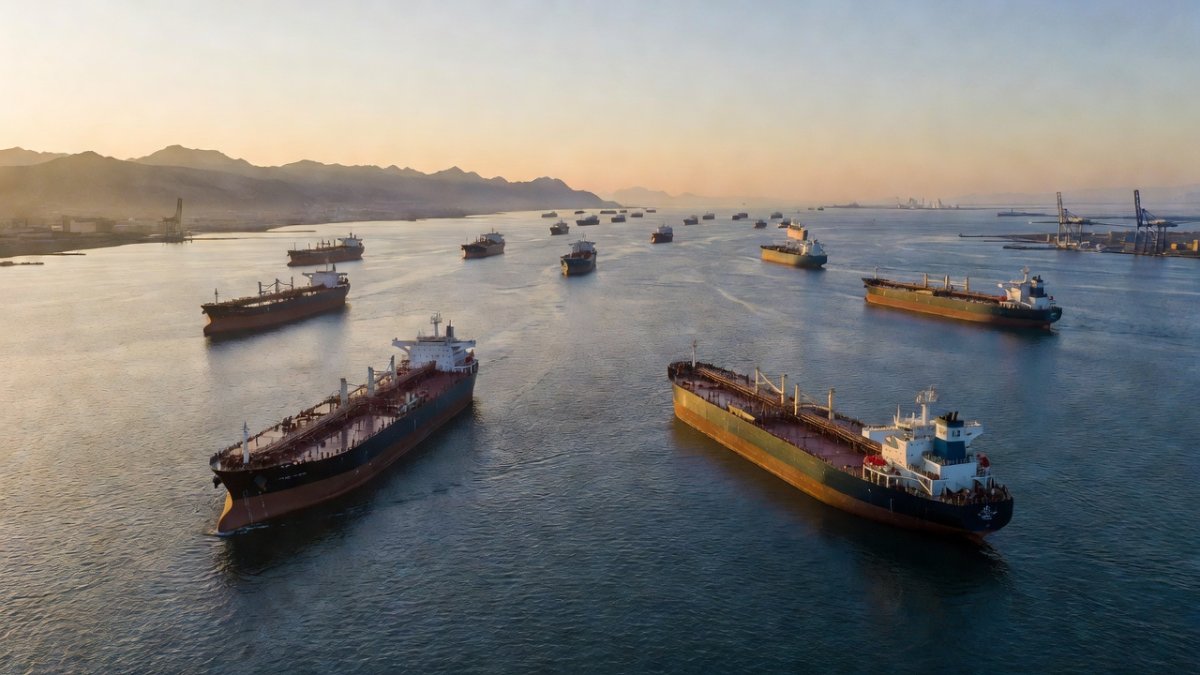
Oil Markets and the Strait of Hormuz: From Crisis to Calibration
The reopening of the Strait of Hormuz — through which approximately 20% of the world's oil and LNG normally passes — represents the most tangible outcome of the preliminary deal. Trump declared the waterway would open "toll-free," a reference to Iran's earlier threats to impose fees on vessels using the strategic chokepoint. Demining operations are reportedly underway, with UK PM Starmer confirming British involvement in the reopening process. The strait has been effectively closed since late February, when the US and Israel launched airstrikes on Iran. Trump publicly urged that oil supplies resume flowing freely to stabilise global markets.
Brent crude, which skyrocketed from approximately $70 per barrel before the war to a peak of around $120 during the conflict, has fallen sharply to $78-82 per barrel following the deal's announcement. This drop from peak represents significant relief for global consumers, particularly in Asia, which is heavily reliant on Middle Eastern oil and LNG supplies. Japanese and South Korean markets surged 5% and 5.2% respectively. However, energy analysts warn that the lack of detail in the MOU could inject unease and uncertainty into markets, potentially prolonging volatility. Global equities including the S&P 500 rose 1.6 percent on the news.
For energy-importing nations across Europe and Asia, the price relief is welcome. But the oil price collapse presents serious challenges for producer states whose budgets depend on higher crude prices — none more so than Russia. The toll-free reopening clause removes a potential revenue tool Iran had previously floated, further contributing to downward pressure on benchmarks. Market participants now await concrete steps on demining and verification before fully pricing in sustained stability.
Russia's Complicated Position: Between Partner and Competitor
Moscow's response to the US-Iran deal reflects the delicate balancing act the Kremlin has maintained throughout the conflict. Russia condemned the initial US-Israeli airstrikes on Iran in February — its regional partner and fellow member of the "axis of resistance" — but has consistently supported de-escalation and mediation efforts. Trump explicitly thanked Russian President Vladimir Putin for facilitating the peace process, alongside Chinese President Xi Jinping, acknowledging the behind-the-scenes diplomatic role Moscow played. The Kremlin has framed its involvement as constructive engagement despite earlier criticisms of Western military actions.
The falling oil price presents a more immediate and painful challenge for the Kremlin. Russia's war economy — now in its fifth year of the conflict in Ukraine — is heavily dependent on energy revenues, which have been squeezed by Western sanctions and price caps. The sharp drop in global crude prices following the Iran deal announcement compounds Russia's fiscal pressures at a time when inflation is rising, labour shortages are acute, and public discontent is growing. A barrel of Brent crude below $80 means reduced revenue for Rosneft and Gazprom, the state-controlled energy giants that underwrite Putin's military spending. Officials in Moscow have noted the dual impact on both state budgets and long-term strategic planning.
Yet there is a diplomatic dimension. Russia's role in facilitating the Iran deal — even indirectly — enhances Moscow's position as an indispensable power in Middle Eastern diplomacy, a narrative the Kremlin actively cultivates. For Putin, being thanked by Trump at the G7 provides a veneer of great-power status that the war in Ukraine has increasingly undermined. Russian statements continue to stress the importance of multilateral approaches while monitoring how the extended ceasefire period unfolds in practice.
Regional Fallout: Israel, Lebanon, and the Proxy Network
Trump's outspoken criticism of Israeli Prime Minister Benjamin Netanyahu — among his most sharp yet — has added a volatile dimension to the post-deal landscape. The US president used his G7 platform to criticise Israel's military operations in Lebanon, where Hezbollah operates under Iranian patronage. The Israel Defense Forces has confirmed carrying out strikes in Lebanon, while Hezbollah's leadership says it has received assurances from Tehran under the ceasefire framework. These developments occur against the backdrop of an extended 60-day period for final negotiations.
Pakistan's PM Shehbaz Sharif, whose nation mediated the breakthrough, said the agreement includes the immediate and permanent termination of military operations on all fronts, including in Lebanon. However, US officials clarified that while Lebanon is covered by the ceasefire framework, the withdrawal of Israeli forces from Lebanese territory is not a condition of the deal, with Israel retaining the right to self-defence. Additional regional leaders such as UAE President Sheikh Mohammed bin Zayed participated in dedicated Middle East sessions at the summit to discuss implementation.
Behind the scenes, the UAE, Egypt, and Qatar — whose leaders joined the G7 Middle East session in Évian — are positioning themselves to shape the next phase. For the Gulf states, the Iran deal removes an immediate threat of regional conflagration but also resets the balance of power in ways that may not favour their long-term interests. Continued monitoring by international observers will be required to ensure proxy dynamics do not reignite tensions during the negotiation window.
Analysis and Implications: What Comes Next
The framework deal represents a historic inflection point — the end of the most severe military confrontation between the United States and Iran in modern history. Yet its very general nature means the hardest work lies ahead. The 60-day negotiation window will test whether both sides can translate principles into enforceable commitments on nuclear enrichment, ballistic missile programmes, sanctions architecture, and regional security arrangements. IAEA inspectors returning to Iran will play a central verification role alongside US technical support for stockpile destruction.
For Russia, the calculus is complex. A stable Middle East with lower oil prices hurts Moscow economically but reduces the risk of a wider conflagration that could further destabilise its southern periphery. The Kremlin will watch closely as the US-Iran technical negotiations unfold, seeking to preserve its influence in Tehran while managing the economic fallout of lower energy revenues. For China, the deal is a double-edged sword: lower oil prices benefit the world's largest energy importer, but reduced Iran-China economic ties and diminished leverage over Tehran's strategic alignment represent significant costs. Both powers have been acknowledged by Trump for their facilitation efforts.
Perhaps most significantly, the deal and the G7 summit that has shaped its reception demonstrate the limits of American military dominance in the Middle East. The war — which began with US and Israeli airstrikes on 28 February — revealed that even the most advanced military power cannot quickly achieve its objectives in a regional conflict. The framework peace, however fragile, may be remembered not as Trump's triumph but as a recognition that the era of unilateral military solutions in the Middle East has passed. Future progress depends on converting broad commitments into detailed, verifiable accords acceptable to Congress and Iranian authorities alike.
By Irina Volkov, Staff WriterThis article was produced with AI-assisted research and editorial support. Reporting is based on sources cited in the article.
What's Your Reaction?
 Like
0
Like
0
 Dislike
0
Dislike
0
 Love
0
Love
0
 Funny
0
Funny
0
 Wow
0
Wow
0
 Sad
0
Sad
0
 Angry
0
Angry
0
Russia/Eastern Europe Correspondent at Global1.News. Covering Russian politics, energy, security, and the shifting dynamics of the post-Soviet space. Provides clear-eyed analysis on one of the world's most opaque regions.










Comments (0)