
The Diamond Dream Fades in Sierra Leone
The Diamond Dream Fades in Sierra Leone In the dusty pits of Kono, Sierra Leone, men strip to the waist and dig under the punishing West African sun. They sift gravel through their fingers, washing it in muddy water, searching for a glint — a tiny fragment of diamond that might change their fortunes. But these days, the glints are getting harder to find. "I have not made a lot
The Diamond Dream Fades in Sierra Leone
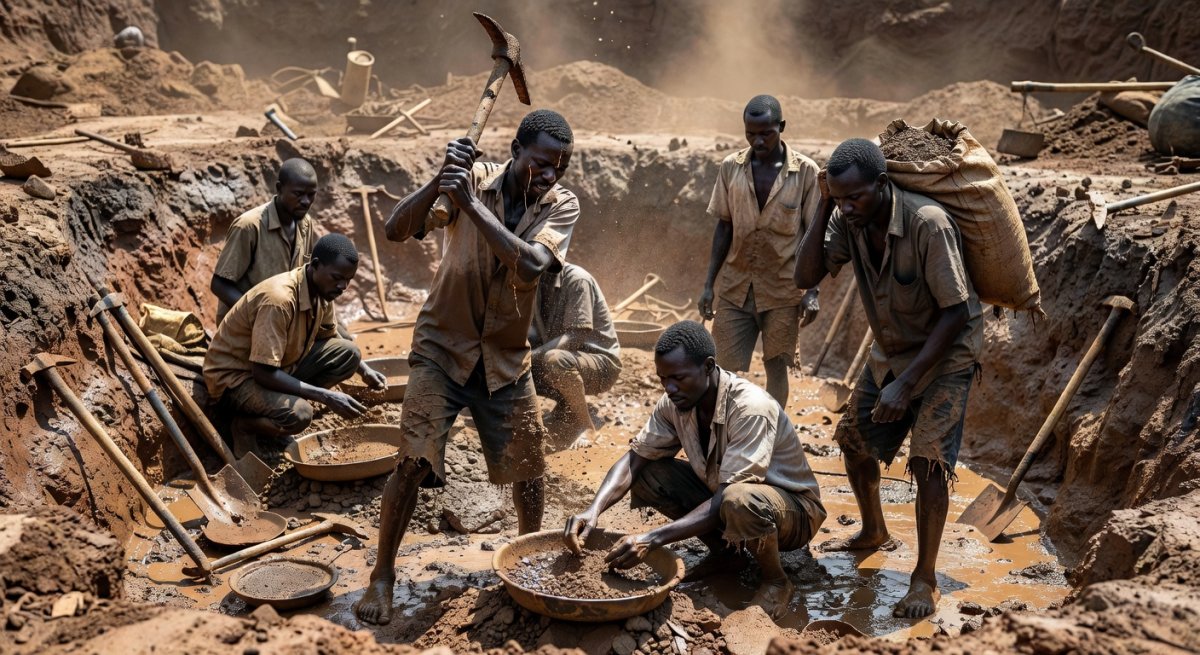
In the dusty pits of Kono, Sierra Leone, men strip to the waist and dig under the punishing West African sun. They sift gravel through their fingers, washing it in muddy water, searching for a glint — a tiny fragment of diamond that might change their fortunes. But these days, the glints are getting harder to find.
"I have not made a lot of money yet," says Daniel, a foreman at one of the informal small-scale mines in the diamond-rich region. "Sometimes for the whole of the year you can't get anything. It is by the grace of God that you find a diamond. We are just dreaming, really. We still have that hope."
That hope is being tested like never before. The rising popularity of lab-grown diamonds — chemically identical stones manufactured mostly in India and China — has sent the price of natural diamonds tumbling by some 40 percent in just four years. And the ripple effects are devastating communities across West Africa that have depended on diamond mining for nearly a century.
A Hundred Years of Digging, a Future in Doubt
Diamond mining has been the lifeblood of this part of Sierra Leone since the 1930s. For generations, families in Kono have built their lives around the glittering stones pulled from the earth. But last year, the country's biggest diamond mine, Koidu Holdings, shut its gates — eliminating 1,000 jobs after a bitter industrial dispute over miners' pay.
Officially, the company cited the cost of the dispute and security concerns. But insiders acknowledge a deeper truth: the global market for natural diamonds has weakened so severely that the economics no longer add up. Lab-grown alternatives now cost up to 70 percent less than mined diamonds, squeezing an industry that was already under pressure.
Kono's governor, Augustine Shekho, puts it bluntly. "Lower diamond values have reduced earnings for miners, constrained investment, and weakened local economic activity," he told the BBC. The decline has hit the region hard over the past five years.
"The Diamonds Have Failed Us"
For many in Sierra Leone, the diamond carries bitter memories alongside its sparkle. Thirty-five years ago, the region was consumed by a brutal 11-year civil war — a conflict immortalised in the Leonardo DiCaprio film Blood Diamonds — in which armed factions fought for control of the mines. More than 50,000 people died, and hundreds of thousands more were maimed or displaced.
Governor Shekho knows that pain intimately. "They shot at random, they killed people, burnt the entire town," he recalls. "All houses were mined. It was a war of terror… She, my mother, unfortunately, was the victim of that… It was a nightmare. I would really not want to think about it."
Those wounds have never fully healed. And now, even the promised prosperity that the diamonds were supposed to bring feels hollow to many.
"To me the diamonds have failed us," says Abubakar Amara, a primary school teacher in Kono. "What have those diamonds done for our community, for Kono, for Sierra Leone? We are considered as poor in the world."
Lab-Grown Diamonds and the Ethics Question
The lab-grown diamond industry presents itself as the ethical alternative. Factory-made from crystallised carbon using high-pressure, high-temperature (HPHT) or chemical vapour deposition (CVD) technology, these stones are cheaper, more traceable, and — their advocates argue — better for the planet.
Rohit Mehta, chief executive of Forlink Ventures, a commodities house based in India's lab-grown diamond capital of Surat, says consumers are increasingly conscious about the environmental cost of mining. "People are more conscious about climate change, about extracting too much from the earth," he argues.
But the claim that lab-grown diamonds are "green" is contested. The energy-intensive manufacturing process carries its own environmental footprint, and for communities like Kono, the shift away from mined diamonds is not an environmental victory — it is an economic catastrophe.
Fair Trade Diamonds: A Fragile Hope
In response to the crisis, British multinational De Beers has launched a project called Gemfair in Sierra Leone. The initiative offers local artisanal miners equipment, training, and more transparent pricing for their finds — essentially a fair-trade certification scheme for diamonds.
"The idea is to connect with markets so that they can be able to find a place to sell their diamonds, and also to empower them, give them training, we give them skills," says Raymond Alpha, Gemfair's local representative.
For De Beers, the project also serves a reputational purpose: allowing retailers to tell the origin story of every diamond they sell. "We are seeing a growing interest from consumers," says David Johnson, a De Beers representative. "With people increasingly wanting to know where their coffee, cotton or chocolate has come from, it's not surprising that people also want to know where their diamond — one of the most emotionally significant purchases — has come from."
Whether increased traceability can revive the market for mined diamonds remains uncertain. The lab-grown sector shows no signs of slowing down, and for the men digging in the pits of Kono, the question is whether the world still values a stone pulled from the earth by hand.
For now, they keep digging. Keep dreaming. Keep hoping for that glint in the gravel.
By Amara Diop, Staff Writer
This article was produced with AI-assisted research and editorial support. Reporting is based on sources cited in the article.
What's Your Reaction?
 Like
0
Like
0
 Dislike
0
Dislike
0
 Love
0
Love
0
 Funny
0
Funny
0
 Wow
0
Wow
0
 Sad
0
Sad
0
 Angry
0
Angry
0

West Africa/Sahel Correspondent at Global1.News. Dakar-based journalist covering politics, security, climate, and development across Francophone and Anglophone West Africa. Tells the stories of a region undergoing profound transformation.












Comments (0)