
Thailand Accelerates AI Adoption as Microsoft Launches First AI Tour in Bangkok with $1 Billion Investment
In the heart of Bangkok, Microsoft has unveiled its first-ever AI Tour, marking a pivotal moment for Thailand's technological landscape with a substantial $1 billion commitment spanning 2026 to 2028. This initiative arrives as the nation experiences remarkable AI diffusion growth at 36.4 percent, positioning it as the world's second-fastest adopter despite an overall diffusion
In the heart of Bangkok, Microsoft has unveiled its first-ever AI Tour, marking a pivotal moment for Thailand's technological landscape with a substantial $1 billion commitment spanning 2026 to 2028. This initiative arrives as the nation experiences remarkable AI diffusion growth at 36.4 percent, positioning it as the world's second-fastest adopter despite an overall diffusion rate of 12.4 percent that trails the global average of 17.8 percent. The developments promise to weave artificial intelligence into the fabric of Thai daily life, from bustling ports to serene rural communities, fostering progress rooted in harmony and mindful advancement.
Thailand Accelerates AI Adoption as Microsoft Launches First AI Tour in Bangkok with $1 Billion Investment
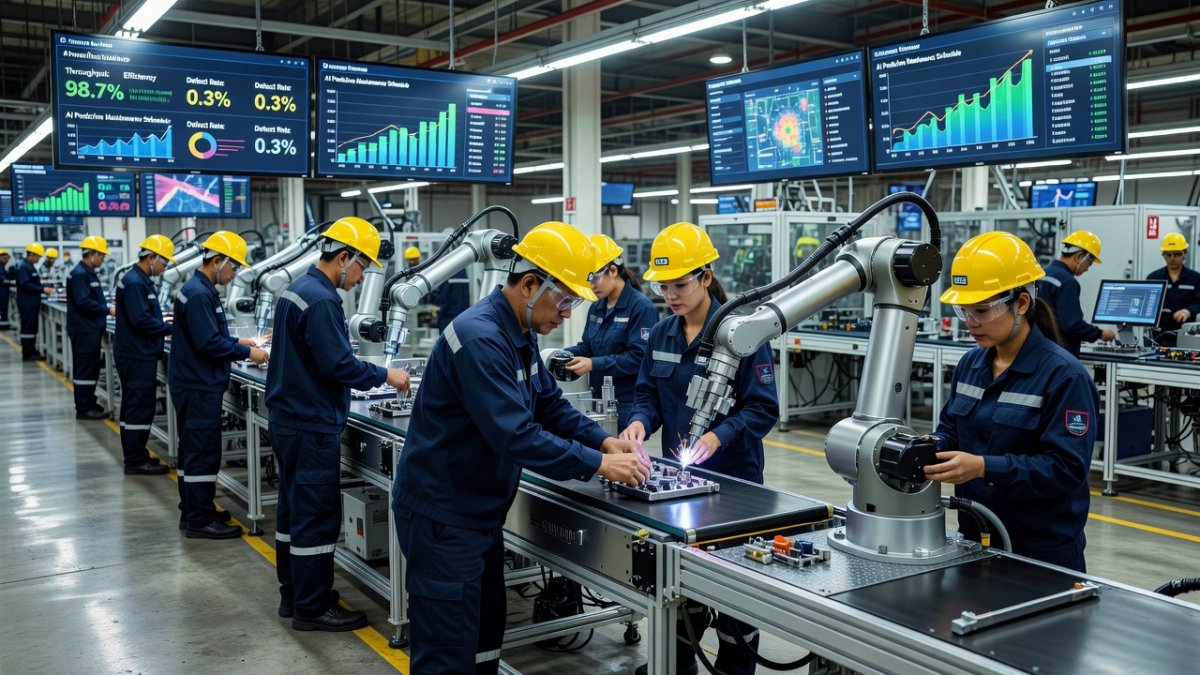
Bangkok, Thailand – Microsoft's landmark AI Tour kicked off in the Thai capital this week, drawing leaders from government, business, and local communities to explore how artificial intelligence can support the kingdom's evolving needs. The $1 billion investment over three years underscores a shared vision for integrating technology with Thailand's cultural emphasis on balance and collective well-being. As factories in the Eastern Economic Corridor demonstrate practical gains, such as a 22 percent reduction in waste through computer vision systems in Rayong, the tour highlights opportunities for sustainable growth across diverse regions including Chiang Mai, Isaan, Khon Kaen, Ayutthaya, and Phuket.

Detailed Analysis — Current AI Diffusion and Investment Scale
Thailand's AI adoption metrics reveal both promise and room for thoughtful expansion, with white-collar workers embracing the technology at 32 percent compared to the global figure of 16 percent. Leadership clarity stands notably higher at 51 percent against the worldwide average of 26 percent, suggesting strong guidance from Thai executives in navigating this transition. These figures emerge from recent surveys that also note Singapore's 63.4 percent diffusion rate and the UAE's leading 70.1 percent, providing context for Thailand's rapid 36.4 percent growth pace as the second fastest globally.
Microsoft Thailand's managing director Dhanawat Suthumpun emphasized during the tour launch that Thailand exhibits the fastest pace in terms of AI adoption among regional peers. This momentum builds on data showing overall diffusion at 12.4 percent, which, while below the 17.8 percent global average, reflects accelerating interest fueled by targeted initiatives. Organizations are increasingly moving beyond mere experimentation, as Microsoft executive vice president Ralph Haupter observed, with practical applications already visible in manufacturing hubs like Laem Chabang port where AI scheduling optimizes operations.
The Eastern Economic Corridor serves as a living laboratory, where Rayong facilities leverage AI computer vision to minimize waste by 22 percent, directly supporting economic efficiency in line with longstanding Thai values of resourcefulness. Government allocations of 1.6 billion baht aim to train 5 million citizens, addressing the reality that 87.6 percent of Thais have yet to adopt AI tools. Such efforts align with the $1 billion Microsoft pledge, creating pathways for inclusive technological integration across urban and rural landscapes.
Thailand Context — Economic Pressures and Policy Direction
Thai society, deeply influenced by Buddhist principles of mindfulness, approaches AI adoption with a focus on harmonious integration rather than hasty disruption. Communities in Isaan and Khon Kaen view these tools as extensions of traditional wisdom, where careful consideration ensures technology enhances rather than overwhelms daily rhythms. The government's training program for 5 million citizens embodies this gentle progression, encouraging citizens to engage with AI in ways that preserve cultural identity and communal bonds.
Economic pressures from an ageing population, which costs the nation approximately 1 percent of GDP annually, further motivate AI strategies as a means to sustain productivity with compassion. In Ayutthaya and Phuket, local enterprises explore AI applications that support elder care and tourism services, reflecting Thailand's enduring value of caring for all generations. The Ministry of Finance sees this as a strategic opportunity to address the demographic challenge while preserving the kingdom's social fabric.
White-collar adoption rates at 32 percent signal growing confidence among professionals who balance technological tools with ethical reflection. Across Bangkok and beyond, the emphasis remains on leadership clarity at 51 percent, guiding teams toward solutions that promote societal harmony. The Bangkok Post YouTube Short "AI-driven growth in Thai manufacturing and logistics," released on May 29 as part of the Bangkok Post Economic Forum coverage, documented how early adopters are already seeing measurable returns.
Implications for Southeast Asia and ASEAN Cooperation
Within ASEAN, Thailand's 36.4 percent AI diffusion growth positions it as a dynamic contributor alongside more advanced adopters like Singapore at 63.4 percent. The Microsoft investment and tour foster collaborative networks that could elevate regional standards, encouraging knowledge sharing rooted in mutual respect. Neighbouring economies observe how Thailand weaves technology into manufacturing and logistics, as seen in Laem Chabang port's AI-driven efficiencies.
Comparisons to the UAE's 70.1 percent diffusion highlight diverse pathways, yet Thailand's pace offers lessons in culturally attuned implementation for other Southeast Asian nations. Eastern Economic Corridor successes, including waste reductions in Rayong, demonstrate scalable models that align with ASEAN goals for sustainable development. The Board of Investment has confirmed that new incentives for AI startups will prioritize projects serving both urban Bangkok districts and remote villages in the northern highlands.
Expert Perspectives — Voices from Business and Government
TMBThanachart Bank chief executive Piti Tantakasem cautioned during panel discussions at the Microsoft AI Tour that organizations should avoid blindly purchasing AI licenses without clear purpose. "Business must define the desired outcome first and then work back to the technology," he said, warning that Thais often use powerful AI for trivial purposes rather than generating business value. His insights underscore the need for deliberate strategies that honor Thai principles of thoughtful decision-making.
Vice-Minister for Finance Santitarn Sathirathai described AI as a vital growth engine with the government acting as a steady enabler rather than a competitor to private innovation. "The government should not compete with the private sector in innovation. Instead, it should act as an enabler by creating trusted digital public infrastructure," he said. This view resonates with the 1.6 billion baht initiative for AI procurement, positioning public support as a foundation for private sector growth.
Michael Chen, chief executive of Buzzebees, added that 90 percent of employees currently lack proper AI usage skills, highlighting training as essential for equitable progress. "The most difficult hurdle is employee mindset," he noted, calling for targeted programmes that respect local work cultures while building practical skills.
Challenges and Barriers — Bridging the Digital Divide
Despite rapid growth, 87.6 percent of Thais remain outside AI adoption, presenting a significant yet surmountable barrier that calls for patient outreach. The statistic that 90 percent of employees do not know how to use AI properly points to gaps in accessible education, particularly in rural areas like Khon Kaen and Ayutthaya. Microsoft's four-pillar framework introduced at the AI Tour addresses this by focusing on employee experience, process overhaul, and innovation acceleration.
Ageing population costs equaling 1 percent of GDP yearly add urgency, yet also demand solutions infused with compassion to avoid alienating older community members. Overall diffusion at 12.4 percent, below global averages, reminds stakeholders of the need for inclusive strategies that respect varying paces of change. Community leaders in Khon Kaen and Ayutthaya have requested workshops that connect AI tools to everyday agricultural and small-business needs.
What to Watch For
Observers anticipate expanded AI applications in logistics at Laem Chabang and manufacturing in Rayong, building on the 22 percent waste reduction achievements already recorded. The Microsoft AI Tour's momentum may spur similar events in Chiang Mai and Phuket, extending benefits to tourism and agriculture sectors. The Ministry of Digital Economy and Society plans to release updated AI procurement guidelines by the end of 2026.
Regional partnerships within ASEAN could accelerate as Thailand shares insights from its 36.4 percent growth trajectory. Parliamentary sessions later this year will review funding allocations for training centres in Chiang Mai and Phuket. The combination of the $1 billion Microsoft commitment and the 1.6 billion baht government procurement creates concrete pathways for five million Thais to access AI models while addressing the 87.6 percent non-adoption rate through targeted community outreach.
As Thailand navigates this AI chapter with its characteristic grace, the fusion of innovation and tradition holds potential for enduring societal enrichment. The $1 billion investment and local initiatives together chart a path where technology uplifts communities while honoring the kingdom's timeless commitment to balance and shared prosperity.
By Ann Srisawat, Staff Writer
This article was produced with AI-assisted research and editorial support. Reporting is based on sources cited in the article.
What's Your Reaction?
 Like
0
Like
0
 Dislike
0
Dislike
0
 Love
0
Love
0
 Funny
0
Funny
0
 Wow
0
Wow
0
 Sad
0
Sad
0
 Angry
0
Angry
0

Southeast Asia Correspondent at Global1.News. Based in Bangkok, covering Thai and Southeast Asian politics, economy, technology, and culture. Deep regional perspective on one of the world's most dynamic regions.














Comments (0)