
Survival before safety for Delhi's poor as temperatures hit 45C
Survival before safety for Delhi's poor as temperatures hit 45C The streets don't cool for the desperate At 11:47 a.m. on a Tuesday when Delhi's mercury touched 45 degrees Celsius, Ramesh Kumar, 47, hauled his cycle-rickshaw through the choking lanes of Old Delhi. His shirt clung like wet paper. Sweat ran into his eyes, blurring the path ahead. He had already ferried three pass
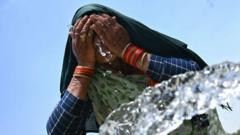
Survival before safety for Delhi's poor as temperatures hit 45C
The streets don't cool for the desperate
At 11:47 a.m. on a Tuesday when Delhi's mercury touched 45 degrees Celsius, Ramesh Kumar, 47, hauled his cycle-rickshaw through the choking lanes of Old Delhi. His shirt clung like wet paper. Sweat ran into his eyes, blurring the path ahead. He had already ferried three passengers that morning and needed four more before sunset to cover rent, his wife's medicine, and the two kids' school fees. Stopping meant starving. Continuing meant gambling with heatstroke.
Kumar is not an outlier. He is one of millions in India's capital who form the backbone of the informal economy and who have no choice but to ignore official heat advisories. While the wealthy retreat to air-conditioned offices and homes, Delhi's street vendors, construction laborers, waste pickers, and transport workers keep moving. Their survival calculus is brutally simple: a day off is a day without food.
45C is the new normal, not the exception
India Meteorological Department data shows Delhi has recorded temperatures above 44C on 18 days this season already, up from an average of nine such days a decade ago. Nighttime lows rarely dip below 32C, turning the city into a concrete oven that never switches off. Urban heat island effects amplify the danger; narrow lanes in areas like Seelampur and Jahangirpuri trap heat long after sunset.
These conditions mirror lethal heat domes seen recently in southern Europe and the American Southwest, yet the human response here is shaped by poverty rather than policy. European cities shut outdoor markets and issued red alerts. Delhi's poor simply hydrate with whatever water they can find and keep working.
Profiles from the furnace
Take Meena Devi, 34, who sells sliced fruit near ITO metro station. She arrives at 6 a.m. with 20 kilograms of watermelon and mango on her head. By noon the fruit wilts, but she stays until the evening rush. Last week she collapsed twice. Both times she revived herself with salt water bought from a nearby tea stall and returned to her cart. "If I go home, the landlord comes asking for money," she said. "The hospital is for people who can pay."
Construction worker Abdul Rahman, 29, labors on a luxury apartment tower in Gurgaon that will eventually house air-conditioned flats. He mixes cement from 8 a.m. to 5 p.m. under direct sun. Protective gear is optional and mostly absent. His contractor offers no shade tents or extra water breaks. "Ten other men wait outside the gate for my job," Rahman explained. "Complaining gets you replaced."
These stories repeat across the informal sector that employs roughly 80 percent of Delhi's workforce. Rickshaw pullers average 12-hour shifts. Domestic helpers walk between multiple households. Waste collectors sift through steaming garbage mountains. None receive paid sick leave or heat-related compensation.
Health data the government downplays
Local hospitals report a 40 percent spike in heat-related admissions compared with last year. Dehydration cases overwhelm emergency wards at Safdarjung and LNJP hospitals. Yet official heat-death tallies remain suspiciously low because most victims never reach a morgue with "heatstroke" listed as cause. Families often cite "fever" or "weakness" to avoid paperwork and stigma.
International comparisons expose the gap. When Phoenix, Arizona, hit similar temperatures, cooling centers opened within 48 hours and utility shutoffs were banned. Delhi's municipal wards contain fewer than 200 public cooling shelters for a population exceeding 20 million. The contrast is not climate; it is governance and inequality.
Climate change meets brutal economics
Global temperature rise has lengthened India's heat season by roughly 15 days since 2000. Scientists at the Indian Institute of Tropical Meteorology link this directly to anthropogenic warming. Yet adaptation remains a privilege. The same families who cannot afford fans also cannot access the new heat-action plans announced with fanfare every April and forgotten by June.
India's growth story depends on these workers. They build the malls, drive the delivery economy, and keep streets clean. Their labor subsidizes the comfort of the middle class and foreign investors alike. When temperatures kill them, the economic machine simply recruits replacements from rural areas where drought has already destroyed farming incomes.
What real protection would require
Enforceable shade and water mandates on construction sites. Portable misting stations in markets. Mandatory rest hours with wage protection. These measures exist on paper in a few states but lack funding and inspection teeth in Delhi. Enforcement would raise costs for contractors and employers who currently treat heat as an act of God rather than a manageable hazard.
International climate funds could help, yet India's negotiating position at COP talks emphasizes emissions reductions over adaptation grants for its poorest citizens. The result is a deadly stalemate where the vulnerable pay the price for both global inaction and domestic priorities skewed toward visible infrastructure over basic survival.
Delhi's poor are not choosing danger. They are choosing between immediate hunger and possible collapse. Until policy treats their lives as equally valuable as the glass towers rising around them, 45C will continue claiming bodies while the city pretends the heat is merely weather.
This is Jessica Ali for Global1 News. 🔥
This article was produced with AI-assisted research and editorial support. Reporting is based on sources cited in the article.
What's Your Reaction?
 Like
0
Like
0
 Dislike
0
Dislike
0
 Love
0
Love
0
 Funny
0
Funny
0
 Wow
0
Wow
0
 Sad
0
Sad
0
 Angry
0
Angry
0

Editor-in-Chief at Global1.News. Atlanta-based journalist who cuts through the BS and tells it like it is. Lead anchor, host, and the voice you hear when the spin stops and the truth starts.













Comments (0)