
South Korea's Leadership Transition: Han Sung-sook's Appointment and the Democratic Party's August Contest
South Korea's Leadership Transition: Han Sung-sook's Appointment and the Democratic Party's August Contest The Appointment of Han Sung-sook as Prime Minister On July 1, 2026, Han Sung-sook assumed office as South Korea's 50th prime minister and the second under President Lee Jae-myung. President Lee approved her appointment on June 30, following the National Assembly's passage
The Appointment of Han Sung-sook as Prime Minister
On July 1, 2026, Han Sung-sook assumed office as South Korea's 50th prime minister and the second under President Lee Jae-myung. President Lee approved her appointment on June 30, following the National Assembly's passage of her confirmation motion by a vote of 166 in favor to one invalid ballot out of 167 lawmakers present. This made Han the country's second female prime minister, after Han Myeong-sook who served from 2006 to 2007. Presidential Chief of Staff Kang Hoon-sik had announced the nomination on June 7, highlighting Han's background as a technology executive and her prior year as the first minister of SMEs and startups as qualifications for guiding the nation through rapid artificial intelligence transformation.
The main opposition People Power Party boycotted both the confirmation hearing report vote and the final confirmation motion, citing unresolved allegations regarding illegal building extensions at Han's property. Despite this absence, the motion passed with near-unanimous support from those present, reflecting the Democratic Party's commanding position in the legislature.
Kim Min-seok's Resignation and Political Calculations
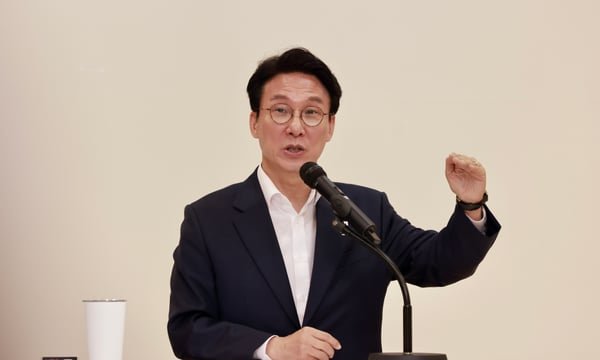
Outgoing Prime Minister Kim Min-seok left office on June 30 after speaking at a press conference in Seoul on June 22. Kim's departure followed the June 3 local elections and positioned him to contest the Democratic Party chairmanship at the party's August convention. Although he has not formally declared his candidacy, the timing of his resignation has been widely interpreted as preparation for that bid. On June 8, marking his first anniversary in office, President Lee remarked that it seemed more appropriate for Kim to take on another role, a statement widely viewed as endorsement of Kim's leadership ambitions within the party.
Kang Hoon-sik credited Kim with the government's achievements to date during the nomination announcement for Han, a comment that gained additional significance once Kim's political intentions became clear. This transition underscores the interplay between executive performance and internal party maneuvering in South Korea's political system.
The Three-Way Contest for Democratic Party Leadership
The August 17 convention now features a three-way race involving Kim Min-seok, veteran lawmaker Song Young-gil, and Jung Chung-rae. Jung, the outgoing party chair who assumed the position in August 2025 after Lee resigned to run for president, stepped down last week in a move interpreted as preparation for seeking another term. Jung has framed his candidacy around completing prosecutorial reform and other unfinished initiatives, while emphasizing that he and Lee share the same political vessel.
Criticism of Jung has emerged even from within his own camp, particularly regarding the party's performance in the June 3 local elections. The Democratic Party failed to retake the Seoul mayorship and saw several key candidates defeated by People Power Party opponents, with narrow margins in races the party did win. Supporters had anticipated a landslide given Lee's approval ratings, yet the results fell short of expectations. Jung's earlier actions, including an emergency press conference on January 22 proposing a merger with the minor Rebuilding Korea Party just as the KOSPI crossed 5,000 points, further fueled internal discontent by overshadowing a major economic milestone tied to Lee's campaign promises.
Legislative Gridlock and Blue House Frustrations
Behind these personnel shifts lies mounting impatience within the presidential Blue House over the pace of legislative progress. At a senior secretaries' meeting on June 15, Kang Hoon-sik noted that 569 of 782 bills linked to the government's policy agenda remained stalled in the National Assembly, representing nearly three-quarters of the legislative wishlist. Additionally, 41 tasks were behind schedule, with 11 delayed more than six months. Kang urged staff to pinpoint interagency friction contributing to these delays, echoing President Lee's own public expressions of concern.
These frustrations targeted shortcomings within the Democratic Party itself rather than opposition obstruction. Despite holding a substantial majority in the legislature, the party has not advanced Lee's agenda with sufficient clarity or speed, according to Kang's assessment. This dynamic highlights structural challenges in translating electoral dominance into policy implementation under South Korea's current institutional arrangements.
Control of Nominations and Long-Term Party Power
The leadership race carries particular weight because the next Democratic Party chair will control candidate nominations for the 2028 parliamentary elections. This authority represents the central source of influence for the incoming leader. Jung's pursuit of a second term, which breaks from the traditional single two-year tenure, is widely understood as an effort to secure his political position amid these stakes.
Historical patterns in Korean party politics show that control over nominations often determines factional survival and policy direction in subsequent electoral cycles. The current contest thus extends beyond immediate administrative coordination to shape the composition of the legislature that will confront the later years of the Lee administration.
Implications for the Lee Administration
Han Sung-sook's arrival as prime minister coincides with a period of internal Democratic Party realignment that directly affects the administration's legislative capacity. The combination of Kim Min-seok's expected candidacy, Jung Chung-rae's re-election bid, and Song Young-gil's participation creates uncertainty over who will manage relations between the Blue House and the party caucus. Effective coordination on the remaining 569 stalled bills will depend on the outcome of the August 17 convention and the new chair's willingness to prioritize the president's agenda.
Lee's administration enters this phase with demonstrated public support yet constrained by uneven local election results and persistent legislative bottlenecks. The resolution of these internal party dynamics will determine whether the government can convert its majority into concrete policy advances before the 2028 electoral cycle begins to dominate political calculations.
By Prof. David Park, Staff WriterThis article was produced with AI-assisted research and editorial support. Reporting is based on sources cited in the article.
What's Your Reaction?
 Like
0
Like
0
 Dislike
0
Dislike
0
 Love
0
Love
0
 Funny
0
Funny
0
 Wow
0
Wow
0
 Sad
0
Sad
0
 Angry
0
Angry
0
East Asia/Technology Correspondent at Global1.News. Seoul-based voice covering Korean politics, technology, business, and culture. Analyzes how technology and geopolitics intersect across East Asia.














Comments (0)