
South Korea's Democratic Party Leadership Race Tests Institutional Reforms and Factional Loyalties
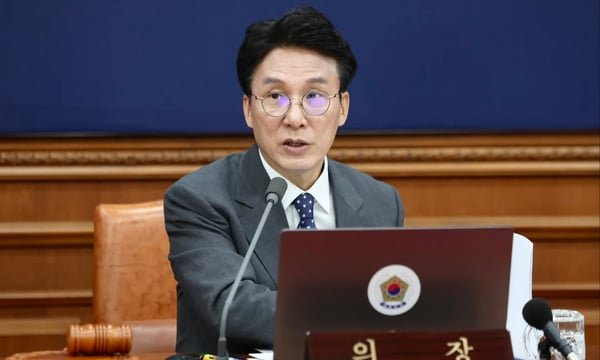
South Korea's Democratic Party Leadership Race Tests Institutional Reforms and Factional Loyalties The Field of Candidates Former Prime Minister Kim Min-seok formally entered the contest for chair of the Democratic Party on July 7, positioning himself as a critic of internal obstruction that had prevented the party from capitalizing on President Lee Jae-myung's public support.
The Field of Candidates
Former Prime Minister Kim Min-seok formally entered the contest for chair of the Democratic Party on July 7, positioning himself as a critic of internal obstruction that had prevented the party from capitalizing on President Lee Jae-myung's public support. Kim's announcement highlighted the need for renewed legislative momentum following the party's strong performance in recent national contests. His entry established an early benchmark in a race that quickly attracted multiple contenders from within the party's established ranks.
Jung Chung-rae, who stepped down from the party leadership the previous month, is expected to declare his candidacy shortly. As the architect of recent procedural changes, Jung faces direct scrutiny over the party's legislative record during his tenure. Son Yong-gil, a six-term National Assembly member who secured a by-election victory on June 3, joined the field on July 8 alongside Ko Min-jung, a sitting lawmaker and former broadcast host. These staggered announcements reflect the compressed timeline typical of Democratic Party leadership transitions, where candidates must quickly consolidate support ahead of the convention.
The composition of the field underscores longstanding patterns in Korean party politics, where former prime ministers and veteran legislators compete alongside figures with media backgrounds. Ko's participation introduces a generational dimension, drawing on networks associated with the Moon Jae-in administration. Historical precedents from earlier Democratic Party contests show that such diverse candidacies often serve as proxies for competing visions of party organization rather than purely personal ambitions.
A Reformed Voting System
The upcoming election marks the first occasion on which the Democratic Party will assign equal weight to votes cast by ordinary dues-paying members and those of convention delegates. This adjustment reverses the previous formula, under which a delegate's ballot carried approximately seventeen times the influence of a rank-and-file member's. Jung Chung-rae advanced the reform earlier in the year as a means of enhancing internal sovereignty and reducing the influence of entrenched convention structures.
Local polling conducted shortly after the initial announcements placed Kim Min-seok at 45 percent support among Democratic Party identifiers, ahead of Jung at 24 percent. These figures, however, must be interpreted cautiously because the new weighting system rewards candidates capable of mobilizing grassroots dues payers rather than solely relying on delegate networks. Korean political history demonstrates that shifts toward broader membership participation, as seen in earlier reforms within both major parties, frequently alter factional balances in unpredictable ways.
The equal-weight mechanism carries implications for long-term party governance by encouraging sustained engagement beyond election cycles. In the Korean context, where regional and generational cleavages have historically shaped party organization, this change may compel candidates to develop durable local structures. Whether the reform ultimately strengthens democratic accountability within the party or merely redistributes influence among existing factions remains an open question for institutional analysts.
Legislative Frustration and Presidential Pressure
President Lee Jae-myung, himself a Democratic Party member, has repeatedly expressed dissatisfaction at Cabinet meetings with the pace at which the party's legislative majority has produced enacted statutes. Despite controlling 161 of the National Assembly's 300 seats along with the speakership and the chairmanship of the Legislation and Judiciary Committee, the party has encountered persistent internal complaints about stalled bills. These frustrations highlight the gap between formal institutional advantages and actual legislative throughput.
Jung Chung-rae's year as party leader coincided precisely with these criticisms, leading many pro-Lee legislators to attribute sluggish progress directly to his strategic decisions. The absence of credible excuses for gridlock has intensified pressure on the leadership contest, transforming it into a referendum on accountability rather than a routine succession exercise. Korean constitutional practice since democratization has shown that ruling parties controlling both the executive and a legislative majority still face coordination challenges rooted in factional competition.
The situation illustrates a recurring tension in South Korean governance between presidential expectations and party organizational autonomy. Historical episodes during previous progressive administrations reveal similar patterns in which legislative majorities failed to translate into rapid policy implementation. The current contest therefore tests whether procedural reforms can overcome entrenched coordination deficits that predate the present leadership.
Factional Dynamics and Strategic Alliances
Kim Min-seok and Son Yong-gil have operated in close coordination, with both directing criticism at Jung Chung-rae and Son indicating willingness to withdraw should his candidacy fragment the anti-Jung vote. This alignment reflects classic Korean party behavior in which personal networks and shared factional interests coalesce around efforts to alter internal power distributions. Control over candidate nominations for the 2028 general elections adds high stakes to the outcome, as the victorious faction gains significant leverage in shaping future legislative cohorts.
Ko Min-jung's entry introduces additional complexity by appealing to a pro-Moon Jae-in constituency that overlaps with Jung's base while advocating generational turnover. Although she has denied characterizations as anti-Lee, her positioning risks splitting support that might otherwise consolidate behind Jung. Past Democratic Party contests demonstrate that such overlapping appeals often prompt strategic withdrawals once polling clarifies the distribution of preferences among dues-paying members.
The interplay among these candidacies reveals the continued salience of factional calculations in Korean party politics. Alliances formed during leadership races frequently determine access to resources and positions well beyond the immediate contest. Observers note that the equal-weight voting system may reward those who successfully bridge traditional factional lines rather than those who rely exclusively on established networks.
Contrasting Crisis Management with the PPP
The Democratic Party's decision to frame its leadership election around accountability for mixed results in the June 3 local elections stands in marked contrast to developments within the opposition People Power Party. Following that party's substantial losses, leader Jang Dong-hyuk declined to resign and instead signaled potential disciplinary measures against internal critics. This divergence illustrates differing institutional cultures regarding responsibility for electoral setbacks.
Korean political history contains numerous examples of opposition parties experiencing prolonged leadership crises after decisive defeats, often resulting in delayed renewal. The People Power Party's approach echoes earlier conservative responses in which incumbents sought to consolidate control rather than invite open competition. Such patterns can prolong periods of internal disarray and reduce the party's capacity to function as an effective check on the ruling majority.
The Democratic Party's more open contest, by comparison, aligns with precedents in which progressive formations used leadership transitions to recalibrate strategy after legislative underperformance. Whether this model produces more responsive governance or simply redistributes factional advantages will depend on the durability of the procedural changes now being tested. The contrast between the two parties underscores ongoing variation in how Korean political organizations manage defeat and succession.
Institutional Implications for Korean Democracy
The Democratic Party leadership contest illuminates broader questions about democratic consolidation in South Korea, particularly the capacity of major parties to translate electoral majorities into coherent policy outputs. Reforms to internal voting procedures represent an attempt to address long-standing critiques of elite dominance, yet their success hinges on sustained member participation rather than episodic mobilization. Comparative studies of East Asian party systems suggest that such institutional adjustments can gradually shift power toward grassroots actors when accompanied by consistent organizational investment.
Presidential frustration with legislative pace further highlights the persistent challenge of executive-legislative coordination in Korea's presidential system. Even with unified government control, factional divisions within the ruling party can impede agenda advancement, echoing difficulties observed across multiple administrations since 1987. The current race therefore serves as a test case for whether procedural innovations can mitigate these coordination problems without exacerbating factional polarization.
Ultimately, the outcome will influence the Democratic Party's ability to maintain internal cohesion ahead of future electoral cycles and shape the quality of governance under President Lee. Korean democracy's resilience has historically depended on parties' willingness to adapt internal rules in response to public expectations for accountability. The present contest offers an opportunity to assess whether recent reforms advance that adaptation or merely rearrange existing power structures within familiar constraints.
By Prof. David Park, Staff WriterThis article was produced with AI-assisted research and editorial support. Reporting is based on sources cited in the article.
What's Your Reaction?
 Like
0
Like
0
 Dislike
0
Dislike
0
 Love
0
Love
0
 Funny
0
Funny
0
 Wow
0
Wow
0
 Sad
0
Sad
0
 Angry
0
Angry
0
East Asia/Technology Correspondent at Global1.News. Seoul-based voice covering Korean politics, technology, business, and culture. Analyzes how technology and geopolitics intersect across East Asia.













Comments (0)