
2026 Blue Ribbon and Laurel Prize Winners Announced by Japan Railfan Club
Each year, the Japan Railfan Club selects the most outstanding new and redesigned railway rolling stock introduced across Japan, honoring innovation in design, technology, and passenger service. For 2026, the prestigious Blue Ribbon Prize has been awarded to the Keifuku Electric Railway Mobo 1 series — the KYOTRAM — while the Laurel Prize recognizes two distinguished entries: the Tobu Railway 80000 series and the Iyo Railway 7000 series.
Each year, the Japan Railfan Club selects the most outstanding new and redesigned railway rolling stock introduced across Japan, honoring innovation in design, technology, and passenger service. For 2026, the prestigious Blue Ribbon Prize has been awarded to the Keifuku Electric Railway Mobo 1 series — the KYOTRAM — while the Laurel Prize recognizes two distinguished entries: the Tobu Railway 80000 series and the Iyo Railway 7000 series. The awards reflect Japan's ongoing commitment to energy-efficient, accessible, and regionally adapted railway technology.
2026 Blue Ribbon and Laurel Prize Winners Announced by Japan Railfan Club
Tokyo, Japan —
Japan's Prestigious Railway Awards
The Japan Railfan Club, a nationwide organization with more than 3,000 members, has named the winners of its 2026 Blue Ribbon Prize and Laurel Prize. The Blue Ribbon Award, established in 1958, marks its 69th year, while the Laurel Prize, introduced in 1961, reaches its 66th year. A selection committee of nine veteran members reviewed 11 candidate vehicles this year, combining member ballots with committee deliberation to determine the recipients.
These awards recognize vehicles that demonstrate excellence in design, technology, and passenger service. Japan's railway industry introduces more than 50 new or redesigned trains annually, making the prizes a key benchmark for innovation across the network.
The Blue Ribbon Prize, inaugurated in 1958, has long served as Japan's premier benchmark for rolling stock excellence, initially recognizing vehicles that advanced postwar reconstruction through superior engineering and passenger amenities. The Laurel Prize, launched in 1961, complements this by highlighting innovative yet practical designs suited to regional operations, together forming a dual framework that has influenced procurement decisions across private and public operators for nearly seven decades.
Voting within the Japan Railfan Club integrates direct member input — drawn from its nationwide base exceeding 3,000 enthusiasts — with the nine-member selection committee's technical review, ensuring both popular sentiment and expert analysis shape outcomes. This hybrid process filters the more than 50 annual new or refurbished vehicles down to a shortlist of 11, emphasizing measurable gains in efficiency, accessibility, and operational reliability.
Japan's railway culture sustains a uniquely engaged community of railfans whose detailed documentation and advocacy amplify these awards' impact, fostering public awareness of technological progress amid dense urban networks and remote rural lines alike.
The Blue Ribbon Prize, inaugurated in 1958, has long served as Japan's premier benchmark for rolling stock excellence, initially recognizing vehicles that advanced postwar reconstruction through superior engineering and passenger amenities. The Laurel Prize, launched in 1961, complements this by highlighting innovative yet practical designs suited to regional operations, together forming a dual framework that has influenced procurement decisions across private and public operators for nearly seven decades.
Voting within the Japan Railfan Club integrates direct member input—drawn from its nationwide base exceeding 3,000 enthusiasts—with the nine-member selection committee's technical review, ensuring both popular sentiment and expert analysis shape outcomes. This hybrid process filters the more than 50 annual new or refurbished vehicles down to a shortlist of 11, emphasizing measurable gains in efficiency, accessibility, and operational reliability.
Japan's railway culture sustains a uniquely engaged community of railfans whose detailed documentation and advocacy amplify these awards' impact, fostering public awareness of technological progress amid dense urban networks and remote rural lines alike.
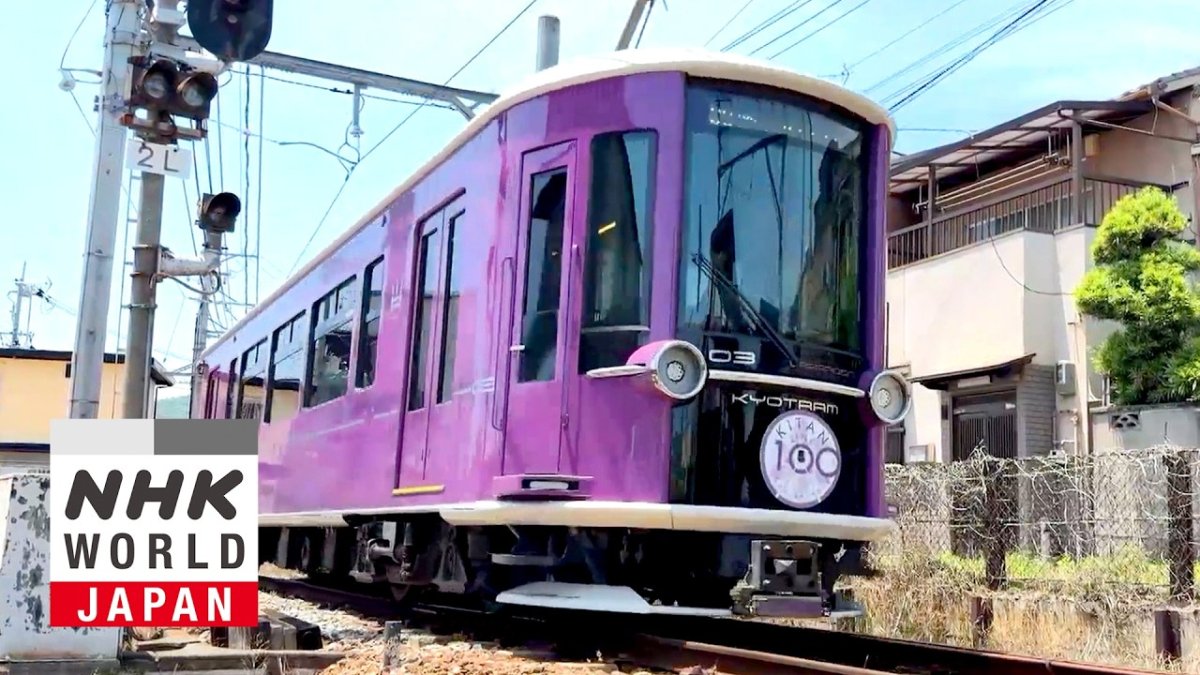
KYOTRAM: Kyoto's Timeless Tram Wins Blue Ribbon
The 2026 Blue Ribbon Prize goes to the Keifuku Electric Railway Mobo 1 series, known as KYOTRAM. This vehicle operates on Kyoto's Randen, the city's only remaining street-level tram line, serving the Arashiyama Line and Kitano Line. It marks the first new train for the Randen in 24 years and entered commercial operation in February 2025.
The KYOTRAM received the highest number of votes in the Japan Railfan Club member poll. Committee members described it as outstanding due to its meticulous attention to detail across exterior, interior, and operational systems.
Design Philosophy: Bridging Past and Future
The KYOTRAM follows a "Timeless Design" concept that connects Kyoto's tram heritage with modern requirements. Its exterior features a traditional rounded front that recalls classic trams, paired with contemporary horizontal lines along the sides. The color scheme uses Kyoto purple, the Randen symbol, with a silver waistband and white, black, and gray accents.
Inside, wood-grain finishes on the ceiling and floor combine with monochrome walls and Kyoto purple seat accents. The design omits overhead racks, incorporates wider double doors that are 10 centimeters broader than previous models, and includes an air purifier. Bucket-style ergonomic seats prioritize passenger comfort, while multilingual LCD displays support Japanese, English, Chinese, and Korean.
Technical features include a SiC VVVF inverter with regenerative braking that halves power consumption compared with earlier vehicles. A central driver's seat improves visibility and supports accident prevention, and a two-stage horn system enhances operational safety.
Tobu 80000 Series: Family-First Commuter Innovation
The Tobu Railway 80000 series receives one of the two 2026 Laurel Prizes. The trains serve the Urban Park Line, formerly the Noda Line, which connects Saitama and Chiba prefectures. The concept centers on creating a society where people and communities continue to shine together.
The series replaces aging 60000 series trains and reduces formation length from six to five cars. It uses an aluminum double-skin structure finished in Future Blue and Bright Green. High-efficiency motors cut power use by more than 40 percent relative to the predecessor, while regenerative braking with a power-regen inverter supplies leftover energy to station lighting, air conditioning, and elevators.
Passenger-focused elements include the TANO-SEAT, a single seat positioned so a guardian can sit beside a child's stroller, plus open space for wheelchairs and strollers in every car. The design also enables future one-person operation. These features align with Tobu Railway's target of a 50 percent reduction in CO2 emissions by 2030 compared with 2013 levels.
Hitachi Rail's production of the 80000 series underscores its central role in Japan's rolling stock manufacturing sector, where the firm supplies lightweight aluminum double-skin bodies and advanced propulsion systems to multiple operators. This project aligns with broader industry trends toward modular, energy-optimized platforms that support both domestic decarbonization targets and potential export adaptations.
The Urban Park Line functions as a critical cross-prefectural corridor linking Saitama and Chiba suburbs to central Tokyo employment hubs, handling substantial commuter volumes while integrating with the wider Tobu network to relieve pressure on radial trunk routes during peak periods.
Iyotetsu 7000 Series: A 67-Year Milestone for Shikoku
The Iyo Railway 7000 series earns the second Laurel Prize. It represents Iyotetsu's first new model in 67 years and operates in Matsuyama, Ehime Prefecture, on the Yokogawara, Takahama, and Gunchu lines. The committee noted that the 7000 series came quite close to the Blue Ribbon winner's total in member voting.
The train features a lightweight stainless-steel body and a new control system with regenerative braking that achieves approximately 50 percent lower power consumption. Larger windows improve scenery viewing, and the absence of overhead racks creates a more open interior. The color scheme draws inspiration from the local iyokan citrus fruit.
To handle sharp curves on regional lines, the 7000 series uses bolster-type bogies rather than modern bolsterless designs. This marks the first Laurel Prize awarded to Iyo Railway.
Regional railways across Japan confront persistent pressures from aging infrastructure and shrinking rural populations, which erode ridership and strain maintenance budgets for operators like Iyotetsu in Shikoku. These conditions demand targeted capital investment to sustain service viability without compromising safety or accessibility standards.
The 7000 series embodies such forward-looking commitment by introducing the first new rolling stock in 67 years, signaling sustained confidence in Matsuyama's tram and rail network as an essential component of Shikoku's long-term mobility and economic resilience.
What the 2026 Awards Signal for Japan's Railway Industry
All three 2026 winners emphasize substantial reductions in energy consumption through regenerative braking and efficient motors. This focus mirrors Japan's Green Transformation (GX) strategy and the broader push toward Society 5.0, where digital and sustainable technologies improve daily life.
The awards span different scales of operation: the Keifuku KYOTRAM on a historic Kyoto tram line, the Tobu 80000 series on Greater Tokyo commuter routes, and the Iyo Railway 7000 series on Shikoku regional lines. Each demonstrates how local operators adapt advanced technology to specific geographic and passenger needs.
Japanese government ministries, including METI, continue to support railway modernization as part of national decarbonization goals. The 2026 prizes illustrate how regional carriers contribute to these objectives while maintaining service quality for residents and visitors alike.
By recognizing vehicles that balance heritage, efficiency, and accessibility, the Japan Railfan Club highlights practical steps the industry is taking to meet future mobility demands across the country.
By Kenji Tanaka, Staff Writer
What's Your Reaction?
 Like
0
Like
0
 Dislike
0
Dislike
0
 Love
0
Love
0
 Funny
0
Funny
0
 Wow
0
Wow
0
 Sad
0
Sad
0
 Angry
0
Angry
0

Japan Correspondent at Global1.News. Tokyo-based voice covering Japanese politics, technology, economy, and culture. Tracks the intersection of tradition and innovation in one of the world's most dynamic societies.













Comments (0)