
Banks Are Quietly Pulling Back from AI Data Center Loans — and a Teacher Just Got Arrested for Clapping
Let me tell you something that''s been sitting heavy with me since I read the morning wire. Two stories crossed my desk today, and they''re both about the same thing from completely different angles.
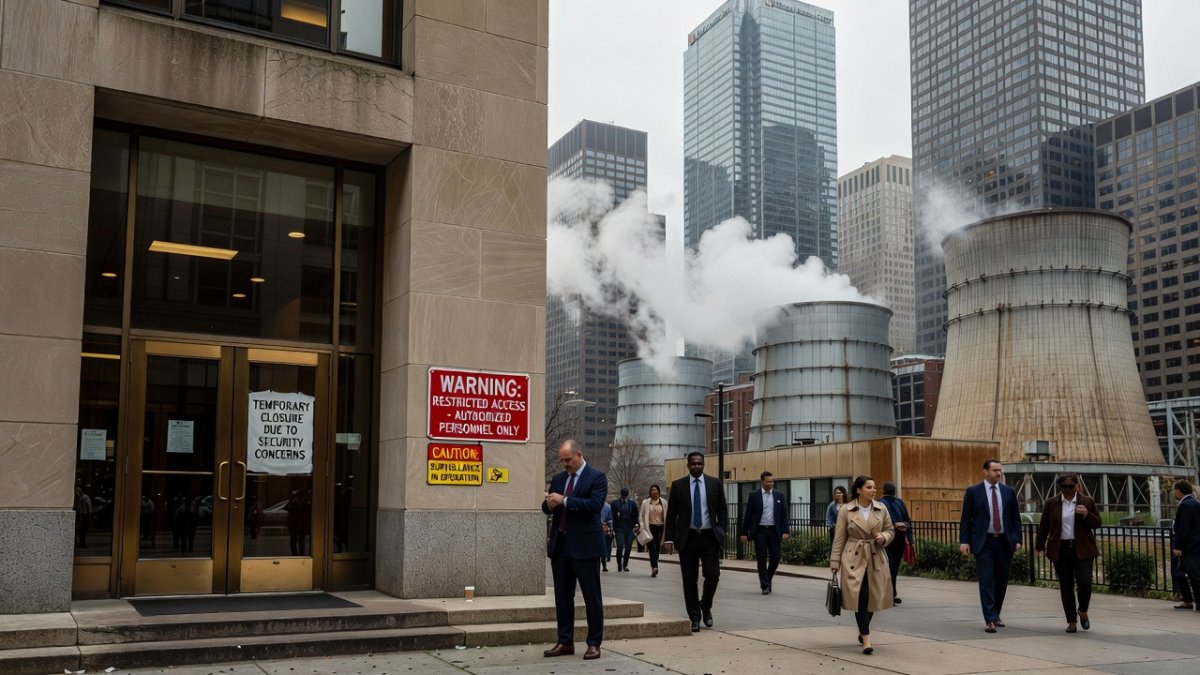
Banks Are Quietly Pulling Back from AI Data Center Loans — and a Teacher Just Got Arrested for Clapping
Let me tell you something that's been sitting heavy with me since I read the morning wire. Two stories crossed my desk today, and they're both about the same thing from completely different angles. The first: one of the world's biggest banks just tried to offload part of a data center loan because it hit its internal lending cap. The second: a high school physics teacher in Kansas got arrested for clapping at a city commission meeting where a gigawatt-scale AI data center was approved anyway, against the will of nearly everyone in the room.
These stories aren't connected by any single company or policy decision. But they converge on the same truth: the AI data center buildout is running into two walls at once — one financial, one social — and neither one is going anywhere.
Banks Are Quietly Pulling Back from AI Data Center Loans — and a Teacher Just Got Arrested for Clapping
Atlanta, GA — July 29, 2026 — I've been writing for fifteen days straight about the structural constraints on AI infrastructure. GPU shortages. Power grid limits. Community backlash. Water consumption. Cyber-physical vulnerabilities. I thought I'd covered every angle. But today brought two data points that, taken together, tell a story I haven't seen anyone connect yet — and I think it's the most important one yet.
Force 1 — The Credit Agricole Story: When the Bank Says "No More"
Let me start with the one that looks like a footnote but isn't. Yesterday, Bloomberg reported that Credit Agricole — a French bank, one of the largest in Europe — is trying to sell down about HK$150 million (US$19 million) of a HK$1.6 billion loan backing a Hong Kong data center project. The loan was extended to ESR Group back in 2023 to convert a cold storage warehouse in Kwai Chung into a data center. Nothing unusual there — data center conversions are standard. What's unusual is why Credit Agricole wants out.
According to people familiar with the matter, the bank has hit its own internal lending cap for data centers. Not a regulatory limit. Not a government mandate. Their own risk management team looked at their data center loan book and said: that's enough. We can't take more exposure.
This is not a one-off. Morgan Stanley has been exploring so-called "significant risk transfer" deals to offload portions of its data center loan portfolio to investors. Voya Financial is actively limiting holdings tied to large technology companies with long-term AI infrastructure contracts. Asset managers are quietly reducing exposure.
The numbers put this in perspective. Bloomberg data shows at least US$334.5 billion in bonds and loans have been issued so far in 2026 to fund AI infrastructure projects. That is nearly double the US$185.5 billion raised in all of 2025. And Moody's Ratings expects at least US$3 trillion to flow into data center-related investments over the next five years — with much of it financed through debt.
But here's the thing about debt markets: they're not infinite. Banks have balance sheet limits. They have concentration risk rules. They have regulators watching. And when Credit Agricole — a bank that's been financing infrastructure for over a century — says "we've hit our cap," it's not a blip. It's a signal that the financial system's appetite for data center debt is approaching its natural ceiling.
Force 2 — The Lux Claridge Story: When the Community Says "Enough"
Now let me tell you about what happened in Emporia, Kansas, on July 22 — because this story should scare every hyperscaler and data center developer who's paying attention.
Lux Claridge is a 37-year-old physics teacher at Emporia High School. On July 22, he attended an Emporia City Commission meeting about the proposed Flint Hills Digital Campus — a gigawatt-scale, 1,000-acre data center development proposed by Kanza Park Place LLC. This is a massive project. One of the largest data center proposals in the central United States.
During the public comment period, a speaker criticized the project. Claridge clapped. Once. According to multiple reports, that single clap was enough for police to drag him out of the meeting, arrest him, and charge him with interference and disorderly conduct. The meeting proceeded. The project was approved — over the objections of nearly nine in ten residents who spoke against it.
Claridge was released on bail later that night. He told reporters the arrest "would not discourage him from continuing to participate in public meetings." And that's the point. A physics teacher. Arrested for clapping at a zoning meeting. This is not a protest in the streets with signs and bullhorns. This is a middle school science educator expressing support for a neighbor's right to speak at a city council meeting.
Let me put this in the broader context because it matters. A Gallup poll conducted in May found that 70% of Americans oppose building AI data centers in their communities. Nearly half are strongly opposed. A separate Reuters/Ipsos poll found that only 14% of Americans would support a data center in their neighborhood. Fourteen percent. That's not a noisy minority — that's an overwhelming majority.
And it's not stopping. The Texas Republican party has warned that data center issues could flip midterm elections. Pennsylvania residents say they're being "bulldozed." Utah has seen mass protests at the state capitol. The teacher arrest in Kansas takes this to a new level — because it signals that local governments are willing to use police power to suppress opposition at public meetings, not just ignore it.
The Convergence — When Financial Limits Meet Social Backlash
Here's why I'm writing about both stories in the same article. They are independent. Credit Agricole didn't decide to cap its data center lending because of a zoning meeting in Kansas. Lux Claridge didn't clap because of a French bank's risk management policy. But both forces are squeezing the same pipeline from opposite ends.
On the financial side: banks are approaching their lending limits. This means the cost of capital for new data center projects is going up. Projects that penciled out at 6% interest rates look very different at 9% or 10% — especially when power utility upgrades, water systems, and transmission lines all need front-loaded capital investment.
On the social side: community opposition is escalating beyond petitions and protest signs. Arrests at public meetings. Bipartisan anger. Moratoriums spreading across states. When 70% of Americans oppose your buildout and local governments are arresting residents for expressing dissent, the permitting timeline for every new project gets longer, more expensive, and less predictable.
The result is a structural squeeze that no amount of hyperscaler capex can fix. Because the constraints aren't on the demand side — they're on the supply side of the buildout itself. And both constraints are compounding.
The BIS Warning — Even the Bank of Central Banks Is Watching
The Bank for International Settlements — the central bank for central banks, the entity that coordinates global financial regulation — issued a stark warning earlier this month about the AI infrastructure debt build-up. They compared the opaque financing structures to the conditions that produced the 2008 financial crisis. Specifically, they flagged that much of the AI data center debt is flowing through shadow banks, hedge funds, and private credit vehicles where traditional bank regulation doesn't reach.
Think about that. The BIS is saying that the debt financing the AI infrastructure buildout is structurally similar to the shadow banking system that blew up in 2008. And now we're seeing the first real signs of banks hitting their internal limits on data center exposure. Morgan Stanley considering risk transfers. Credit Agricole hitting its cap. Voya reducing holdings. The early warning signals are flashing — the question is whether anyone will listen before the stress reaches the broader market.
What This Actually Means for Independent Hosting Providers
If you're running an independent hosting business like I am, you're probably thinking: those two things are big forces, but how do they hit my bottom line? Let me give you three specific signals to watch.
First — lock in supplier relationships now. When banks pull back on data center lending, the first response from large operators is to squeeze supply chains. Hardware vendors get paid later. Equipment orders get delayed. If you have existing relationships with colo providers, power utilities, or hardware suppliers, strengthen them. Lock in rates where you can. The pricing window is closing.
Second — secondary markets are your friend. When hyperscalers cancel projects or sell down assets, distressed hardware hits the secondary market. We've already seen signs of this with the GPU secondary market swelling. Keep your ears open for operators who overbuilt and need to offload capacity at a discount.
Third — position as the anti-hyperscaler. The community backlash against data centers is real and bipartisan. When 70% of Americans oppose local data centers and a teacher gets arrested for clapping at a meeting, your small, quiet, existing data center in a community that already knows you looks a lot more attractive than a gigawatt-scale hyperscaler campus forcing its way into a farmland zoning dispute. Use that. Your biggest competitive advantage right now is that nobody has to hold a public meeting to let you keep operating.
The Structural Reality — Neither Constraint Is Ending Soon
Let me be clear about what I'm not saying. I'm not saying AI demand is collapsing. I'm not saying the buildout is stopping. OpenAI still raised $122 billion. Meta is still spending $145 billion in capex. The demand for compute is real.
What I'm saying is that the buildout has two new structural constraints that weren't fully priced in six months ago. The financial system's capacity to lend against data center projects is approaching limits that banks themselves are defining. And the social tolerance for the buildout — already low — just produced a teacher-arrested-for-clapping headline that local news will be sharing for months.
Both constraints operate independently. Both constrain the same pipeline. Both have legs that extend years, not weeks. The lending caps won't ease until banks see actual revenue from AI workloads. The community backlash won't ease until data center operators demonstrate real community benefit — which most of them haven't even tried to do.
The Bottom Line
Here's where I land after fifteen days of writing about this stuff. The AI infrastructure buildout isn't one story. It isn't even one crisis. It's a dozen structural constraints converging on the same pipeline from different directions, each one independent of the others, each one compounding the total friction on the buildout.
Today's two stories — a French bank hitting its lending cap and a Kansas physics teacher getting dragged out of a city meeting — seem disconnected. But they're symptoms of the same underlying shift: the easy phase of the AI infrastructure buildout is over. The capital is getting harder to raise. The communities are getting harder to convince. And the old playbook of "just spend more money" doesn't solve either problem.
For independent hosting providers, this is actually good news. Because when the hyperscalers slow down — not stop, slow down — the market for reliable, existing, community-accepted infrastructure gets more valuable, not less. The question is whether you're positioned for that shift before it happens.
— Allan Ali, Founder
This article was produced with AI-assisted research and editorial support. Reporting is based on sources cited in the article.
What's Your Reaction?
 Like
0
Like
0
 Dislike
0
Dislike
0
 Love
0
Love
0
 Funny
0
Funny
0
 Wow
0
Wow
0
 Sad
0
Sad
0
 Angry
0
Angry
0

Publisher of Global1.News. Automation architect, systems builder, and the guy making sure the truth gets published.













Comments (0)