
Fake Monks Rearrested at Ayutthaya Rice-Field Camp
Fake monks arrested after returning to Ayutthaya rice-field camp Ayutthaya, Thailand — Police arrested two men, aged 63 and 67, accused of impersonating Buddhist monks and soliciting donations from a makeshift camp beside a rice field in Bang Pa-in district. Officers recognized the pair immediately...
Fake monks arrested after returning to Ayutthaya rice-field camp
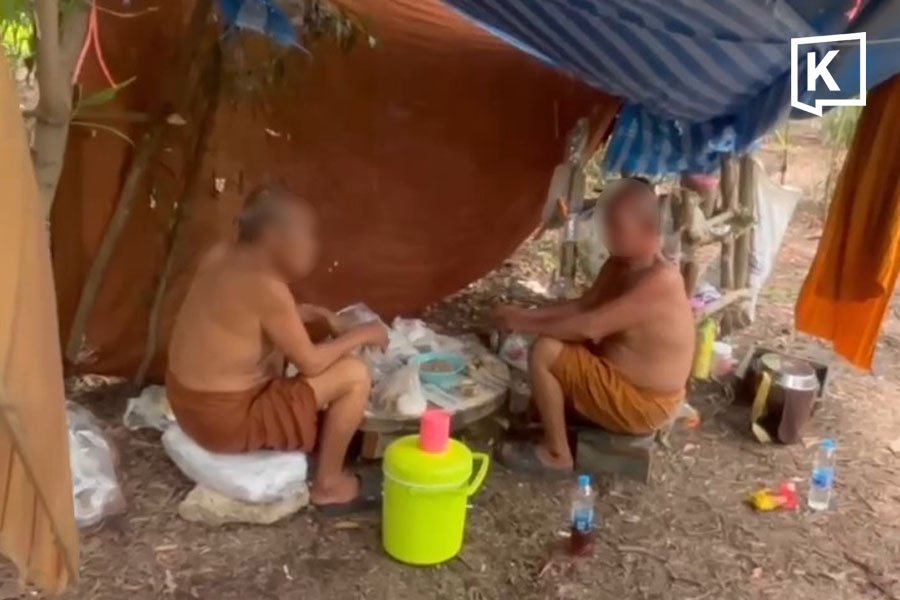
Ayutthaya, Thailand — Police arrested two men, aged 63 and 67, accused of impersonating Buddhist monks and soliciting donations from a makeshift camp beside a rice field in Bang Pa-in district. Officers recognized the pair immediately — they had been arrested at the same location earlier this year and had returned to continue the same practice.
Police Detain Two Men at Rice-Field Camp
Pol. Col. Chanan Prempluemjit, chief of Phra In Racha Police Station, led officers to a wooden shelter covered with yellow cloth beside a rice-field embankment in Moo 8, Chiang Rak Noi subdistrict, Bang Pa-in district, Ayutthaya province. Residents had alerted police after spotting men dressed in monk-like robes near the area, a sight that raised immediate concern in this close-knit agricultural community.
At the camp, investigators found two men, aged 63 and 67, both from Kaeng Khro district in Chaiyaphum province in the northeast. Police seized two sets of monk's robes, two alms bowls with shoulder straps, and two monk's bags. The men could not produce any monk identification documents when asked. Checks of the Royal Thai Police database showed their national identification cards listed them as civilians using the title "Mr" — not as ordained monks registered with the National Office of Buddhism.
Repeat Offenders Return to Same Location
Officers recognized the makeshift camp as the same site where they had made arrests on 7 May 2026 — and the two men were the same individuals taken into custody at that time. The men told police they had returned about three days earlier and dressed as monks to collect money because they faced debt and needed income to survive. They had chosen the same rice-field embankment, apparently believing the remote location would again escape notice.
Repeat offences at the same location highlight the persistent challenge authorities face in preventing religious impersonation. In rural Thailand, where agricultural incomes can fluctuate with seasonal weather and market prices, and alternative work remains scarce in many areas, some individuals resort to deception as a misguided means of survival. Each incident strains limited police resources and erodes the trust that communities place in the monastic system.
Police noted that the men had arrived from Chaiyaphum province, a journey of several hours across central Thailand, suggesting they had deliberately chosen Ayutthaya's historic temple districts as their target area.
Sacred Symbols and Cultural Significance
The yellow robe, alms bowl known as the bat, and the monk's bag called the yiam carry profound meaning in Thai Buddhist practice. The robe, or kasaya, symbolizes renunciation of worldly attachments and the purity expected of those who follow the Buddha's path. The bat represents the monk's dependence on lay support through daily alms rounds, a practice that has continued for over 2,500 years. The yiam holds personal necessities during monastic duties, marking the wearer as part of the ordained order.
In Thai communities, these objects are regarded not as mere clothing or tools but as extensions of the Triple Gem — the Buddha, the Dhamma, and the Sangha. When individuals misuse them for personal gain, it is felt as a direct affront to the faith that shapes daily life for millions across the kingdom. Communities regard unauthorized handling of monastic items as a violation that touches the core of spiritual practice, which is why residents acted quickly when they noticed something amiss.
Legal Consequences Under Thai Law
During the arrest, the two men argued with officers and attempted to negotiate their release, according to police reports. Both were transported to Phra In Racha Police Station and charged with unlawfully wearing clothing or using symbols intended to make others believe they were Buddhist monks, an offence under Thailand's Criminal Code.
Impersonating a monk carries both legal and moral weight in Thai jurisprudence. Courts treat these cases not simply as fraud but as acts that undermine the cultural and religious order that has sustained Thai society for centuries. The legal system recognizes that the monkhood occupies a deeply revered place in Thai life. Sentencing typically reflects both the need for deterrence and the importance of reaffirming respect for the Sangha, the community of ordained monks.
Community Vigilance Protects Buddhist Traditions
Residents in Bang Pa-in who alerted police about the unusual activity played a vital role in ensuring the arrests. In rural central Thailand, close-knit communities watch over their neighborhoods as an extension of shared cultural values, viewing vigilance as part of maintaining harmony and protecting sacred spaces.
Local temples and village committees in Ayutthaya work alongside police to safeguard traditions, teaching younger generations the proper conduct expected of monastics. The province's deep Buddhist heritage — stretching back to its days as the capital of Siam — means residents take particular care in preserving the integrity of religious practices. Such cases serve as reminders that collective awareness helps protect the Buddhist institutions that have formed the bedrock of Thai society for centuries.
By Ann Srisawat, Staff Writer
This article was produced with AI-assisted research and editorial support. Reporting is based on sources cited in the article.
What's Your Reaction?
 Like
0
Like
0
 Dislike
0
Dislike
0
 Love
0
Love
0
 Funny
0
Funny
0
 Wow
0
Wow
0
 Sad
0
Sad
0
 Angry
0
Angry
0

Southeast Asia Correspondent at Global1.News. Based in Bangkok, covering Thai and Southeast Asian politics, economy, technology, and culture. Deep regional perspective on one of the world's most dynamic regions.













Comments (0)