
South Africa Turns to Art as a Weapon Against Recidivism: Inside Leeuwkop's Prison Gallery
When most people think of prison, they picture steel bars, locked gates and lost freedom. But at Leeuwkop Correctional Facility in Johannesburg, visitors are greeted by something unexpected: an art gallery filled with paintings and sculptures created by incarcerated men and women. It is part of a quiet revolution in South Africa's approach to justice — one that trades punishmen
When most people think of prison, they picture steel bars, locked gates and lost freedom. But at Leeuwkop Correctional Facility in Johannesburg, visitors are greeted by something unexpected: an art gallery filled with paintings and sculptures created by incarcerated men and women. It is part of a quiet revolution in South Africa's approach to justice — one that trades punishment for paintbrushes and seeks to break a devastating cycle of reoffending.
South Africa Turns to Art as a Weapon Against Recidivism: Inside Leeuwkop's Prison Gallery
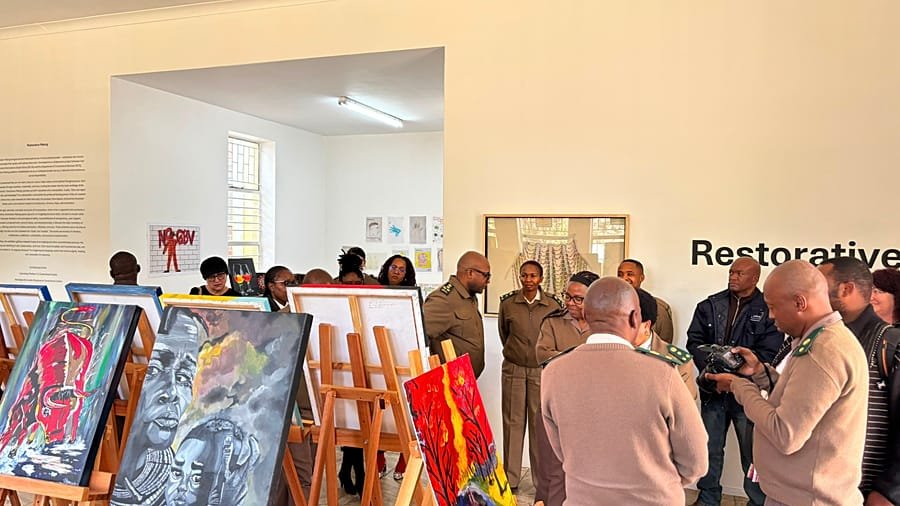
Johannesburg, South Africa — The Department of Correctional Services has opened nine prison arts-and-crafts galleries since 2023, and the newest and most prominent sits inside the walls of Leeuwkop Correctional Facility. Here, 34 inmates display their work to visitors who step past the usual signs of incarceration into a space of colour, texture, and raw human storytelling.
A Gallery Behind Bars: The Art of Rehabilitation
Leeuwkop Correctional Facility in Johannesburg opened its dedicated prison arts gallery in June 2026 as part of the Department of Correctional Services initiative that has established nine such spaces since 2023. National Commissioner Makgothi Samuel Thobakgale attended the launch event and emphasised the facility's role in shifting from punishment to creative expression.
The exhibition carries the theme "Restorative Making" and features work by exactly 34 inmates whose paintings and sculptures fill the gallery walls and display tables. The contrast between the surrounding prison environment and this creative space strikes every visitor immediately upon entry.
Individual pieces range in price from 50 rand which equals three United States dollars to more than 2,000 rand which equals 120 United States dollars. All proceeds return directly to the programme to purchase fresh art supplies and provide modest stipends to participating inmates.
Visitors often remark on how the bright colours and textured surfaces stand out against the grey institutional walls that define daily life at Leeuwkop Correctional Facility. The gallery operates on scheduled visiting days and welcomes members of the public alongside family members of the artists.
The Department of Correctional Services motto "Transforming lives through creativity" appears on signage throughout the space and guides the daily schedule that balances security requirements with dedicated studio time for the 34 participating inmates.
Programme records show that sales from the first three months alone covered the cost of new materials for the following quarter while also distributing small stipends that inmates use for personal necessities inside the facility.
Freddy Mongkoai: A Story of Transformation Through Creativity
Freddy Mongkoai also known as Monakodi is 51 years old and serving a 12-year sentence for murder at Leeuwkop Correctional Facility. He joined the art programme in October 2025 after years of limited structured activity and now works primarily in painting and papier-mache sculpture.
His current series explores themes of memory and community drawn from his upbringing in the Eastern Cape. Mongkoai states that the work allows visitors to "learn something about us prisoners" beyond the headlines that brought them to the facility.
Upon release he plans to open a small gallery where he can "employ other inmates" so they "don't come back here." He has already begun sketching floor plans and contacting former programme participants who share the same goal of sustained creative employment.
Fellow artists Lebogang Molefe and Sizwe Mosotho work alongside Mongkoai in the same studio wing. Molefe specialises in beadwork integrated with canvas while Mosotho focuses on large-scale papier-mache figures that require collaborative assembly.
Mongkoai describes the daily routine as beginning with a security count followed by three hours of uninterrupted studio time before lunch. This structure has given him measurable progress in both technical skill and emotional regulation according to programme facilitators.
His most recent sale of a papier-mache mask for 1,800 rand provided enough funds to purchase new brushes for the entire group and still left a small stipend for himself that he saves toward his post-release gallery plans.
Behind the Programme: Partners in Restorative Justice
Unathi Mahlati serves as senior programme officer at Just Detention International-South Africa which has partnered with the Department of Correctional Services since 2024. She describes the gallery as offering inmates "a chance to just be" within an otherwise rigid daily schedule.
The partnership has supported the opening of nine galleries across the country since 2023 with Leeuwkop Correctional Facility representing the largest single-site installation to date. Just Detention International provides training for correctional staff on facilitating creative workshops without compromising security protocols.
Restorative justice principles drawn from African communal traditions underpin the programme design. These approaches emphasise repairing harm through dialogue and skill development rather than isolation alone which aligns with longstanding practices in many African societies where elders guide reintegration after conflict.
Skill-building sessions cover basic business concepts such as pricing artwork and tracking inventory so that participants leave with practical preparation for life after release. Income generated from sales creates a direct economic incentive that reinforces continued participation.
Mahlati notes that the programme also addresses mental health needs by giving inmates a structured outlet for expression in an environment where psychological services remain limited. Regular exhibitions provide measurable milestones that boost morale across the participant group.
Department of Correctional Services records indicate that inmates who complete at least six months in the art programme show improved behaviour reports compared with the general population at Leeuwkop Correctional Facility.
South Africa's Recidivism Crisis: Why Art Matters
Recidivism rates in South Africa reach as high as 95 percent according to Department of Correctional Services data which places enormous strain on an already overcrowded prison system. Repeat offenders contribute directly to the persistent overcrowding that affects facilities such as Leeuwkop Correctional Facility.
Gang activities and administrative failures compound the problem while chronic underfunding leaves few resources for meaningful rehabilitation programmes. The result is a revolving door that undermines public safety and drains national budgets allocated to corrections.
International evidence from multiple countries demonstrates that art therapy programmes in prisons can reduce reoffending by providing emotional outlets and marketable skills. South African officials have begun citing these studies when justifying expanded arts funding within the Department of Correctional Services.
Post-apartheid justice reform efforts have long sought alternatives to purely punitive models yet implementation remains uneven across provinces. The Leeuwkop gallery represents one concrete step toward addressing these historical gaps through practical creative engagement.
Overcrowding statistics show that many cells designed for two people now house four or more which increases tension and limits access to any form of structured activity. The art programme offers a rare exception that operates within existing security constraints.
Programme evaluations conducted after the first year of the nine-gallery initiative report measurable improvements in inmate self-reported well-being and a modest but statistically significant drop in disciplinary incidents among participants.
A Continent-Wide Conversation on Prison Reform
Other African nations have experimented with rehabilitation approaches that incorporate cultural practices and community involvement. Senegal's correctional system for example emphasises vocational training and family reconnection programmes that echo the skill-building focus seen at Leeuwkop Correctional Facility.
The National Arts Festival in Makhanda recently featured inmate artwork that generated more than 50,000 rand in sales demonstrating public appetite for these creations beyond prison walls. Coverage by the Associated Press and CGTN Africa has brought wider attention to similar initiatives across the continent.
In Senegal artists and community leaders often collaborate on projects that use traditional motifs to foster dialogue between former offenders and their home communities. These efforts reflect a broader African recognition that justice systems must balance accountability with pathways for return.
Regional conferences organised by the African Commission on Human and Peoples' Rights have highlighted prison arts programmes as low-cost interventions with high social return. South Africa's nine-gallery expansion since 2023 positions the country as an active participant in this growing continental discussion.
Media reports from AP and CGTN Africa note that public exhibitions help humanise incarcerated individuals and challenge stereotypes that hinder reintegration. Sales data from Makhanda shows sustained buyer interest when work is presented with clear provenance and artist stories.
Cross-border exchanges between South African and Senegalese correctional officials have begun exploring shared curricula that blend local artistic traditions with modern business skills for inmates preparing for release.
What This Means for African Justice
The Leeuwkop Correctional Facility gallery signals a meaningful shift in how African justice systems can address the root causes of repeated incarceration. By transforming punitive environments into spaces that nurture creativity the programme demonstrates practical respect for human dignity within secure settings.
Economic arguments support wider adoption because lower recidivism rates reduce long-term costs associated with repeated incarceration. Skills and income generated through art sales prepare participants for life after release in ways that purely custodial models cannot achieve.
Human dignity remains central to the effort with the Department of Correctional Services motto "Transforming lives through creativity" guiding daily operations. Inmates who produce and sell work experience tangible recognition of their capacity to contribute positively.
Africa's history of community-based conflict resolution provides fertile ground for scaling such innovations across the continent. The combination of measurable sales data and personal transformation stories offers compelling evidence that second chances can be structured effectively.
Continued investment in these programmes could ease overcrowding pressures while building public confidence in rehabilitation outcomes. The nine galleries opened since 2023 represent an initial but expandable model that other nations can adapt to their own cultural contexts.
Ultimately the work at Leeuwkop Correctional Facility illustrates Africa's capacity for innovative solutions that honour both accountability and the possibility of renewal for those who have served their sentences.
By Amara Diop, Staff Writer
This article was produced with AI-assisted research and editorial support. Reporting is based on sources cited in the article.
What's Your Reaction?
 Like
0
Like
0
 Dislike
0
Dislike
0
 Love
0
Love
0
 Funny
0
Funny
0
 Wow
0
Wow
0
 Sad
0
Sad
0
 Angry
0
Angry
0
West Africa/Sahel Correspondent at Global1.News. Dakar-based journalist covering politics, security, climate, and development across Francophone and Anglophone West Africa. Tells the stories of a region undergoing profound transformation.









Comments (0)