
Sheinbaum announces 21 billion-peso boost for Mexico’s pharmaceutical industry, with private-sector funding
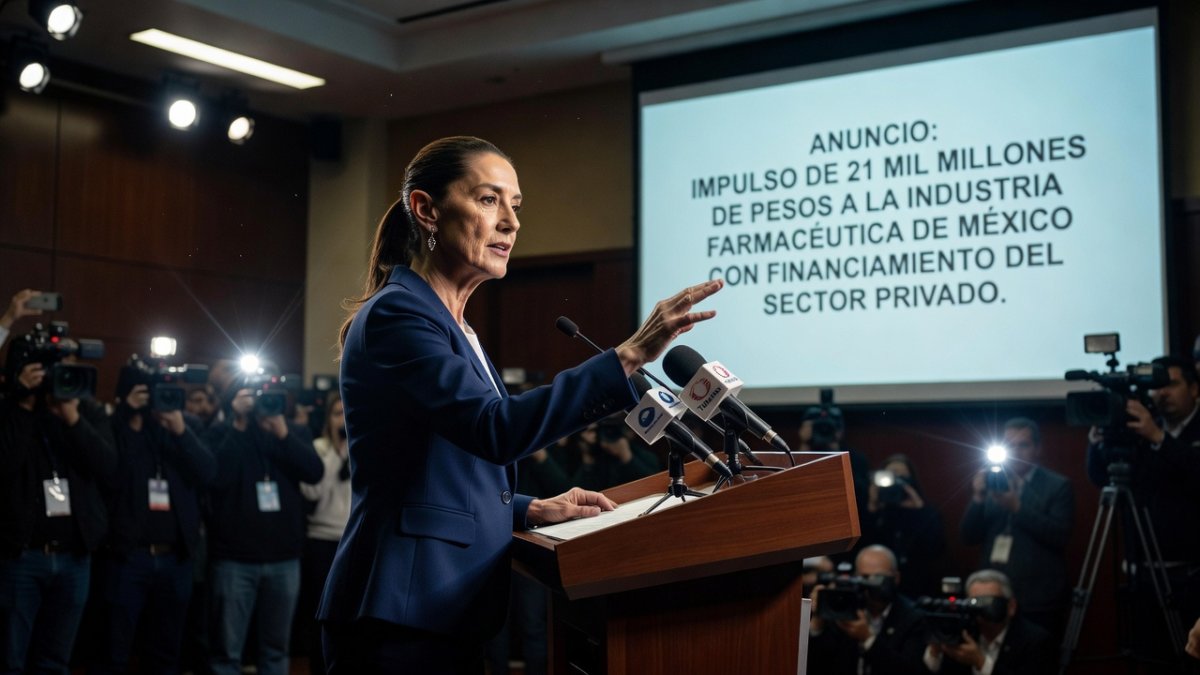
Sheinbaum Announces 21 Billion-Peso Boost for Mexico’s Pharmaceutical Industry, with Private-Sector Funding
Historic Investment Aims to Lower Medicine Costs and Strengthen National Self-Sufficiency
In a move that could reshape access to healthcare for millions of Mexican families, President Claudia Sheinbaum stood alongside Health Minister David Kershenobich on Thursday to unveil the Health Investment Project. The initiative brings 21 billion pesos in combined public and private capital to expand domestic pharmaceutical manufacturing and research. Speaking from the National Palace, Sheinbaum described the plan as a direct response to the medicine shortages that have long burdened communities from Chiapas to Sonora.
The announcement arrives at a critical moment. Mexico currently imports more than 80 percent of its active pharmaceutical ingredients, leaving the country vulnerable to global supply shocks. Kershenobich emphasized that the new project will prioritize local production of essential drugs, including treatments for diabetes, hypertension, and cancer. “We are not simply buying medicines abroad anymore,” he stated. “We are building the capacity here at home so that every Mexican can count on reliable, affordable treatment.”
Project Details and Private-Sector Commitments
The 21 billion pesos will support the construction of five new manufacturing facilities and two research hubs, primarily in Estado de México, Jalisco, and Yucatán. Private partners including Grupo Ferrer, a Mexican firm, and international companies such as Novartis and a consortium led by local generics producer PiSA have pledged the majority of the funds. The federal government will contribute regulatory streamlining and tax incentives valued at approximately 4 billion pesos over five years.
Officials project the facilities will generate 12,000 direct jobs and an additional 25,000 indirect positions in logistics and distribution. Production targets include 150 million units of generic medicines annually by 2028, focusing on high-demand molecules currently sourced from India and China. Early modeling suggests a potential 25 percent reduction in retail prices for targeted therapies within three years of full operation.
Background: Mexico’s Longstanding Dependence on Foreign Pharmaceuticals
For decades, Mexican families have faced unpredictable access to treatments. During the COVID-19 pandemic, hospitals in Mexico City reported critical shortfalls of antibiotics and sedatives when international shipments stalled. Earlier this year, the Mexican Social Security Institute documented delays affecting more than 1.2 million prescriptions for insulin and oncology drugs. These gaps hit hardest in rural clinics where patients often travel hours only to return empty-handed.
Industry data from the Mexican Association of Pharmaceutical Industries shows that active ingredient imports reached 42 billion pesos last year, exposing the sector to currency fluctuations and geopolitical tensions. Sheinbaum’s administration has framed the new project as part of a broader nearshoring strategy, positioning Mexico as a reliable supplier for both domestic needs and regional markets in Central America.
Expert Perspectives on Cost Reduction and Quality
Health economists at the National Autonomous University of Mexico have welcomed the investment but caution that success depends on rigorous quality oversight. Dr. Elena Vargas, who has studied medicine pricing for two decades, noted that local manufacturing could cut logistics costs by 18 to 22 percent. “The key,” she explained, “is ensuring these new plants meet international bioequivalence standards so patients and doctors trust the products.”
Patient advocates echoed the optimism. María López, coordinator of the Diabetes Families Network in Guadalajara, shared how her group has collected stories of retirees splitting pills to stretch limited supplies. “This project gives us hope that our parents won’t have to choose between food and insulin,” she said. “We will be watching closely to make sure the price drops reach community pharmacies.”
Economic and Social Implications for Mexican Communities
Beyond immediate health benefits, the initiative aligns with Mexico’s push for industrial diversification. Construction of the new plants is expected to stimulate demand for local suppliers of glass vials, packaging, and cold-chain equipment. Analysts at Banorte project a 0.3 percent boost to manufacturing GDP in the states hosting the facilities.
Community health workers in Oaxaca have already begun discussing how faster access to affordable generics could reduce preventable hospitalizations. One nurse in a mountain clinic described cases where patients with controlled hypertension suddenly appeared with strokes after months without medication. The project, she believes, could change those outcomes by keeping shelves stocked year-round.
Potential Challenges and Government Safeguards
Opposition lawmakers have questioned whether private partners will prioritize profits over public access. In response, the administration released a memorandum requiring participating companies to allocate at least 40 percent of output to public-sector tenders at fixed prices for the first eight years. Kershenobich added that an independent monitoring committee will publish quarterly production and pricing reports.
Environmental groups have also raised concerns about wastewater from pharmaceutical plants. The Health Ministry confirmed that all facilities must incorporate zero-liquid-discharge systems and undergo annual audits by the Federal Attorney for Environmental Protection.
Looking Ahead: A Step Toward Health Sovereignty
Thursday’s announcement marks the largest coordinated investment in Mexico’s pharmaceutical sector since the 1990s. While full results will take years to materialize, the early signals suggest a meaningful shift toward greater self-reliance. Families across the country, many of whom have spent years navigating fragmented supply chains, now have a concrete reason to anticipate more consistent care.
As the first concrete pours begin at the new sites later this month, the focus remains on execution. Sheinbaum closed the presentation by inviting civil society organizations to participate in oversight committees. “This is not a government project alone,” she said. “It belongs to every Mexican who has ever waited in line for a prescription that never arrived.”
This is Rosa Martinez for Global1 News, reporting from Mexico City. 🇲🇽
This article was produced with AI-assisted research and editorial support. Reporting is based on sources cited in the article.
What's Your Reaction?
 Like
0
Like
0
 Dislike
0
Dislike
0
 Love
0
Love
0
 Funny
0
Funny
0
 Wow
0
Wow
0
 Sad
0
Sad
0
 Angry
0
Angry
0
Latin America/Andes Correspondent at Global1.News. Based in Bogota, covering politics, environment, energy, and social movements across the Andean region. Passionate about environmental journalism and communities protecting their land.













Comments (0)