
Sara Duterte Faces Senate Impeachment Court July 6
Senate Leadership Takes Center Stage in Impeachment Proceedings The impeachment trial of Vice President Sara Duterte is scheduled to begin on July 6, 2026, with Senate President Sherwin Gatchalian set to preside over the Senate sitting as an impeachment court. Gatchalian shared this plan in an interview with dzMM on July 3, 2026, while noting that he continues to study the tech

Senate Leadership Takes Center Stage in Impeachment Proceedings
The impeachment trial of Vice President Sara Duterte is scheduled to begin on July 6, 2026, with Senate President Sherwin Gatchalian set to preside over the Senate sitting as an impeachment court. Gatchalian shared this plan in an interview with dzMM on July 3, 2026, while noting that he continues to study the technicalities involved in leading the proceedings and evaluating the merits of the case.
Earlier discussions within the majority bloc had considered electing Sen. Chiz Escudero as presiding officer, according to Sen. Ping Lacson. The final decision places Gatchalian at the helm, a role that carries significant responsibility in guiding the 22 expected senator-judges through the process. This development connects directly to the workings of the Philippine Senate, where leadership choices shape how national issues unfold for ordinary citizens across the archipelago.
Families in provinces far from Manila often follow Senate actions closely, seeing them as reflections of accountability that touch everyday concerns like public spending and governance. The trial's structure, with its emphasis on careful preparation, underscores how such proceedings can influence trust in institutions that affect workers and communities nationwide.
Senate building in Pasay City ahead of the impeachment trial. (Global 1 News)
Road Closures and Heightened Security Around the Senate
Pasay City authorities will implement road closures near the Senate starting Monday, July 6, 2026. Both northbound and southbound lanes of Diokno Boulevard, from Seaside Boulevard to Atang Dela Rama Street, will be shut from 7 a.m. to 7 p.m. on scheduled trial days. These measures may extend across a period of seven to eight months, with motorists directed to use Macapagal Boulevard as an alternate route.
Around 6,000 police personnel from the Philippine National Police will be deployed in the vicinity of the Senate building. PNP spokesperson Col. Allen Rae Co confirmed that no request has been made for officers to be stationed inside the Senate itself. The trial is planned for Mondays through Wednesdays from July 6 to July 28, shifting to Tuesdays through Thursdays after the State of the Nation Address on July 27.
These changes will affect daily commuters, including jeepney drivers and tricycle operators who navigate Metro Manila routes. Local government units in Pasay and nearby areas may see ripple effects on small businesses such as sari-sari stores that rely on passing traffic. Residents in surrounding barangays often adjust their routines during extended national events, drawing on the spirit of bayanihan to support one another through disruptions.
Notice Delivered and Articles of Impeachment Outlined
The Senate impeachment court issued a one-page notice on July 2, 2026, signed by Senate President Gatchalian, requiring Vice President Duterte to appear at 2 p.m. on July 6 either in person or through counsel. The notice reached her law firm, Fortun Narvasa & Salazar, at 7:50 p.m. that same day.
Duterte faces four articles of impeachment covering alleged misuse of confidential funds, unexplained wealth, bribery of Department of Education officials, and grave threats against President Marcos and his family. Conviction on any single article requires the votes of 16 out of 24 senator-judges and would result in removal from office along with disqualification from future public office.
These charges touch on institutions central to Philippine life, including the Department of Education that serves millions of students and families. Ordinary citizens, from farmers to overseas Filipino workers, watch such cases for signs of how public resources are managed, knowing that outcomes can shape policies affecting schools, health services, and local economies.
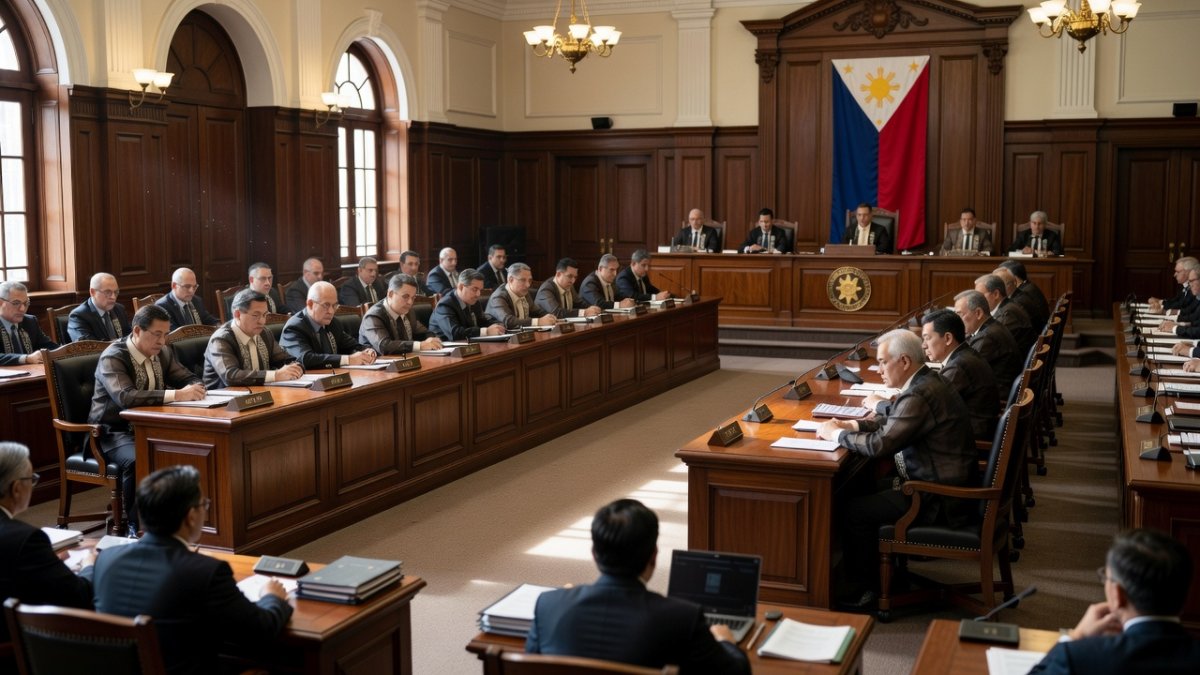
Inside the Senate session hall where the impeachment court will convene. (Global 1 News)
Planned Duration and Pre-Trial Arrangements
A total of 92 trial days have been allocated, with 62 days reserved for House prosecutors and 30 days for the defense. Pre-trial conferences concluded on June 25, 2026, and a pre-trial order was issued on June 29. The proceedings will feature a mix of English and Tagalog in broadcasts, allowing wider accessibility for viewers across the country.
Sixty-one public seats are set aside for observers. This allocation reflects efforts to balance security needs with public interest in a process that unfolds within the Senate, an institution that represents voices from Luzon to Mindanao and the Visayas.
Communities often gather around radios or community centers during major national broadcasts, turning proceedings into shared moments that spark discussions in barangay halls. Students and workers may follow updates between classes or shifts, seeing the trial as part of the larger story of governance that influences daily opportunities.
Attendance Expectations Among Senator-Judges
All elected senators except Sen. Ronald Dela Rosa and Sen. Jinggoy Estrada are expected to participate as senator-judges. Dela Rosa remains unavailable due to an International Criminal Court warrant, while Estrada faces a 90-day suspension related to a plunder case. Senate President Gatchalian stated that everyone physically able to join is anticipated to attend on the opening day.
Duterte's counsel, lawyer Michael Poa of Fortun Narvasa & Salazar, has not commented on whether the Vice President will appear in person on July 6. The presence of 22 senator-judges will shape how the trial moves forward in its early stages.
Such participation highlights the Senate's role in checks and balances that matter to citizens who rely on stable leadership. In provinces and cities alike, people discuss these developments in terms of fairness and representation, connecting national events to local concerns about justice and public service.
Broader Effects on Filipino Daily Life and Communities
The impeachment trial's start on July 6, 2026, arrives at a time when many households balance economic pressures with hopes for steady governance. Road adjustments in Pasay may prompt families to plan alternative travel for work or school runs, while the extended timeline of potential closures calls for patience among motorists and small vendors.
Broadcasts in mixed English and Tagalog open the proceedings to a wider audience, including households in rural areas where Tagalog remains a primary language of conversation. This approach allows kapitbahay networks to share insights and reactions, strengthening community bonds during periods of national attention.
Workers, students, and local leaders across the Philippines often view Senate actions through the lens of how they affect budgets for education, health, and infrastructure. The trial's focus on specific articles invites reflection on accountability mechanisms that ultimately touch the lives of jeepney drivers navigating city streets, farmers awaiting policy clarity, and overseas Filipino workers sending support home.
As the proceedings unfold with scheduled days and allocated time for both sides, the emphasis remains on following established Senate processes. Residents in various regions continue their routines while staying informed, drawing strength from shared cultural values that prioritize unity and resilience amid change.
By Bella Reyes, Staff WriterThis article was produced with AI-assisted research and editorial support. Reporting is based on sources cited in the article.
What's Your Reaction?
 Like
0
Like
0
 Dislike
0
Dislike
0
 Love
0
Love
0
 Funny
0
Funny
0
 Wow
0
Wow
0
 Sad
0
Sad
0
 Angry
0
Angry
0

Africa Correspondent at Global1.News. Based in Lagos, covering politics, business, technology, and culture across the continent. Focused on telling African stories beyond the headlines — the innovation, entrepreneurs, and communities shaping the region's future.













Comments (0)