
Sandigan orders Jinggoy arrested anew over graft
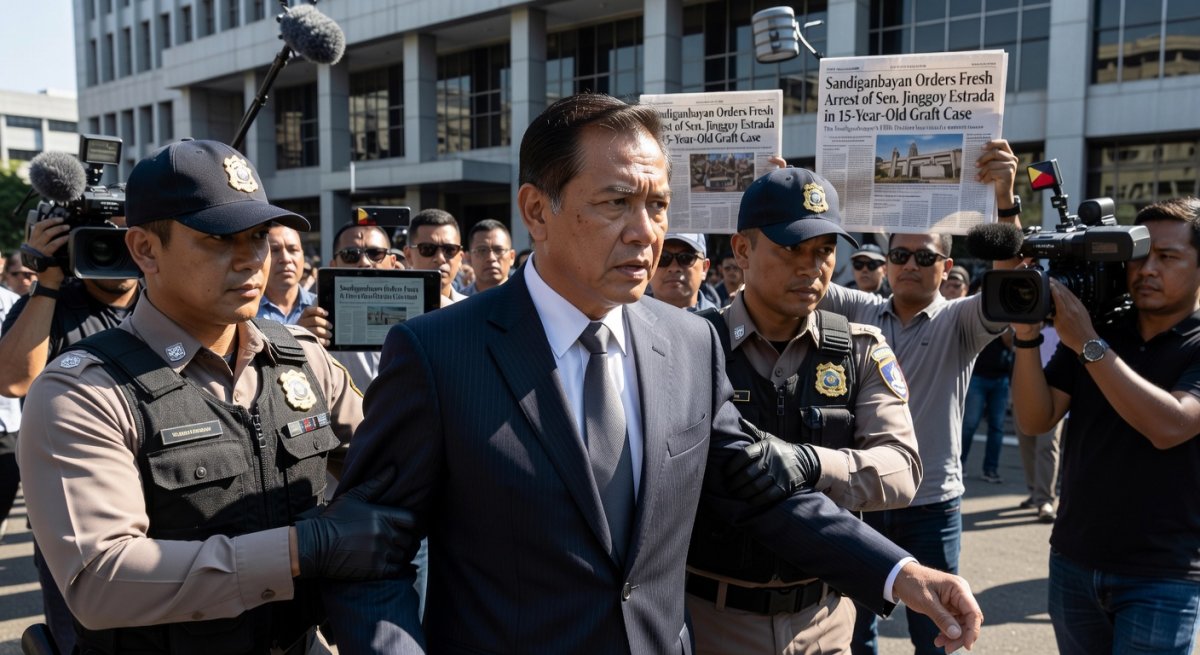
Sandiganbayan Orders Fresh Arrest of Sen. Jinggoy Estrada in 15-Year-Old Graft Case
The Sandiganbayan’s Fifth Division has issued a warrant for the arrest of Senator Jinggoy Estrada, directing the Senate sergeant-at-arms and the Philippine National Police to take him into custody immediately over graft charges tied to the alleged misuse of his Priority Development Assistance Fund in 2008. The court’s 12-page resolution, promulgated on October 10, 2024, denied the senator’s motion to quash the information and found probable cause to proceed to trial, reviving a case that has languished for more than a decade.
Details of the Arrest Order
Presiding Justice Rafael Lagos, together with Associate Justices Maria Theresa Mendoza-Arcega and Maryann Corpus-Manalac, ruled that the prosecution, led by the Office of the Ombudsman, had sufficiently alleged that Estrada conspired with then-Technology and Livelihood Resource Center director general Dennis Cunanan and several private individuals to divert P13.5 million in PDAF allocations to fictitious non-governmental organizations. The court rejected arguments that the charges were politically motivated or barred by prescription, noting that the filing of the original information in 2014 tolled the prescriptive period.
Authorities are expected to serve the warrant at Estrada’s residence in San Juan City or at the Senate premises once Congress reconvenes. Senate President Francis Escudero confirmed that the upper chamber will respect the court’s order but will also ensure Estrada retains his privileges as a sitting senator until final conviction. “The Senate is not above the law,” Escudero stated in a brief media interview.
Background of the Case
The charges stem from the 2013 exposé on the pork barrel scam that implicated several lawmakers in funneling billions of pesos to bogus foundations controlled by businesswoman Janet Lim-Napoles. Estrada, then a senator, was accused of endorsing Napoles-linked NGOs for livelihood projects in his home province of San Juan and in other areas. The Ombudsman filed the case in 2014, but proceedings were repeatedly delayed by motions, a brief stint in detention in 2014–2015, and Estrada’s eventual acquittal in a related plunder case in 2017.
Unlike the plunder charge, which required proof of personal gain exceeding P50 million, the graft charge under Section 3(e) of Republic Act 3019 only needs a showing of evident bad faith or gross inexcusable negligence causing undue injury to the government. The Sandiganbayan’s latest ruling emphasized that the prosecution’s evidence—bank records, NGO incorporation papers, and whistleblower testimony—meets the threshold for trial.
Previous Legal Proceedings and Acquittals
Estrada was detained at the Philippine National Police Custodial Center in 2014 after the court found probable cause in both plunder and graft informations. He posted bail after several months and was released. In 2016, the Sandiganbayan acquitted him of plunder, ruling that the evidence failed to establish that he amassed ill-gotten wealth. The graft case, however, survived because it carries a lower evidentiary bar. Estrada’s legal team immediately filed a motion for reconsideration, which the court denied last week, prompting the fresh arrest directive.
Legal analysts note that acquittal in plunder does not automatically extinguish graft liability. “These are distinct offenses with different elements,” explained former Sandiganbayan justice Gregory Ong in a phone interview. “The court is simply saying there is enough to go to trial on the graft aspect.”
Political Context and Estrada Family Legacy
The arrest order arrives at a sensitive political moment. Estrada’s father, former President Joseph Estrada, remains a significant force in Manila politics, while Jinggoy himself has signaled interest in a possible 2028 presidential run. The timing has prompted speculation that the case could either bolster or undermine his image as a victim of selective prosecution.
Anti-corruption advocates welcomed the development. “This shows the justice system can still move, albeit slowly,” said lawyer and former Commission on Audit commissioner Heidi Mendoza. “Fifteen years is too long, but accountability must still be pursued.” Conversely, Estrada’s allies in the Senate described the order as “harassment,” arguing that the Ombudsman under previous administrations had already cleared him of wrongdoing in related administrative proceedings.
Expert Analysis on Rule of Law Implications
University of the Philippines law professor Dante Gatmaytan observed that repeated delays in high-profile cases erode public trust. “When cases drag on for more than a decade, people begin to question whether the system is capable of delivering timely justice,” he said. Gatmaytan added that the Sandiganbayan’s willingness to issue an arrest order despite Estrada’s senatorial status sends a message that no public official is immune from judicial processes.
Data from the Sandiganbayan’s 2023 annual report shows that of 1,248 pending graft cases involving public officials, only 187 reached judgment last year. The average case age for PDAF-related matters exceeds nine years, highlighting systemic bottlenecks in evidence gathering and witness availability.
Public Reaction and Media Scrutiny
Social media erupted with mixed reactions within minutes of the court’s order becoming public. Hashtags #JinggoyArrest and #PorkBarrelCase trended locally, with citizens demanding faster resolution of all remaining PDAF cases. Civil society groups, including the National Movement for Free Elections, called for live-streaming of future hearings to promote transparency.
Estrada’s office released a statement expressing confidence that the charges will ultimately be dismissed. “We will exhaust all legal remedies and prove once again that Senator Estrada acted in good faith,” the statement read. His camp declined to comment on whether he intends to surrender voluntarily or contest the warrant.
Broader Implications for Philippine Governance
The revival of this case underscores ongoing challenges in prosecuting corruption involving the Priority Development Assistance Fund, which Congress abolished in 2013 following public outrage. While the fund’s demise removed one avenue for abuse, lawmakers continue to receive substantial discretionary allocations under other budget items, prompting renewed calls for stricter oversight mechanisms.
Economists estimate that the pork barrel scam drained at least P10 billion from public coffers between 2007 and 2013. Recovery efforts remain limited; the government has so far retrieved only P3.2 billion through asset forfeiture proceedings. The Estrada case, if it proceeds to conviction, could set precedent for holding legislators accountable even after partial acquittals.
International observers, including the Asian Development Bank’s governance unit, have cited the Philippines’ handling of PDAF cases as a litmus test for judicial reform. A successful prosecution could strengthen investor confidence, while further delays risk reinforcing perceptions of elite impunity.
As the warrant remains outstanding, attention now shifts to how quickly law enforcement will act and whether Estrada will seek temporary restraining orders from the Supreme Court. The Sandiganbayan has set the arraignment for November 18, 2024, assuming the senator is in custody by then.
This is Bella Reyes for Global1 News, reporting from Manila. 🇵🇭
This article was produced with AI-assisted research and editorial support. Reporting is based on sources cited in the article.
What's Your Reaction?
 Like
0
Like
0
 Dislike
0
Dislike
0
 Love
0
Love
0
 Funny
0
Funny
0
 Wow
0
Wow
0
 Sad
0
Sad
0
 Angry
0
Angry
0

Philippines/Southeast Asia Correspondent at Global1.News. Manila-based journalist covering Philippine politics, environment, maritime security, and social issues. Passionate about marine conservation and the communities protecting the Philippines' natural heritage.















Comments (0)