
Marcos rejects remote Senate vote, tells Dela Rosa to show up instead
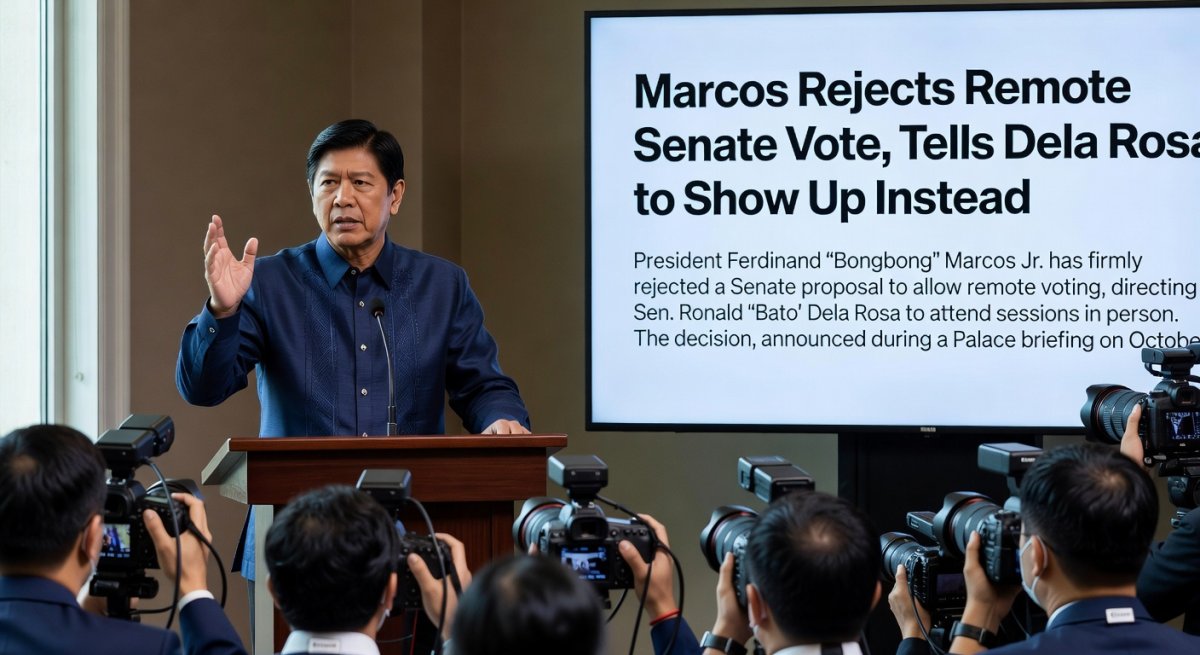
Marcos Rejects Remote Senate Vote, Tells Dela Rosa to Show Up Instead
President Ferdinand "Bongbong" Marcos Jr. has firmly rejected a Senate proposal to allow remote voting, directing Sen. Ronald "Bato" Dela Rosa to attend sessions in person. The decision, announced during a Palace briefing on October 10, underscores the administration's insistence on physical presence amid ongoing debates over Senate procedures.
Background on the Remote Voting Proposal
The proposal emerged last week when a group of senators floated amendments to Senate rules permitting hybrid sessions. Proponents cited logistical challenges, including travel restrictions for members based in distant provinces and health precautions lingering from the pandemic era. Data from the Senate's own records show that average attendance dipped to 17 out of 24 members during the 19th Congress's special sessions in 2023, prompting calls for flexibility.
Under the draft measure, senators could participate via secure video platforms for votes on bills, resolutions, and confirmations. The measure would require a two-thirds majority to activate remote options during declared emergencies. Critics within the chamber, however, immediately flagged the timing, noting that it coincided with Dela Rosa's extended absences from key committee hearings on the Philippine National Police budget.
President Marcos' Direct Response
Marcos addressed the matter head-on during his weekly press engagement. "The proposal appears meant to benefit Sen. Bato dela Rosa," the President stated. "We have clear rules for a reason. Senators took an oath to serve the people in the chamber, not from their living rooms." He emphasized that the 1987 Constitution envisions collegial deliberation in a physical setting, where debate and accountability occur face-to-face.
Marcos further noted that existing Senate rules already provide for medical leave or official missions abroad, mechanisms Dela Rosa has not formally invoked. Palace sources confirmed that the President instructed Executive Secretary Lucas Bersamin to relay the message directly to Senate President Juan Miguel Zubiri, effectively halting further discussion of the hybrid rules for the remainder of the year.
Who Benefits? The Dela Rosa Context
Sen. Dela Rosa, former Philippine National Police chief under the previous administration, faces multiple overlapping obligations. He chairs the Senate Committee on Public Order and Dangerous Drugs and serves as a key voice on security legislation. Yet attendance logs released by the Senate secretariat reveal he has missed 11 plenary sessions since July, including votes on the 2025 General Appropriations Bill.
Observers point to his involvement in high-profile inquiries, such as the ongoing review of the war on drugs. A remote-voting arrangement would allow him to cast ballots without appearing for grilling by colleagues or the public. Marcos' rejection therefore carries symbolic weight, signaling that no senator enjoys special accommodations.
Senate Leadership and Internal Divisions
Senate President Zubiri expressed measured support for Marcos' position while leaving room for future study. "The President has spoken, and we respect the separation of powers," Zubiri said in a statement. "Physical presence remains the default." Majority Leader Joel Villanueva echoed the sentiment, stressing that quorum requirements under the Constitution demand members to be "present" in the traditional sense.
Opposition senators, including Risa Hontiveros and Koko Pimentel, welcomed the clarification. Hontiveros stated, "Democracy thrives on transparency. Remote voting risks diluting the solemnity of our legislative work." Minority bloc members have scheduled a caucus to discuss whether to file a formal resolution affirming in-person attendance as non-negotiable.
Constitutional and Legal Dimensions
Article VI, Section 16 of the 1987 Constitution requires a quorum of at least a majority of senators "present" to conduct business. Legal scholars note that the term has historically been interpreted as physical presence. A 2020 Supreme Court ruling on congressional sessions during the pandemic upheld temporary virtual formats only under explicit public health declarations, which are no longer in effect.
Constitutional expert Prof. Pacifico Agabin of the University of the Philippines observed that any permanent shift to remote voting would likely require either a constitutional amendment or a new statute. "The proposal skirts dangerously close to redefining legislative accountability," Agabin told Global1 News. "Marcos is correct to draw the line."
Broader Implications for Philippine Democracy
The episode highlights ongoing tensions between convenience and institutional integrity. With midterm elections approaching in 2025, public trust in the Senate stands at 42 percent according to the latest Pulse Asia survey. Allowing remote participation could further erode that trust if perceived as shielding powerful figures from scrutiny.
Analysts also see the move as reinforcing Marcos' image as a leader willing to distance himself from Duterte-era allies when institutional norms are at stake. Dela Rosa's political stock, once high among security hardliners, now faces renewed questions about his commitment to the chamber's daily grind.
Advocates for modernized legislative tools argue that secure digital platforms have matured since 2020. However, the President's stance prioritizes precedent over technological upgrades, a position that resonates with citizens who view Senate attendance as a basic duty rather than an optional engagement.
This is Bella Reyes for Global1 News, reporting from Manila. 🇵🇭
This article was produced with AI-assisted research and editorial support. Reporting is based on sources cited in the article.
What's Your Reaction?
 Like
0
Like
0
 Dislike
0
Dislike
0
 Love
0
Love
0
 Funny
0
Funny
0
 Wow
0
Wow
0
 Sad
0
Sad
0
 Angry
0
Angry
0

Philippines/Southeast Asia Correspondent at Global1.News. Manila-based journalist covering Philippine politics, environment, maritime security, and social issues. Passionate about marine conservation and the communities protecting the Philippines' natural heritage.












Comments (0)