
Russia would have lost Ukraine war without China – Ex-MI6 chief
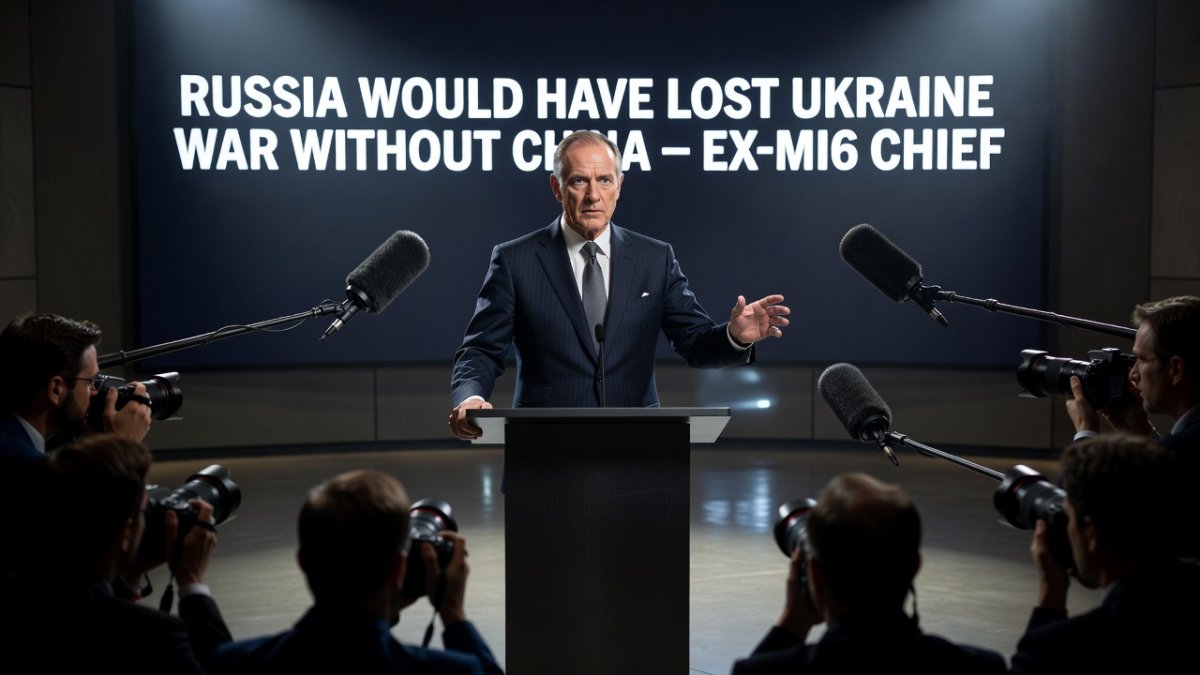
Russia Would Have Lost Ukraine War Without China – Ex-MI6 Chief Warns of Beijing’s Decisive Backing
By Sarah Okafor, Global1 News | Lagos
In a stark assessment that reverberates through global capitals, former MI6 chief Richard Moore has declared that Russia would have been unable to sustain its military campaign in Ukraine without China’s sustained economic and technological lifeline. Speaking to The Wall Street Journal, Moore highlighted how Beijing’s support has allowed Moscow to circumvent Western sanctions and maintain battlefield momentum four years into the conflict.
Moore’s Direct Assessment of Chinese Leverage
Moore, who led Britain’s Secret Intelligence Service until 2023, told the Journal that many Western observers remain “oblivious” to the scale of dual-use exports, semiconductor shipments, and energy purchases flowing from China to Russia. “Without that support, Russia’s economy would have seized up and its military machine would have ground to a halt,” he stated. His remarks come amid fresh data showing bilateral trade between Moscow and Beijing reaching $240 billion in 2024, with Chinese components now embedded in Russian drones, missiles, and armored vehicles.
The former spy chief’s intervention carries weight precisely because it bridges intelligence assessment with hard economic metrics. Moore noted that China has supplied over 90 percent of Russia’s imported microelectronics since 2022, enabling the Kremlin to replenish precision-guided munitions at a rate Western sanctions were designed to prevent.
Quantifying Beijing’s Material Support
Trade statistics released by China’s General Administration of Customs confirm that Russian purchases of Chinese excavators, trucks, and machine tools surged 300 percent between 2021 and 2024. These items, while ostensibly civilian, have been repurposed for frontline engineering and logistics. Simultaneously, China imported 1.2 million barrels per day of discounted Russian crude in 2024, providing Moscow with vital hard currency that has stabilized the ruble and funded military procurement.
Western intelligence assessments, corroborated by Moore, indicate that Chinese firms have transferred milling equipment and guidance systems that directly enhance Russia’s Iskander and Kinzhal missile production lines. This pipeline has allowed Russia to fire an average of 1,200 missiles and drones monthly into Ukrainian territory throughout 2024, far exceeding pre-war output projections.
Global Economic Ripple Effects and Nigeria’s Exposure
From Lagos, the implications are immediate. Nigeria, Africa’s largest oil producer, has seen Brent crude hover above $78 per barrel partly because Russian barrels remain locked in a Sino-Russian trading loop rather than flooding open markets. Yet the same dynamic threatens to prolong elevated fertilizer and wheat prices, squeezing Nigerian households already contending with 34 percent inflation.
Central Bank of Nigeria data shows food import costs rose 22 percent year-on-year in the first quarter of 2025, with wheat from the Black Sea region still disrupted. Moore’s warning therefore translates into a concrete fiscal risk for Abuja: any extension of the war through Chinese-enabled Russian resilience will keep borrowing costs high and delay planned infrastructure projects under the 2025 budget.
Expert Perspectives on Sanctions Evasion
Dr. Aisha Okonjo, senior fellow at the Lagos-based African Policy Institute, argues that Moore’s assessment understates the speed at which parallel payment systems have matured. “The yuan-ruble settlement mechanism now handles 60 percent of Russia-China transactions,” she notes. “This is not temporary war economics; it is the scaffolding of a durable alternative financial architecture.”
Meanwhile, European analysts at the Brussels-based Bruegel Institute estimate that Chinese components have lowered Russia’s military production costs by 25 percent, effectively neutralizing the intended impact of export controls imposed by the United States and its allies. These savings allow Moscow to maintain troop levels near 600,000 in Ukraine without triggering domestic economic collapse.
Strategic Implications for Multipolar Trade
Moore’s comments arrive at a moment when several African nations are weighing deeper engagement with both BRICS institutions and Western partners. Nigeria’s recent application to join the New Development Bank reflects this hedging strategy. Should Chinese support keep Russia economically afloat, the precedent strengthens arguments in Abuja and elsewhere that sanctions regimes can be weathered through South-South trade corridors.
Yet the same dynamic raises questions about technology transfer risks. Nigerian defense planners have quietly expressed concern that advanced Chinese dual-use items reaching Russian hands could eventually appear in Sahel insurgencies via gray-market networks, complicating already fragile security operations in the northeast.
Outlook and Policy Choices Ahead
Moore concluded his interview by urging Western capitals to treat Chinese supply chains as a primary sanctions target rather than an afterthought. For Nigerian policymakers, the message is equally pointed: diversification of export destinations and accelerated domestic refining capacity are no longer optional. With global energy markets now shaped by the Russia-China nexus, Lagos must accelerate non-oil revenue reforms to insulate the economy from prolonged geopolitical friction.
The ex-MI6 chief’s assessment therefore serves less as abstract geopolitics and more as a prompt for concrete economic recalibration across emerging markets still tethered to commodity cycles.
This is Sarah Okafor for Global1 News, reporting from Lagos. 🇳🇬
This article was produced with AI-assisted research and editorial support. Reporting is based on sources cited in the article.
What's Your Reaction?
 Like
0
Like
0
 Dislike
0
Dislike
0
 Love
0
Love
0
 Funny
0
Funny
0
 Wow
0
Wow
0
 Sad
0
Sad
0
 Angry
0
Angry
0

Africa Correspondent at Global1.News. Based in Lagos, covering politics, business, technology, and culture across the continent. Focused on telling African stories beyond the headlines — the innovation, entrepreneurs, and communities shaping the region's future.













Comments (0)