
Russia Signs Agreement to Build First Nuclear Power Plant in Kazakhstan
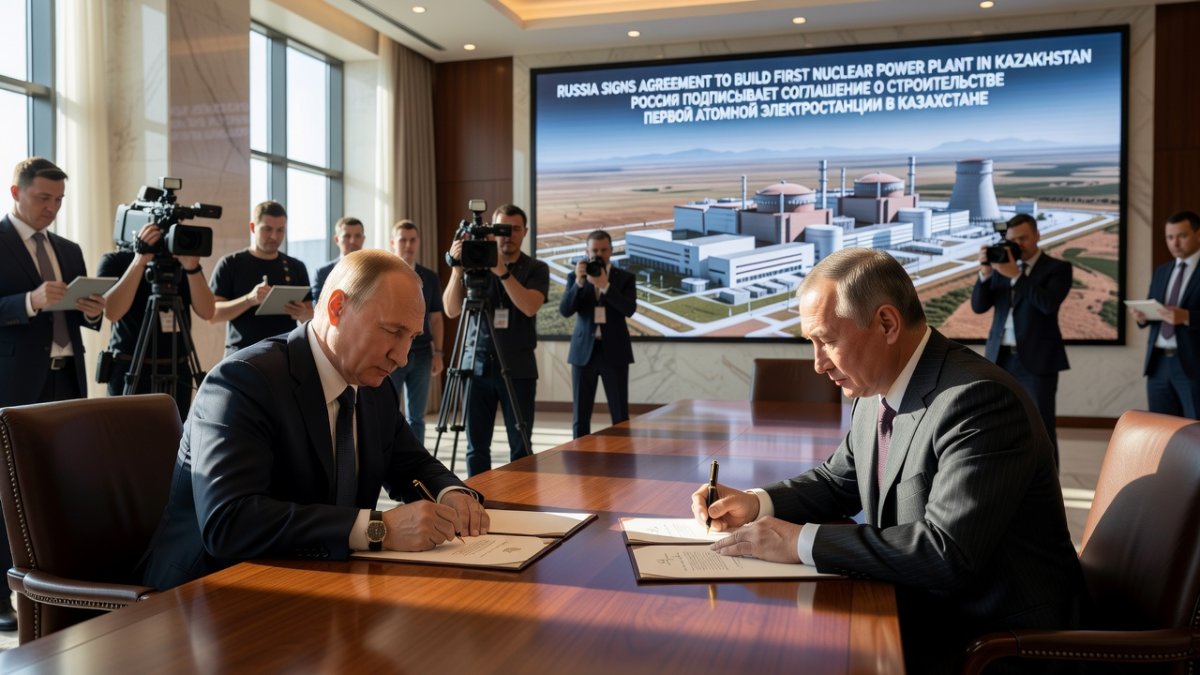
Russia and Kazakhstan Finalize Landmark Agreement for Astana’s First Nuclear Power Plant During Putin’s Astana Visit
ASTANA — On the second day of President Vladimir Putin’s state visit to Kazakhstan’s capital, the two nations signed a comprehensive intergovernmental agreement to construct Kazakhstan’s inaugural nuclear power plant. The deal, concluded after closed-door sessions between Putin and President Kassym-Jomart Tokayev, designates Russia’s Rosatom State Atomic Energy Corporation as the primary contractor for a 1,200-megawatt VVER-1200 reactor at a site near Lake Balkhash in the Almaty region.
Details of the Signed Agreement
The protocol commits Rosatom to engineering, procurement, construction, and initial fuel supply for the plant, with a projected operational start in 2032. Kazakhstan will retain 51 percent ownership through its national atomic company Kazatomprom, while Russia holds the remaining stake under a build-own-operate model adapted for local conditions. Total project cost is estimated at $10.5 billion, financed through a mix of Kazakh sovereign funds, Russian export credits, and syndicated loans from Eurasian Development Bank institutions.
Putin emphasized energy sovereignty in his remarks following the signing: “This project embodies our shared commitment to advanced technology transfer and long-term energy stability in Central Asia.” Tokayev added that the plant would help Kazakhstan meet its target of carbon neutrality by 2060 while reducing dependence on coal-fired generation, which still accounts for 68 percent of the country’s electricity.
Historical Context of Kazakhstan’s Nuclear Ambitions
Kazakhstan has pursued civilian nuclear power since the early 2000s, yet repeated delays occurred due to financing shortfalls and public concerns rooted in Soviet-era nuclear testing at Semipalatinsk. The country produces 43 percent of global uranium output, exporting 21,000 metric tons in 2023, yet imports all of its electricity-generating nuclear fuel. The new agreement includes a clause for gradual localization of fuel fabrication at the Ulba Metallurgical Plant in Ust-Kamenogorsk, potentially cutting import reliance by 40 percent within a decade.
Earlier attempts, including a 2007 memorandum with Russia and a 2014 tender involving Japanese and French vendors, collapsed amid shifting political priorities and Western sanctions concerns. The current accord revives a framework first outlined during Tokayev’s 2019 Moscow visit, updated to incorporate post-2022 geopolitical realities.
Geopolitical and Regional Implications
The timing of the agreement, reached while Western sanctions on Russian energy exports remain in force, signals Astana’s willingness to deepen strategic ties with Moscow despite international pressure. Kazakhstan’s multi-vector foreign policy has historically balanced Russian security guarantees with Chinese infrastructure investment and occasional Western economic overtures. Analysts note that nuclear cooperation locks in Russian technical influence for at least 60 years, the expected lifespan of the reactor.
China, which operates two nuclear units in neighboring Xinjiang and has expressed interest in Kazakh uranium processing, may view the deal as a setback to its Belt and Road energy corridor ambitions. Meanwhile, the United States and European Union have voiced quiet reservations over proliferation risks, although International Atomic Energy Agency safeguards are explicitly written into the contract.
Economic and Technical Dimensions
Rosatom will supply the reactor under a turnkey contract that includes training for 1,200 Kazakh specialists at its St. Petersburg and Obninsk academies. Local content requirements mandate that 35 percent of construction materials and 25 percent of equipment be sourced domestically by the time of grid connection. This clause aims to stimulate Kazakhstan’s heavy industry, particularly steel and turbine manufacturing in Karaganda and Pavlodar.
Electricity from the new plant is expected to cover 15 percent of national demand by 2035, easing pressure on aging thermal stations and supporting projected 4.2 percent annual GDP growth. The project also includes a desalination component capable of producing 50,000 cubic meters of fresh water daily for the arid Balkhash basin.
Expert Perspectives and Domestic Debate
Energy economist Serik Sultangaliyev of the Kazakhstan Institute for Strategic Studies described the agreement as “pragmatic realism rather than ideological alignment.” He noted that coal phase-out timelines make nuclear the only baseload option capable of meeting winter peak loads exceeding 18 gigawatts. Environmental groups, however, have organized petitions citing seismic risks near the chosen site and demanding greater transparency on waste management protocols.
Russian nuclear expert and former Rosatom deputy director Mikhail Kovalenko told Global1 News that the VVER-1200 design incorporates post-Fukushima safety upgrades, including passive cooling systems and core catchers, meeting the most recent IAEA standards. “This is not a Soviet-era transplant,” he stressed. “It reflects 15 years of iterative improvements tested at units already operating in Russia, Bangladesh, and Egypt.”
Long-Term Outlook for Central Asian Energy Architecture
With the plant online, Kazakhstan could evolve into a regional electricity exporter, potentially supplying surplus power to Uzbekistan and Kyrgyzstan through existing 500-kilovolt lines. The agreement also opens discussions on a future second unit and small modular reactor pilots for remote mining operations in the east of the country.
Putin’s visit concludes tomorrow with a meeting of the Eurasian Economic Union supreme council, where energy harmonization is expected to feature prominently on the agenda. For both Moscow and Astana, the nuclear project represents more than megawatts; it is a concrete demonstration that bilateral cooperation can advance despite global turbulence.
This is Irina Volkov for Global1 News, reporting from Moscow. 🇷🇺
This article was produced with AI-assisted research and editorial support. Reporting is based on sources cited in the article.
What's Your Reaction?
 Like
0
Like
0
 Dislike
0
Dislike
0
 Love
0
Love
0
 Funny
0
Funny
0
 Wow
0
Wow
0
 Sad
0
Sad
0
 Angry
0
Angry
0
Russia/Eastern Europe Correspondent at Global1.News. Covering Russian politics, energy, security, and the shifting dynamics of the post-Soviet space. Provides clear-eyed analysis on one of the world's most opaque regions.












Comments (0)