
Gaza Health Crisis: 83% of Displacement Sites Infested
UN warns of major public health risks in Gaza as 83% of displacement sites report infestations Gaza City, Occupied Palestinian Territories — The United Nations has issued a stark warning about deteriorating public health conditions in the Gaza Strip, revealing that rodent and ectoparasite infestations have been reported in 83 percent of displacement sites assessed this month, as the enclave's already devastated infrastructure continues to collapse under the weight of prolo...
UN warns of major public health risks in Gaza as 83% of displacement sites report infestations
Gaza City, Occupied Palestinian Territories — The United Nations has issued a stark warning about deteriorating public health conditions in the Gaza Strip, revealing that rodent and ectoparasite infestations have been reported in 83 percent of displacement sites assessed this month, as the enclave's already devastated infrastructure continues to collapse under the weight of prolonged military assault and collective punishment.
UN spokesperson Farhan Haq, citing data from the Office for the Coordination of Humanitarian Affairs (OCHA), told reporters that civilians in Gaza face "major public health risks, adding to the insecurity and displacement" that have defined Palestinian life since the start of the war on Gaza.
The UN warning: Infestation, sewage and stagnant water
"Widespread rodent and ectoparasite infestations were reported in 83% of displacement sites assessed earlier this month, and that is alongside sewage in streets, stagnant water and poor sanitation conditions," Haq said during a news conference, describing conditions that humanitarian workers on the ground have called the worst they have seen since the beginning of the military campaign.
Humanitarian agencies are scaling up rodent control operations this week, but Haq warned that sustained access to critical equipment and supplies such as spare parts and engine oil is urgently needed to prevent a full-scale public health catastrophe. The UN official stressed that humanitarian partners managing solid waste must be permitted to access landfills in areas where access is restricted by Israeli forces — approximately 65 percent of the Gaza Strip remains off-limits to waste management operations.
Displacement camps: Life under siege
For the more than 1.9 million displaced Palestinians crammed into makeshift tent camps, former school buildings and bombed-out hospital courtyards, the UN warning confirms what they have been living through for months. Families sleep on concrete floors amidst piles of uncollected garbage. Children play in streets flooded with sewage. Mothers struggle to keep infants clean as skin diseases spread through overcrowded shelters.
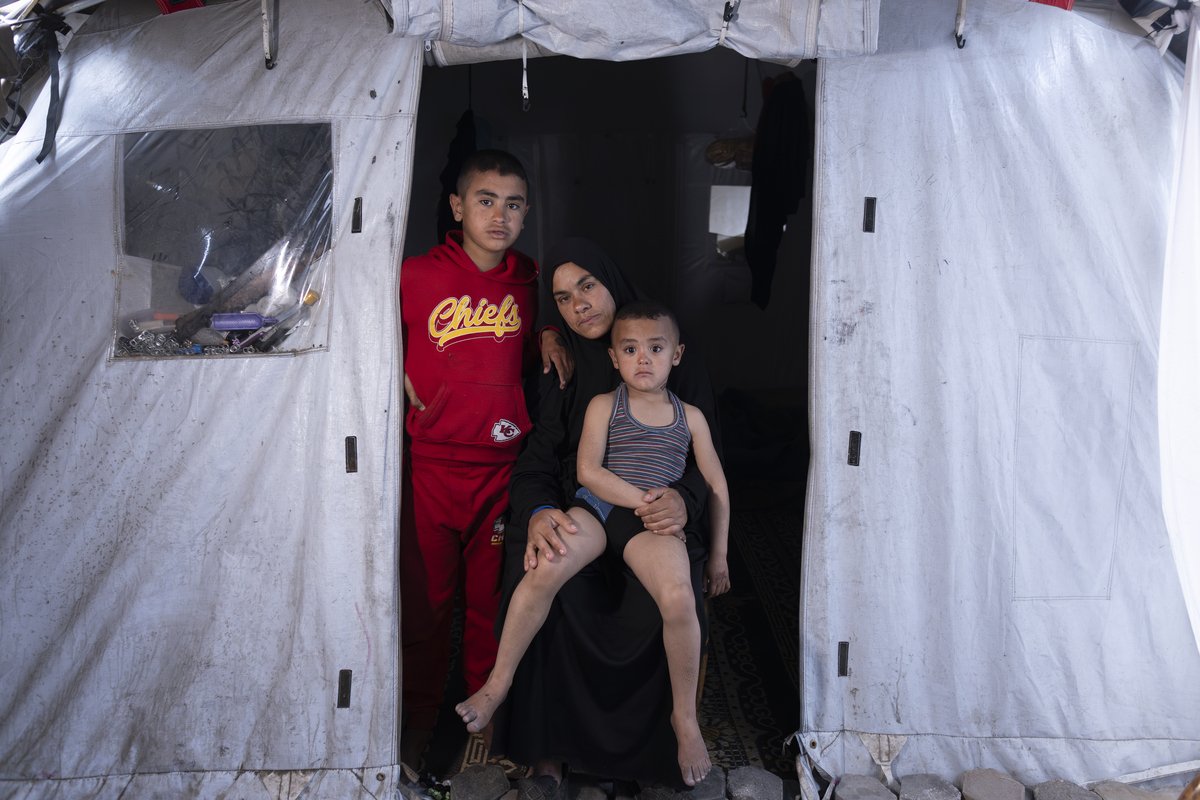
Wisam Abdulhadi, a Palestinian widow who lost her husband in an Israeli attack, was seen with her children at a shelter in Al-Azhar University in Gaza City, where her children have developed skin conditions from the unsanitary conditions. Her story is one among hundreds of thousands — women left to shoulder the burden of survival in a landscape where even clean water has become a luxury.
Infrastructure collapse: Water, sanitation and the daily struggle
Access to water remains a daily challenge for families across the Gaza Strip. The UN and its partners are supporting hundreds of thousands of children and their families with essential water, sanitation and hygiene services, but the scale of need far outstrips the resources available.
Before the current military campaign, Gaza's water and sanitation infrastructure was already fragile — decades of blockade had prevented the maintenance and upgrade of critical systems. Now, after years of sustained bombardment that has targeted water treatment plants, sewage pumping stations, and electrical infrastructure, the system has largely collapsed. Sewage flows openly in the streets of multiple neighborhoods, creating breeding grounds for disease-carrying rodents and insects.
Health officials on the ground have reported rising cases of hepatitis A, cholera-like symptoms, and severe skin infections, particularly among children whose immune systems are weakened by malnutrition and lack of access to clean water. The World Health Organization has repeatedly warned that the combination of untreated sewage, stagnant water, and overcrowded living conditions creates a perfect vector for disease outbreaks that could spread rapidly through the displaced population.
The 65 percent restriction: Access denied by design
Perhaps the most alarming data point in the UN's warning is the revelation that Israeli forces restrict access to approximately 65 percent of the Gaza Strip for humanitarian operations, including solid waste management. This means that the majority of Gaza's territory is effectively off-limits to the very agencies trying to prevent a public health disaster.
Humanitarian organizations have repeatedly documented how the Israeli military's designation of "no-go zones," buffer areas, and closed military zones prevents waste collection teams from reaching landfills, leaving garbage to accumulate indefinitely in residential areas and displacement camps. The restriction on spare parts and engine oil further cripples what remains of Gaza's water and sanitation infrastructure, as pumps cannot be repaired and waste collection trucks cannot operate.
International humanitarian law requires occupying powers to ensure the welfare of civilian populations, including access to adequate food, water, and medical care. Human rights organizations have documented that Israel's systematic restriction of humanitarian access amounts to collective punishment of the Palestinian civilian population in Gaza, a violation of Article 33 of the Fourth Geneva Convention.
The human toll: 73,000 dead and counting
The public health crisis unfolds against the backdrop of staggering loss of life. According to Gaza's Health Ministry, more than 73,000 Palestinians have been killed and over 174,000 injured since the start of the war on October 8, 2023 — the vast majority of them women and children. The true figure is believed to be significantly higher, as thousands of bodies remain buried under rubble that cannot be reached due to ongoing hostilities and fuel shortages for heavy equipment.
Despite a ceasefire agreement that took effect on October 10, 2025, Israeli attacks have continued, killing at least 1,207 Palestinians and injuring 3,914 others in the months since the supposed cessation of hostilities. The continued toll of death and injury has led multiple human rights organizations and international legal bodies to document what they describe as acts of genocide, with the International Court of Justice having issued provisional measures ordering Israel to prevent genocidal acts and allow humanitarian access.
Children bearing the heaviest burden
The thousands of displaced children in Gaza are paying the highest price for the collapse of the territory's infrastructure. Living in conditions where untreated sewage runs through displacement sites, where drinking water is contaminated or unavailable, and where medical care for preventable diseases is beyond reach, an entire generation is being marked by malnutrition, disease, and psychological trauma.
The UN is supporting hundreds of thousands of children with essential water, sanitation and hygiene services, but these efforts reach only a fraction of those in need. Humanitarian agencies report that the combination of restricted access, fuel shortages, and funding gaps means that the majority of displaced children do not receive adequate sanitation support. The psychological toll is equally devastating — children who have already lost parents, siblings, and homes to the war now face the additional trauma of living in disease-ridden conditions with no end in sight.
International inaction and the road ahead
The UN's warning comes as the international community remains largely paralyzed in the face of the unfolding catastrophe in Gaza. Despite multiple UN Security Council resolutions calling for ceasefire, humanitarian access, and accountability, the United States has continued to provide diplomatic cover and military support to Israel, vetoing or watering down resolutions and providing weapons that have been used in the assault on Gaza.
Humanitarian organizations have called for an immediate and verifiable ceasefire, unrestricted humanitarian access to all areas of Gaza, the lifting of the blockade that prevents the entry of essential supplies including spare parts and engine oil for water and sanitation infrastructure, and international funding to rebuild what has been destroyed. Without these measures, the UN warns, Gaza faces not just a public health crisis but a full-scale humanitarian catastrophe whose consequences will reverberate for generations.
The warning from OCHA is clear: the combination of rodent infestations, sewage in the streets, restricted access to landfills, and the collapse of water and sanitation infrastructure has created conditions where preventable diseases will claim more lives. For the 2.3 million people trapped in Gaza, the choice between bombs and disease is no choice at all.
By Fatima Al-Rashid, Staff Writer
This article was produced with AI-assisted research and editorial support. Reporting is based on sources cited in the article.
What's Your Reaction?
 Like
0
Like
0
 Dislike
0
Dislike
0
 Love
0
Love
0
 Funny
0
Funny
0
 Wow
0
Wow
0
 Sad
0
Sad
0
 Angry
0
Angry
0

Gulf/MENA Correspondent at Global1.News. Based in Doha, covering Gulf politics, energy markets, diplomacy, and development across the Middle East and North Africa. Tracks the economic transformation of the Gulf states.










Comments (0)