
PACE Keeps Chechen Dissident on Advisory Panel After LGBTQ+ and ‘Honor Killing’ Comments
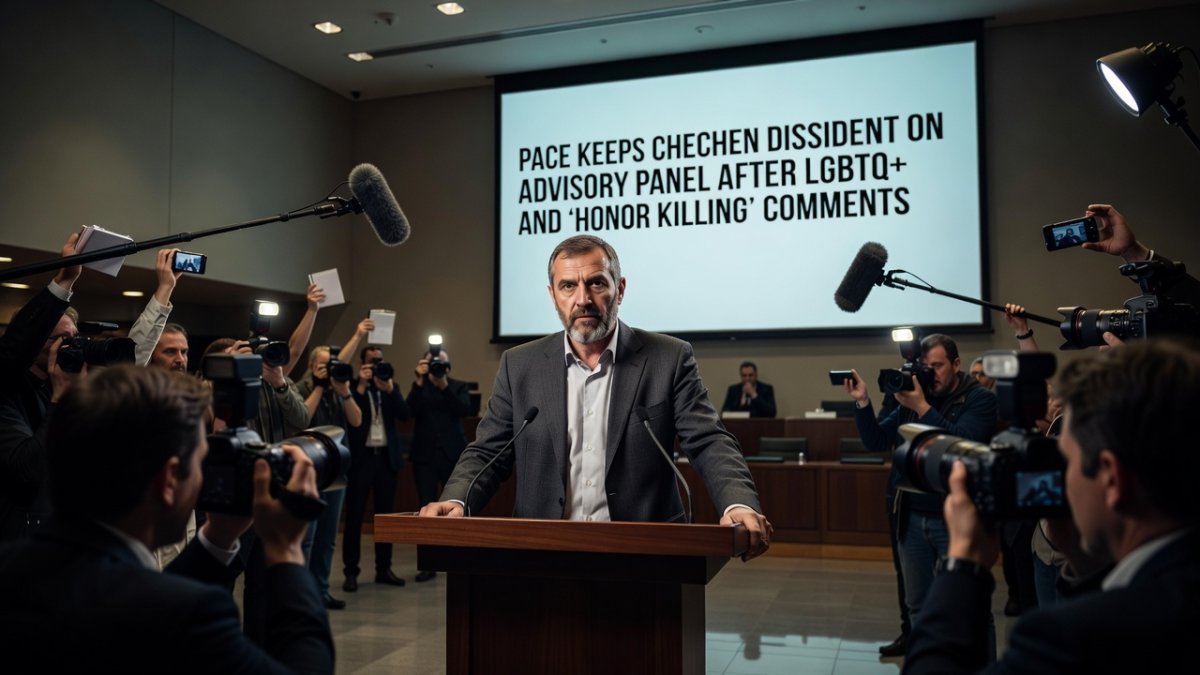
PACE Keeps Chechen Dissident on Advisory Panel After LGBTQ+ and ‘Honor Killing’ Comments
The Decision and Immediate Fallout
The Parliamentary Assembly of the Council of Europe (PACE) voted on 12 October to retain Ruslan Kutayev, a prominent Chechen dissident, as a member of its advisory panel on minority rights despite statements he made last month dismissing the need to investigate violence against women and LGBTQ+ individuals fleeing Chechnya. Kutayev told a closed-door meeting in Strasbourg that he had “no desire to look into” reports of honor-based violence and forced disappearances, adding that such cases often stemmed from “cultural misunderstandings” rather than systematic state policy under Ramzan Kadyrov.
The vote passed 142 to 89, with 23 abstentions. PACE’s Bureau cited Kutayev’s long record of documenting enforced disappearances in the North Caucasus as outweighing the controversy. Critics within the assembly, including Swedish MP Maria Gardfjell and German delegate Frank Schwabe, argued that retaining him undermined PACE’s credibility on gender and sexual-minority protections.
Background on Ruslan Kutayev
Kutayev, 54, founded the Chechen Committee for National Salvation in 2007 after two of his brothers were killed during the second Chechen war. He has testified before the European Court of Human Rights in 17 cases involving extrajudicial killings and has supplied documentation to the UN Special Rapporteur on torture. Russian authorities placed him on a federal wanted list in 2018 for alleged “extremist” financing, forcing him into exile in Norway and later France.
His advisory role at PACE began in 2021 as part of an initiative to incorporate voices from Russia’s restive republics. Kutayev’s reports on the 2017–2019 anti-LGBTQ+ purge in Chechnya, which Human Rights Watch estimated displaced at least 150 individuals, were initially welcomed by Western diplomats.
The Controversial Remarks
The remarks that triggered the current crisis were delivered on 19 September during a PACE working-group session on “honor-based violence in the Caucasus.” When asked about documented cases of women murdered by relatives after attempting to escape Chechnya—figures compiled by the Russian LGBT Network show 23 such killings between 2018 and 2023—Kutayev replied that he had “no desire to look into” the matter. He further stated that many honor-killing claims were “inflated by foreign NGOs seeking grants.”
Audio of the session, leaked to the independent Russian outlet Novaya Gazeta Europe, also captured Kutayev saying that LGBTQ+ Chechens who sought asylum in Europe were “mostly economic migrants” and that traditional family structures in the republic should not be judged by “Brussels standards.”
Chechnya’s Human Rights Record in Numbers
Official Chechen statistics report zero honor killings since 2015, yet data from the Russian Interior Ministry’s forensic database, obtained by Memorial Human Rights Center, lists 47 female deaths in Chechnya between 2016 and 2022 where autopsy reports noted “blunt-force trauma consistent with domestic assault.” The Russian LGBT Network’s 2023 annual report documented 112 cases of LGBTQ+ individuals from the North Caucasus seeking relocation assistance, with 67 percent citing threats from both family members and local security forces.
Kadyrov’s administration has repeatedly denied the existence of a state-sponsored anti-LGBTQ+ campaign, instead framing violence as “private family affairs.” In a 2022 interview with Rossiya 24, Kadyrov stated that “we do not have those people” when asked about gay Chechens.
Reactions Across the Political Spectrum
Chechen state media welcomed PACE’s decision. Grozny TV described it as “recognition that one man’s blunt words do not erase decades of work against Russian imperialism.” In contrast, the International Lesbian, Gay, Bisexual, Trans and Intersex Association (ILGA-Europe) issued a statement calling the retention “a dangerous signal that testimony on enforced disappearances can excuse indifference to femicide and homophobic murder.”
Inside Russia, liberal opposition figures offered muted criticism. Alexei Navalny’s Anti-Corruption Foundation noted that Kutayev’s earlier documentation of Kadyrov’s abuses remains valuable, yet warned that “selective human-rights advocacy creates hierarchies of suffering.”
Expert Analysis of PACE’s Calculus
Dr. Ekaterina Schulmann, a political scientist formerly at the European University at St. Petersburg, observed that PACE faces structural pressure to maintain dialogue channels with Russian civil society even after Russia’s 2022 expulsion from the Council of Europe’s main bodies. “Kutayev represents one of the few remaining non-Kadyrovite Chechen voices still willing to engage European institutions,” she said. “Discarding him would further shrink the already narrow space for Caucasus expertise.”
Conversely, University of Oslo researcher Julie Wilhelmsen argued that the decision reflects a broader European reluctance to confront the intersection of ethnic-minority rights and gender-based violence. “Honor killings and anti-LGBTQ+ purges are not peripheral to Chechen politics; they are central instruments of social control,” she told Global1 News.
Implications for Dissident Credibility and European Policy
The episode exposes fault lines within the Russian opposition diaspora. Several Chechen activists in Europe have begun circulating petitions demanding Kutayev’s removal, while others defend him as a necessary “pragmatist” who understands that alienating Kadyrov’s clan could endanger remaining family members inside the republic.
For European policymakers, the retention complicates efforts to craft coherent sanctions and asylum policies. The EU’s 2024–2027 Human Rights Action Plan for the Eastern Partnership explicitly lists “protection of women and LGBTI persons in the North Caucasus” as a priority. Retaining an advisor who publicly declines to examine those exact issues risks accusations of inconsistency when the same institutions criticize Russian federal authorities for similar selectivity.
Meanwhile, asylum statistics reveal the human stakes. Eurostat data for 2023 show 184 Chechen nationals granted refugee status in EU countries on grounds of gender-based or sexual-orientation persecution, up 31 percent from 2022. Case files reviewed by the Norwegian Organisation for Asylum Seekers indicate that 42 percent of female applicants cited honor-related threats.
Looking Ahead
PACE’s monitoring committee is scheduled to review the advisory panel’s composition again in March 2025. Whether Kutayev remains will depend on whether member states view his continued presence as an asset for documenting disappearances or a liability for the assembly’s normative claims on equality. For now, the decision stands as a stark illustration of the trade-offs European institutions make when engaging with Russia’s fractured opposition landscape.
This is Irina Volkov for Global1 News, reporting from Moscow. 🇷🇺
This article was produced with AI-assisted research and editorial support. Reporting is based on sources cited in the article.
What's Your Reaction?
 Like
0
Like
0
 Dislike
0
Dislike
0
 Love
0
Love
0
 Funny
0
Funny
0
 Wow
0
Wow
0
 Sad
0
Sad
0
 Angry
0
Angry
0

Russia/Eastern Europe Correspondent at Global1.News. Covering Russian politics, energy, security, and the shifting dynamics of the post-Soviet space. Provides clear-eyed analysis on one of the world's most opaque regions.











Comments (0)