
Russia Unleashes Massive Strike on Kyiv: 13 Dead, 50+ Wounded in Overnight Barrage
Russia Unleashes Massive Strike on Kyiv: 13 Dead, 50+ Wounded in Overnight Barrage The Night the Sky Lit Up Over Kyiv Folks, I'm going to tell you exactly what happened last night because the mainstream coverage is already sanitizing it. July 2, 2026. Kyiv. Around midnight, the air raid sirens started wailing — the same sound Ukrainians have been living with for over two years
Russia Unleashes Massive Strike on Kyiv: 13 Dead, 50+ Wounded in Overnight Barrage
The Night the Sky Lit Up Over Kyiv
Folks, I'm going to tell you exactly what happened last night because the mainstream coverage is already sanitizing it. July 2, 2026. Kyiv. Around midnight, the air raid sirens started wailing — the same sound Ukrainians have been living with for over two years now. But this time it was different. This time, Russian missiles and Iranian-made Shahed drones came in from multiple vectors simultaneously, a coordinated barrage designed to do one thing: overwhelm the defenses.
They succeeded. At least partially. Ukrainian air defense crews knocked down dozens of incoming threats — we're talking cruise missiles, ballistic missiles, and loitering munitions all mixed together in what military analysts call a "complex strike package." But enough got through. Reuters confirmed that residential apartment buildings in central Kyiv took direct hits. A hotel full of guests was struck. Medical facilities were damaged. Thirty locations across the city, all hit in a single night.
President Zelensky called it a "night of horror." He's not wrong. But here's what the headlines won't tell you: this wasn't a tactical military strike. This was deliberate terror aimed at civilians, plain and simple. And we need to talk about what that really means.
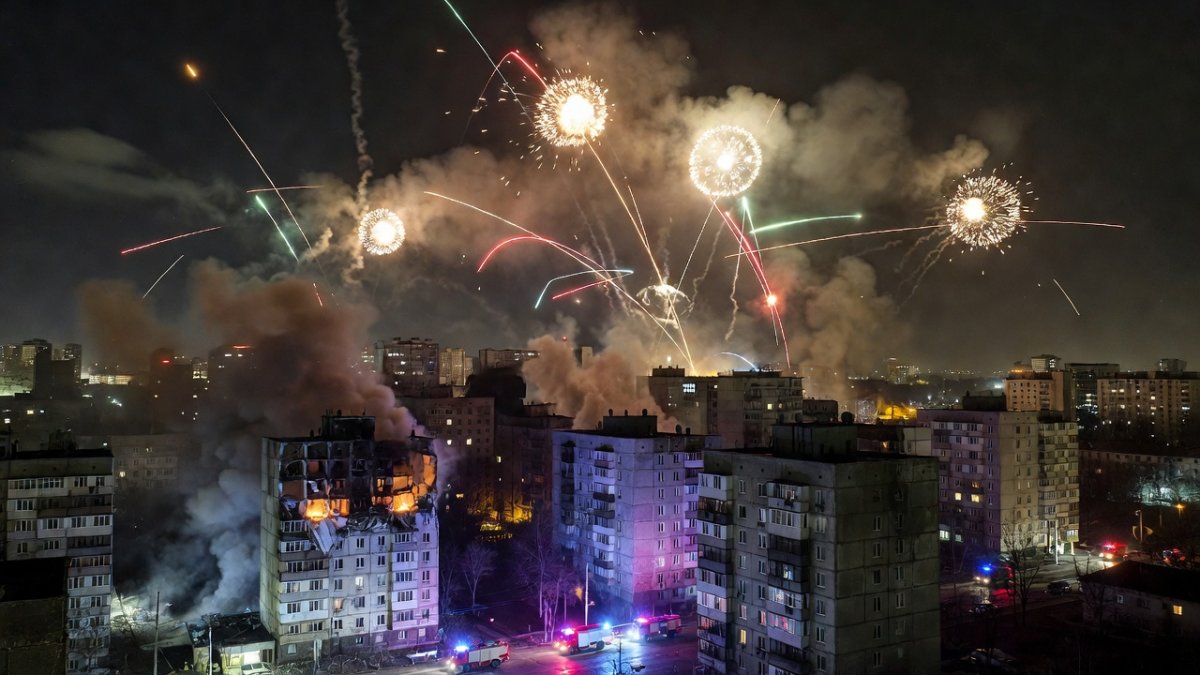
Residential building damaged in Russian missile strike on Kyiv, July 2, 2026 (Global 1 News)
The Human Toll: Thirteen Dead, Dozens Wounded, Lives Upended
Let's talk numbers, because the numbers tell a story the Kremlin doesn't want you to hear. At least 13 people are confirmed dead. More than 50 others are wounded — some critically, fighting for their lives in hospitals that were themselves damaged in the attack. The Associated Press reporters on the ground described survivors wandering through streets carpeted with broken glass and twisted metal. Rescue workers pulled families from collapsed apartment buildings through the night.
These aren't soldiers. These aren't military targets. These are ordinary people — parents, children, elderly residents — who happened to be sleeping in their homes when Russian missiles decided otherwise. Ukrainian officials released photographs showing entire floors sheared off residential towers. One image shows a woman being carried out of a building that no longer has a front wall. Another shows a family's living room, completely exposed to the night sky, their furniture and photographs still intact as if nothing happened — except the entire front of their building is gone.
The hotel that was hit? Full of guests, including journalists covering the war. The medical facility that was struck? A place where wounded civilians and soldiers receive treatment. This isn't collateral damage. This is a pattern. Russia targets places where people gather, where they sleep, where they seek safety. That's not a mistake. That's a tactic.
Volodymyr Zelensky posted video of the aftermath in the early hours, standing in front of a smoldering apartment block, his voice hoarse. "Every night, Russia chooses terror," he said. "Every missile is a deliberate choice to kill civilians." He's right, and the evidence is there for anyone willing to look.
Why Now? The Escalation Cycle Nobody Wants to Acknowledge
Here's where the story gets uncomfortable, because context matters and I'm not going to spoon-feed you one side. Ukraine had just conducted a series of successful strikes on Russian energy infrastructure — hitting oil refineries and fuel depots deep inside Russian territory. These strikes hurt. They disrupted Russia's ability to fuel its war machine. And Moscow's response, as it has been throughout this war, was to hit back at Ukrainian civilians.
This is the escalation cycle that has defined the conflict since 2022. Ukraine hits a military or energy target inside Russia. Russia responds by leveling a residential neighborhood in Kyiv, Kharkiv, or Dnipro. One side claims it's legitimate retaliation. The other side claims it's defending itself. Meanwhile, ordinary people die in the middle.
The Kyiv Independent's reporting from the frontlines shows this attack followed weeks of escalating drone and missile exchanges — both sides launching deeper and more destructive strikes. Russia claims this barrage was retaliation for the energy infrastructure hits. Ukraine says it has every right to strike military targets inside the aggressor's territory. Both statements are technically true, but let's not lose sight of the fundamental fact that started this war: Russia invaded. Russia chose this path. And no amount of "both sides" framing changes that reality.
What's changed is the scale. This was one of the largest attacks on Kyiv in months. The combined use of ballistic missiles, cruise missiles, and cheap drones represents an evolution in Russian tactics — and it's one that Western air defense planners should be studying very, very carefully.
Poland Scrambles: The NATO Border Factor That Should Terrify Everyone
Here's the part of the story that should make every American sit up straight. During the attack on Kyiv, Poland scrambled fighter jets. NATO aircraft were in the air, responding to Russian missiles flying dangerously close to the alliance's eastern border. This wasn't a drill. This was a real-world reaction to a real-world threat.
Polish officials didn't sugarcoat it. They activated air defense protocols, put planes in the sky, and monitored the situation in real time. Why? Because Russian missiles don't come with GPS coordinates that stop politely at Ukraine's border. A missile aimed at Kyiv that malfunctions or gets diverted doesn't know it's supposed to land in Ukraine. It keeps flying. And when it does, it enters NATO airspace — triggering the collective defense provisions that could, in a worst-case scenario, pull the entire alliance into a shooting war with Russia.
We came close to that scenario last night. Closer than most news outlets are reporting. The scramble was precautionary, but the fact that it happened at all should tell you something about the trajectory we're on. Each escalation inches us closer to a direct NATO-Russia confrontation. And the question nobody in Washington wants to answer is: what's the plan if that happens?
Western leaders issued the usual statements of concern. Same script, different night. But statements don't stop missiles. Air defense systems do. And right now, Ukraine doesn't have enough of them to protect every city, every night, from every angle of attack.
How Modern Warfare Is Changing: The Drone-Missile Hybrid Threat
Let me get technical for a minute, because this matters for America's own defense posture. What we saw overnight in Kyiv is a preview of how future wars will be fought. Russia combined low-cost Iranian Shahed drones — which cost maybe $20,000 each — with high-end cruise missiles and ballistic missiles worth millions. The drones serve as bait. They force air defense systems to reveal their positions, exhaust their expensive interceptor missiles, and create gaps in coverage that the precision missiles then exploit.
It's a tactic borrowed from Yemen's Houthis and Iran's playbook, and it works. Ukraine's air defense crews are some of the most skilled in the world at this point — they've been doing this every night for years — but even they can't stop everything when the attack comes from multiple directions with mixed munitions. The math is brutal: a $20,000 drone can force a $500,000 Patriot interceptor to be fired. Run that equation twenty times in a single night, and suddenly the defender runs out of ammunition before the attacker runs out of drones.
Pentagon analysts have been warning about this for years. The question is whether Congress is listening. Every delay in Ukraine aid, every debate over defense spending, every political squabble — it all translates into real gaps in capability that cost real lives.
What America Needs to Understand: This Is Not Someone Else's War
Here's the bottom line, and I'm not going to dress it up. Russia is testing how much punishment Ukraine can absorb while the West debates. They're watching American politics. They see the aid delays, the congressional infighting, the fatigue setting in among Western publics. And they're calculating that if they make the war painful enough for long enough, Ukraine will eventually have to negotiate on Russia's terms.
That calculation depends on one thing: whether the United States and its allies maintain their commitment. Every time we hesitate, Russia escalates. Every time we delay a weapons package, more apartment buildings get hit. Every time we signal wavering resolve, the Kremlin orders another barrage.
This is not someone else's war. The tactics being tested on Kyiv tonight — the drone swarms, the missile barrages, the hybrid attack packages — will be used against other cities in other conflicts. The principle that borders can be redrawn by force, that civilian populations can be terrorized into submission, is being tested in real time. And the outcome will determine the global security environment for decades.
So here's what I need you to do. Call your representatives. Demand they pass the Ukraine aid package — not as a favor to Ukraine, but as a matter of American national security interest. Push for faster delivery of Patriot and NASAMS air defense systems. Hold your elected officials accountable when they play political games with defense funding. And for the love of everything, don't let this story become background noise that you scroll past on your way to the next celebrity scandal.
The sky over Kyiv will light up again. The only question is whether we'll have done enough to make sure fewer families are pulled from the rubble when it does.
By Jessica Ali, Staff Writer
This article was produced with AI-assisted research and editorial support. Reporting is based on sources cited in the article.
What's Your Reaction?
 Like
0
Like
0
 Dislike
0
Dislike
0
 Love
0
Love
0
 Funny
0
Funny
0
 Wow
0
Wow
0
 Sad
0
Sad
0
 Angry
0
Angry
0

Editor-in-Chief at Global1.News. Atlanta-based journalist who cuts through the BS and tells it like it is. Lead anchor, host, and the voice you hear when the spin stops and the truth starts.













Comments (0)