
Premiers Forge United Front Against Trump's 50 Per Cent Tariffs
In a CBC News YouTube video titled “Canada's premiers shift focus to looming U.S. tariffs | The Current,” Prime Minister Mark Carney joined the premiers virtually from Charlottetown as the Council of the Federation opened its annual meeting. The July 21, 2026 session was dominated by U.S. President Donald Trump’s announcement of 50 per cent tariffs on Canadian wine, hockey sticks, cement, honey, dairy and auto parts.
In a CBC News YouTube video titled “Canada's premiers shift focus to looming U.S. tariffs | The Current,” Prime Minister Mark Carney joined the premiers virtually from Charlottetown as the Council of the Federation opened its annual meeting. The July 21, 2026 session was dominated by U.S. President Donald Trump’s announcement of 50 per cent tariffs on Canadian wine, hockey sticks, cement, honey, dairy and auto parts. The premiers quickly coalesced around a single “Team Canada” strategy to counter the duties before the August 19 deadline.
Premiers Unite Against Trump’s 50 Per Cent Tariffs
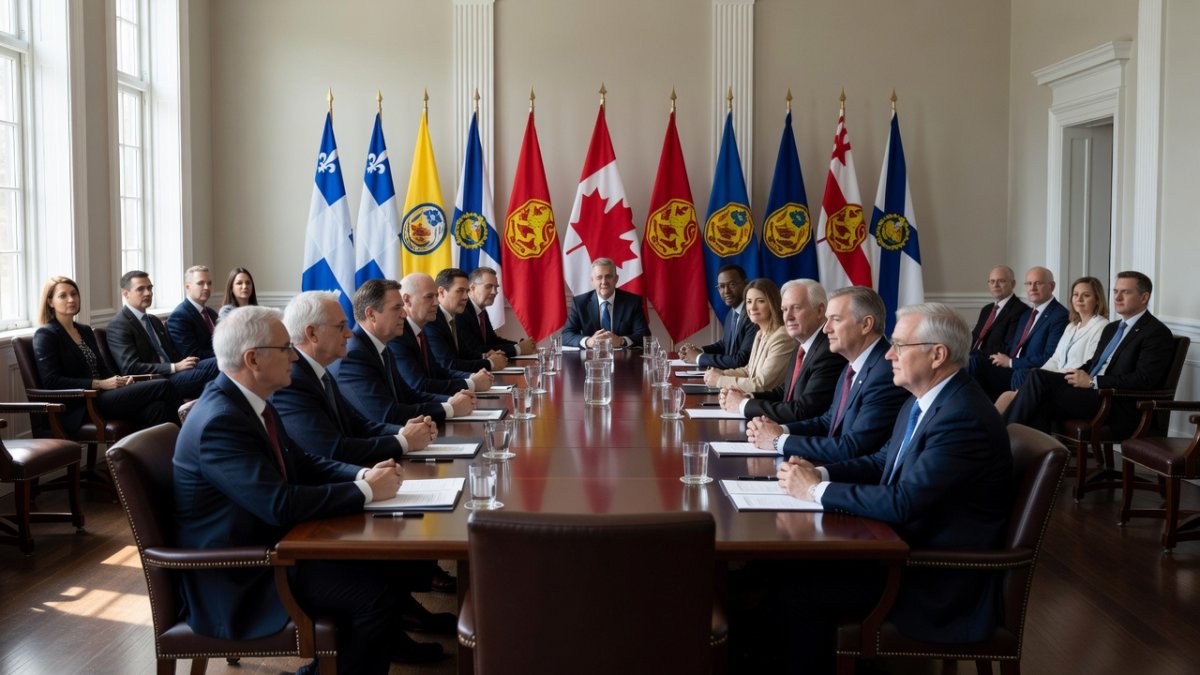
Charlottetown — Prime Minister Mark Carney joined the premiers virtually on July 21, 2026, as the Council of the Federation annual meeting opened with U.S. President Donald Trump’s announcement of 50 per cent tariffs on Canadian wine, hockey sticks, cement, honey, dairy and auto parts dominating every discussion.
Tariff Scope and August Deadline
The new tariffs target even goods compliant with the Canada-United States-Mexico Agreement and take effect on August 19, 2026, marking the sharpest escalation in the bilateral trade war that began in 2025. The 50 per cent tariffs strike at products whose combined annual exports to the United States exceed $18 billion, according to Industry Canada data. Auto parts alone account for roughly $9.4 billion, concentrated in Ontario assembly plants and Quebec component makers that feed the Detroit-Windsor corridor. Dairy shipments valued at $1.8 billion originate chiefly from Quebec and Ontario farms operating under supply management, while British Columbia and Ontario wineries face duties on $620 million of bottled and bulk wine. Hockey-stick manufacturers in Ontario and Quebec, whose $95 million in U.S. sales carry deep cultural resonance as emblems of national identity, now confront the same punitive rate as cement from Alberta and honey from the Prairies. New Brunswick softwood and energy exports add another $4.2 billion at risk, illustrating how the measures span resource, manufacturing and value-added sectors across every region.
White House officials justified the measures by citing alleged Canadian discrimination against U.S. dairy, auto and alcohol sectors, while U.S. Trade Representative Jamieson Greer told a Senate hearing the tariffs were simply “business.”
Premiers Present United Front
Hosting Premier Rob Lantz of Prince Edward Island opened the two-day session by stressing that all 13 premiers and the Prime Minister had formed a single “Team Canada” position against the duties. Manitoba Premier Wab Kinew stated after the first session that “Team Canada is very united against Trump,” while Ontario Premier Doug Ford demanded Ottawa prepare a strong, coordinated response.
New Brunswick’s Direct Exposure
New Brunswick Premier Susan Holt told CBC’s The Current that her province faces immediate risk because its energy exports and softwood lumber shipments cross the border daily. Holt noted that any disruption beginning August 19 would affect thousands of jobs in mills and power plants that rely on U.S. markets.
Bridge Celebration Cancelled
Ottawa cancelled the July 27 joint celebration planned for the $5.7-billion Gordie Howe International Bridge linking Windsor, Ontario, to Detroit, a project first announced in 2012 as a symbol of Canada-U.S. friendship. The cancelled Gordie Howe Bridge celebration underscores a deeper rupture in bilateral symbolism. Conceived in the early 2000s to replace the ageing Ambassador Bridge, the project secured a 2012 Canada-U.S. agreement that included a 30-year toll-sharing formula allocating 45 per cent of net revenues to Canadian authorities. Construction began in 2018 with federal and provincial funding exceeding $2.4 billion. The decision to forgo a joint opening ceremony on 27 July signals that even infrastructure built explicitly to bind the two economies can no longer serve as a diplomatic photo opportunity, revealing how tariff hostilities have poisoned routine cooperation on border modernisation and supply-chain resilience.
The bridge agreement, which includes detailed toll-sharing arrangements between the two countries, remains in force, but federal officials said the tariff climate made a ceremonial opening inappropriate.
Targeted Counter-Tariffs Debated
Alberta Premier Danielle Smith called for counter-measures aimed only at U.S. goods that would not raise costs for Canadian consumers, while Saskatchewan Premier Scott Moe supported the same approach but ruled out any export taxes on Canadian energy. The premiers agreed that any retaliation must protect domestic supply chains and avoid repeating mistakes from earlier rounds of the trade conflict.
Interprovincial Barriers Targeted
In a direct response to the tariff threat, the premiers committed to accelerate removal of internal trade barriers across Canada, a step long advocated by economists as a way to strengthen domestic markets. Premiers have pledged to fast-track removal of long-standing internal barriers under the Canadian Free Trade Agreement and the New West Partnership. Alcohol retail restrictions that currently force separate provincial labelling and distribution channels will be harmonised by March 2027, while trucking weight and dimension rules will align across six provinces by year-end. Professional licensing for nurses, electricians and engineers will move to mutual recognition, eliminating duplicate exams that economists at the C.D. Howe Institute estimate cost the economy $4.7 billion annually in lost productivity. By expanding the domestic market of 41 million consumers, these changes are projected to offset up to 12 per cent of the export losses threatened by U.S. tariffs, providing a structural buffer that previous rounds of external trade disputes lacked.
The agreement includes specific timelines for aligning regulations on trucking, alcohol sales and professional licensing between provinces and territories.
Indigenous Economic Interests Raised
Assembly of First Nations National Chief Cindy Woodhouse Nepinak met premiers on the sidelines to ensure Indigenous businesses and resource projects are shielded from the coming duties. She reminded leaders that many First Nations economies in New Brunswick, Quebec and British Columbia depend on the same export sectors now facing 50 per cent tariffs.
Recession Warnings Issued
Economists appearing before the premiers warned that the August tariffs could push manufacturing and agriculture into recession, with ripple effects on employment and provincial revenues. The Council of the Federation will reconvene virtually before August 19 to finalise a joint federal-provincial strategy ahead of the tariff deadline.
Impact on Canadians
Ordinary Canadians will feel the August tariffs first at grocery shelves and in paycheques. Modelling by the Conference Board of Canada indicates a 50 per cent duty on imported U.S. dairy inputs could raise retail cheese and butter prices by 9 to 14 per cent within weeks, while auto-parts tariffs threaten 38,000 assembly and parts jobs, many in southern Ontario communities already navigating high living costs. Provincial treasuries in New Brunswick and Manitoba anticipate revenue shortfalls of $310 million and $290 million respectively from reduced corporate and personal income taxes, forcing difficult choices between program cuts and higher provincial levies. These pressures compound existing inflation, turning a distant trade dispute into a tangible cost-of-living shock for middle-income households.
What Happens Next
The premiers agreed to maintain daily coordination calls through the summer and to present a unified list of counter-tariff targets to federal negotiators by early August. Ottawa is expected to release its formal retaliation package within days of the August 19 deadline, while provinces continue to advance internal trade reforms. First Nations leaders have requested a dedicated seat at future strategy sessions to protect Indigenous export interests.
By Alex Thompson, Staff WriterThis article was produced with AI-assisted research and editorial support. Reporting is based on sources cited in the article.
What's Your Reaction?
 Like
0
Like
0
 Dislike
0
Dislike
0
 Love
0
Love
0
 Funny
0
Funny
0
 Wow
0
Wow
0
 Sad
0
Sad
0
 Angry
0
Angry
0

Canada Correspondent at Global1.News. Based in Toronto, covering Canadian politics, energy, trade, and US-Canada relations. Provides the Canadian perspective on North American and global affairs.











Comments (0)