
'Protests Today' Surges in Israeli Google Searches as Public Demonstrations Intensify Across the Country
'Protests Today' Surges in Israeli Google Searches as Public Demonstrations Intensify Across the Country A sharp spike in Google searches for "הפגנות היום" — Hebrew for "protests today" — has swept across Israel in the last 24 hours, reflecting a renewed wave of public demonstrations that has drawn thousands of citizens into the streets from Tel Aviv to Jerusalem, Haifa to Beer
'Protests Today' Surges in Israeli Google Searches as Public Demonstrations Intensify Across the Country
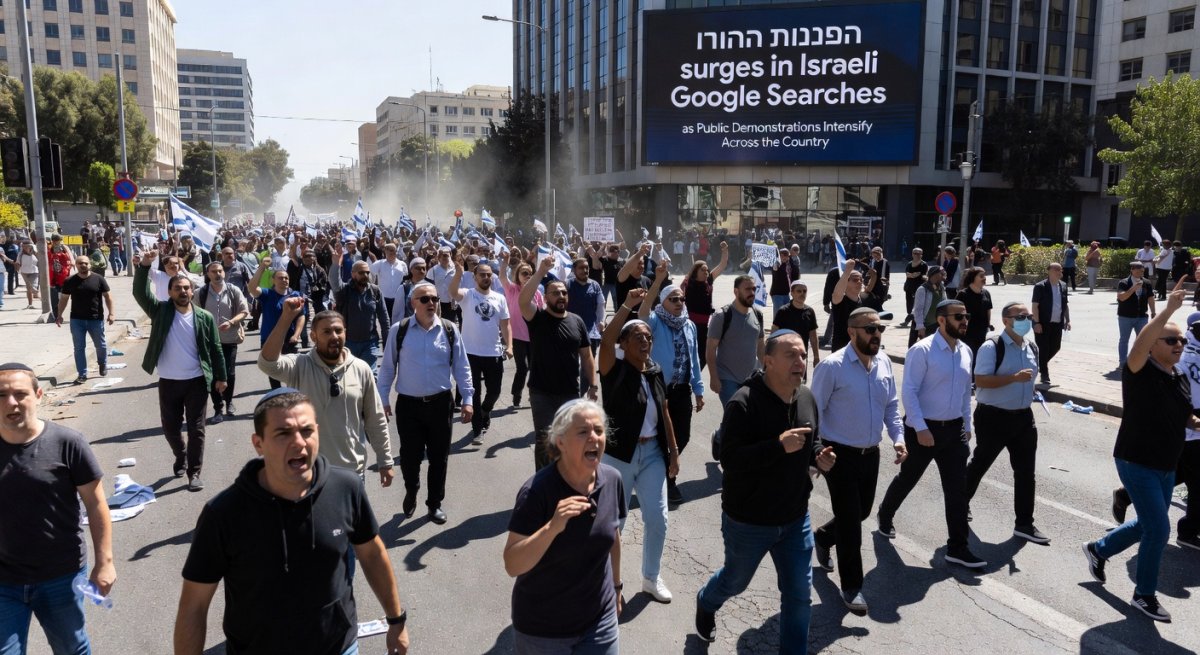
A sharp spike in Google searches for "הפגנות היום" — Hebrew for "protests today" — has swept across Israel in the last 24 hours, reflecting a renewed wave of public demonstrations that has drawn thousands of citizens into the streets from Tel Aviv to Jerusalem, Haifa to Beersheba. Google Trends data shows the search term has crossed the 1,000+ threshold, placing it among the top trending queries in the country.
The surge comes amid an escalation in the ongoing protest movement that has periodically reshaped Israeli political discourse over the past several years. Demonstrators gathered in major city centers tonight, with the largest crowds reported at Kaplan Street in Tel Aviv — traditionally the focal point of the country's protest movement — and outside the Knesset building in Jerusalem.
What's Driving the Demonstrations
Protest organizers have cited a combination of factors fueling public discontent. According to reports circulating in Israeli media, the demonstrations have been galvanized by recent government policy moves, including proposed budget allocations that protesters argue sideline key social welfare programs, as well as ongoing concerns about the direction of judicial policy and civil liberties.
The protest coalition, which brings together groups from across the political spectrum, has issued statements calling for broader public accountability and a halt to what they describe as accelerated legislative initiatives that bypass traditional checks and balances. The Jerusalem Post has reported on the growing coordination between protest factions, noting that attendance at organizing meetings has increased significantly in recent weeks.
Scale and Scope of the Mobilization
Eyewitness accounts and social media footage circulating tonight show substantial crowds at the main protest sites. In Tel Aviv, demonstrators have blocked sections of Kaplan Street and Ayalon Highway — a recurring feature of large-scale Israeli protests — while in Jerusalem, protesters gathered near Prime Minister Benjamin Netanyahu's official residence on Balfour Street.
Smaller but significant demonstrations have been reported in Haifa, where protesters focused on housing affordability, and in Beersheba, where the central issue centered on government investment in the Negev region. The geographic spread of tonight's protests underscores the breadth of public engagement with the movement, which has drawn support from urban professionals, students, and communities across Israel's diverse social fabric.
Official Response
The Israel Police have deployed additional units to manage the protests, with officers stationed at major intersections and near government buildings. In a statement issued this evening, a police spokesperson confirmed that the force is facilitating the right to protest while ensuring public safety and maintaining access to emergency services.
"We respect the democratic right of citizens to express their views," the spokesperson said. "Our role is to ensure that these demonstrations remain peaceful and that they do not disrupt essential services or endanger participants and the general public."
No significant incidents of violence had been reported as of late evening, though traffic disruptions in central Tel Aviv and Jerusalem are expected to continue into the night. The Knesset guard has been placed on heightened alert as a precautionary measure.
Broader Context: A Movement in Evolution
Israel's protest movement has evolved significantly since its initial surge in early 2023. What began as focused opposition to specific judicial legislation has broadened into a wider civic movement encompassing concerns about governance, economic inequality, and the relationship between state institutions and civil society.
Research from the Israel Democracy Institute has documented shifting public attitudes during this period, with survey data showing that an increasing percentage of Israeli citizens view protest as a legitimate and necessary tool of democratic participation. The movement has also developed sophisticated organizational infrastructure, using digital platforms to coordinate logistics, disseminate information, and mobilize supporters across geographic and demographic lines.
Tonight's demonstrations represent the latest chapter in this ongoing civic engagement. The Google Trends spike in searches for "protests today" reflects not just the scale of the current mobilization but the broader pattern of Israelis turning to digital tools to stay informed about real-time developments in their rapidly changing political landscape.
What Comes Next
Protest organizers have signaled that tonight's demonstrations may be the beginning of an intensified period of mobilization. Social media channels affiliated with the movement have posted calls for continued action in the coming days, with particular focus on the Knesset's upcoming legislative agenda.
The government, for its part, has not issued an official statement responding specifically to tonight's protests. However, coalition members have in recent days defended the administration's agenda as democratically mandated and have characterized the protests as the work of organized opposition groups rather than spontaneous public sentiment.
For Israelis following the situation, the message from tonight's Google Trends data is clear: the protests have once again captured the nation's attention. As the Knesset session continues and budget discussions intensify, the coming weeks are likely to see sustained public engagement from a citizenry increasingly accustomed to taking its concerns directly to the streets.
This is Hannah Berg for Global1 News, reporting from Tel Aviv. 🇮🇱
This article was produced with AI-assisted research and editorial support. Reporting is based on sources cited in the article.
What's Your Reaction?
 Like
0
Like
0
 Dislike
0
Dislike
0
 Love
0
Love
0
 Funny
0
Funny
0
 Wow
0
Wow
0
 Sad
0
Sad
0
 Angry
0
Angry
0

Israel Correspondent at Global1.News. Based in Tel Aviv, covering Israeli politics, security, technology, and society. Provides balanced, deeply-sourced reporting on one of the most closely-watched regions in the world.












Comments (0)